19 English Country Mudroom Ideas for Practical Charm
1. Painted Shaker Peg Rail with Wicker Baskets
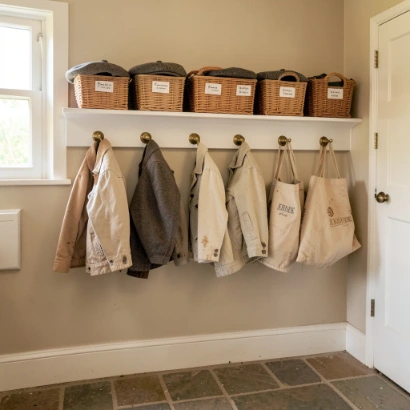
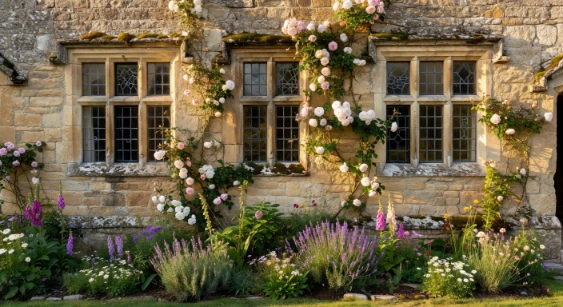
A painted Shaker peg rail running the full length of the mudroom wall is the most functionally perfect and most aesthetically authentic storage foundation for the classic English country mudroom, combining the Shaker tradition’s fundamental belief in honest, beautiful, purposeful design with the English countryside household’s daily requirement for generous, organized, immediately accessible hanging storage for the considerable quantity of outdoor clothing, equipment, and accessories that an actively outdoor country life inevitably accumulates. Install the peg rail at a height of 1.6 to 1.8 meters from the floor using a continuous painted timber batten of substantial thickness — at least 32mm deep — with turned Shaker pegs in solid brass, antique iron, or painted hardwood spaced at 200mm intervals to provide maximum hanging capacity while allowing coats and jackets to hang freely without overcrowding or crushing. Paint the peg rail and its mounting batten in a heritage color that establishes the mudroom’s overall decorative tone — warm white, sage green, deep navy, or the characteristic Shaker blue-grey — and extend the same color to the surrounding wall paneling or tongue-and-groove for a unified, architecturally coherent storage wall of considerable practical and visual satisfaction.
Mount a continuous shelf at 50mm above the peg rail to provide additional storage for wicker baskets, each labeled with a handwritten ink tag identifying its designated owner or contents — dog leads and tennis balls, gardening gloves and seed packets, children’s hats and scarves — creating a family storage system of genuine organizational intelligence and considerable personal warmth. Choose wicker baskets of uniform size but slightly varied weave or color for a collection that reads as curated rather than randomly assembled, and line each basket with a small fabric drawstring bag for the most easily cleaned and most practically convenient organization of loose small items. This Shaker peg rail mudroom idea earns exceptional Pinterest engagement because it delivers the most complete, most practically resolved, and most characteristically English country storage solution available to the mudroom in a single, beautifully executed wall installation of entirely appropriate material quality and functional generosity.
2. Flagstone Floor with Underfloor Heating
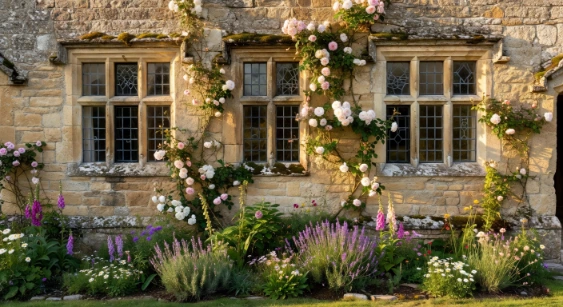
Reclaimed limestone flagstones laid over underfloor heating are the most luxuriously practical and most materially authentic flooring combination available to the English country mudroom, resolving the fundamental tension between the flagstone floor’s undeniable authentic beauty and its notorious thermal coldness underfoot by installing a modern hydronic underfloor heating system beneath the stone that transforms the entire floor surface into a continuously warm, gently radiating thermal mass of extraordinary comfort and drying efficiency. Source genuinely reclaimed flagstones from agricultural building demolitions, traditional flooring specialists, or regional quarries producing stone with the correct geological character for the house’s specific county location — Purbeck limestone in Dorset, Welsh slate in the west, Yorkstone in the north, and the warm honey-toned Cotswold limestone in the central counties — choosing pieces with the natural surface irregularity, worn edges, and beautiful color variation of genuinely aged stone rather than newly quarried material however attractively priced. Lay the flagstones in a random pattern of varied rectangular sizes — mixing large 600 by 900mm pieces with smaller 300 by 600mm flags and occasional square infill pieces — on a bed of lime mortar over the underfloor heating pipework, pointing the joints with a matching lime mortar of slightly lighter color that emphasizes the individual flag shapes without creating artificially dark or overly wide joint lines.
The underfloor heating’s continuous gentle warmth serves a dual mudroom function of exceptional practical value — warming the space comfortably for the removal of cold, wet outdoor clothing and simultaneously drying the stone floor surface, the wellington boots lined up on the adjacent rack, and the wet dog who invariably accompanies the country household’s return from every outdoor expedition — making the warm flagstone floor the single most practically useful and most gratifyingly luxurious element of the entire mudroom installation. Lay a generously sized coir or sisal mat directly inside the exterior door on the flagstone surface to capture the first burst of mud and moisture from arriving boots before they reach the main stone floor. This warm flagstone mudroom floor earns tremendous Pinterest engagement because it represents the most completely resolved and most genuinely luxurious English country mudroom flooring solution — one that is simultaneously historically authentic in its material, supremely comfortable in its daily use, and extraordinarily beautiful in its warm stone surface and naturally varied color.
3. Built-In Wellington Boot Storage Rack
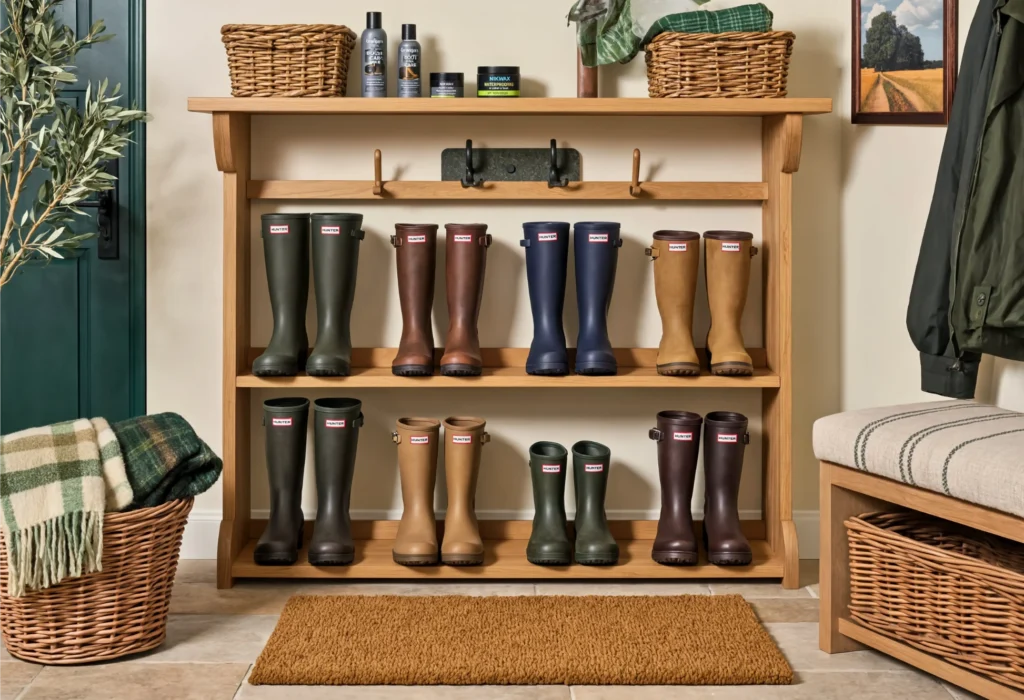
A custom-built slatted oak wellington boot storage rack is the most practically essential and most honestly purposeful storage feature of the English country mudroom, addressing the fundamental organizational challenge of storing multiple pairs of muddy, wet wellington boots in a manner that is sufficiently tidy to satisfy the household’s standards of domestic order while providing the air circulation and drainage necessary for the boots to dry properly between outings and to remain in the best possible condition for the longest possible working life. Build the boot rack from solid oak or painted timber in a slatted construction that allows both visual tidiness and maximum air circulation around each pair of stored boots, sizing the individual boot compartments to accommodate the widest wellington size used in the household — typically an adult size twelve — with a 50mm gap between each pair to prevent boots from touching and creating damp pockets that accelerate rubber deterioration. Set the rack at a height from the floor that allows tall adult wellingtons to stand fully upright without folding at the ankle, and raise the entire rack structure 100mm above the floor level on feet or a plinth that allows water and mud drips to collect on the floor beneath rather than soaking into the timber frame.
Mount a traditional iron or brass boot jack on the adjacent wall at an appropriate height for use while seated on the nearby bench — the boot jack’s distinctive two-pronged heel grip providing the most effective and most satisfying mechanical assistance for the removal of tight-fitting wellingtons after a long, muddy country walk — and position a small labeled shelf above the boot rack holding boot cleaning spray, waterproofing wax, and a boot brush for maintaining the household’s wellington collection in good condition throughout the season. This wellington boot rack mudroom idea earns devoted Pinterest engagement because it addresses the most universally recognized English country mudroom organizational challenge — the wellington boot accumulation problem — with a custom storage solution of genuine practical intelligence, satisfying visual tidiness, and completely appropriate natural material quality that makes an honest, useful, and quietly beautiful contribution to the mudroom’s overall character and functional excellence.
4. Antique Pine Settle Bench with Storage
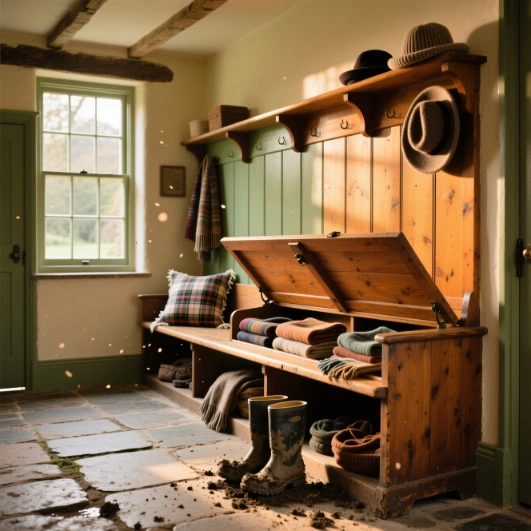
An antique pine settle bench with a hinged lid concealing deep interior storage is the most characterfully complete and most historically authentic piece of mudroom furniture available to the English country interior, combining the settle’s centuries-old role as the primary seating and wind-sheltering piece of the English farmhouse kitchen entrance with a practical storage function of considerable organizational value in the coat-hanging, boot-removing daily theater of the working English country mudroom. Source a genuinely antique pine or oak settle from a country house auction, a specialist antique dealer, or a rural antique fair, choosing a piece with a high paneled back that provides additional visual enclosure to the boot-removing seat and a characterful, warm-toned pine surface bearing the beautiful honey-amber patination that only decades of wax polishing, daily use, and gradual light exposure can produce in genuinely aged pine. The settle’s hinged seat lid — opening to reveal a deep storage compartment of generous dimensions — provides the most practically useful and most spatially efficient solution to the mudroom’s requirement for concealed storage of the numerous seasonal accessories, spare dog leads, emergency waterproofs, and miscellaneous countryside equipment that every English country household accumulates in quantities that quickly overwhelm more conventional open storage.
Place a firmly attached tartan or needlepoint seat cushion on the settle’s flat wooden seat to provide comfortable padding for the boot-removal process and to introduce a welcome textile warmth and color into the mudroom’s primarily hard, utilitarian material palette of stone, timber, and painted wall surfaces. Position the settle directly below the main coat hook arrangement so that the seated boot-remover has immediate access to the hanging coats above and can complete the full arrival routine of boot removal, coat hanging, and accessory storage from a single, comfortable, well-organized position. This antique pine settle mudroom idea earns exceptional Pinterest engagement because it is the single piece of mudroom furniture that most completely resolves the practical challenge of comfortable, organized arrival in the English country home while simultaneously contributing the most character, the most historical warmth, and the most genuinely beautiful material presence of any individual storage piece available to this most functional and most English of all domestic spaces.
5. Chalkboard Wall for Family Messages

A full-wall chalkboard section framed with painted timber molding is the most practically interactive and most personally expressive organizational feature available to the English country mudroom, transforming a section of wall into a continuously updated family communication board, scheduling system, and daily reminder surface that keeps the household’s considerable logistical complexity organized with the most low-technology, most easily updated, and most visually characterful system imaginable. Apply chalkboard paint to a carefully chosen wall section — typically the wall immediately adjacent to the exterior door or above the boot rack — in two or three well-rolled coats over a smooth-prepared surface, then frame the chalkboard area with simple painted timber molding of proportions appropriate to the mudroom’s scale, creating a visual frame that makes the chalkboard read as a deliberately designed interior feature rather than an improvised painted surface of accidental appearance. Season the chalkboard surface by rubbing the side of a piece of chalk across the entire area and wiping clean before first use, a process that prevents the ghosting of first-written messages that unseasoned chalkboard surfaces invariably produce and that would compromise the visual clarity of the board’s communication function from its very first day of use.
Write the most essential and most frequently referenced household information in clear, confident chalk lettering across the board surface — weekly family schedules in one section, reminders about dog walking and feeding in another, shopping lists building gradually through the week, and a rotating selection of cheerful, encouraging messages of the kind that make a family mudroom feel genuinely warm, humorous, and personally inhabited rather than merely organized and tidy. Mount a small timber shelf beneath the chalkboard’s lower frame edge to hold a selection of colored chalk pieces in a repurposed vintage tin or ceramic pot, providing immediate access to writing materials for every household member who passes through the mudroom in the course of the busy English country day. This chalkboard mudroom wall earns outstanding Pinterest engagement because it delivers the most practically useful and most personally expressive organizational feature available to the English country mudroom — a communication system of extraordinary family warmth, daily relevance, and completely individual character that makes the mudroom feel genuinely, humorously, and lovingly alive.
6. Dog Washing Station with Copper Tap
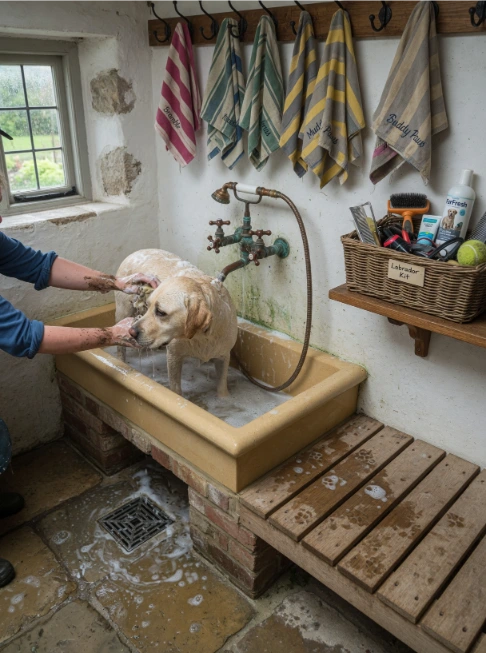
A dedicated dog washing station with a low stone trough and a copper mixer tap is the most practically brilliant and most characteristically English country mudroom feature, acknowledging with complete honesty and considerable ingenuity the fundamental role that muddy, wet dogs play in the daily life of the English countryside household and providing a purpose-designed washing facility that prevents the recurring domestic disaster of a wet Labrador or spaniel shaking mud across the clean kitchen before being intercepted and directed back to the mudroom for washing. Install a low stone, slate, or vitreous enamel trough at a height of 400 to 500mm from the floor — the correct ergonomic height for washing a medium to large dog without the handler needing to bend excessively — positioning the trough against the mudroom’s most easily plumbed external wall and connecting it to both hot and cold water supplies through a wall-mounted copper or chrome mixer tap with a flexible rubber hose and spray head attachment. The flexible hose is absolutely essential for effective dog washing, allowing the handler to direct the water stream precisely around the dog’s body, under the belly, between the legs, and across the face without the dog becoming alarmed by a fixed shower head’s more forceful and less controllable water delivery.
Set a slatted wooden duck-board around the trough base to provide comfortable, slip-resistant standing for both dog and handler on the inevitably wet floor surface during and after washing, and ensure a generously sized floor drain is installed in the flagstone directly below and around the trough to handle the considerable volumes of muddy water that a thorough post-walk dog wash generates in the course of an active English country household’s normal weekly routine. Mount a row of simple hooks above the washing station for a set of dedicated dog-drying towels in faded striped cotton or old bath towels recycled for the purpose, and position a small shelf beside the trough for a basket of dog shampoo, coat conditioning spray, a slicker brush, and a pair of rubber grooming gloves. This dog washing station mudroom idea earns magnificent Pinterest engagement because it is the most honestly, specifically, and completely English country mudroom feature imaginable — a facility that addresses with practical intelligence and genuine good humor the most universal and most characteristically English country domestic challenge of the muddy, wet dog at the back door.
7. Original Victorian Encaustic Tile Floor
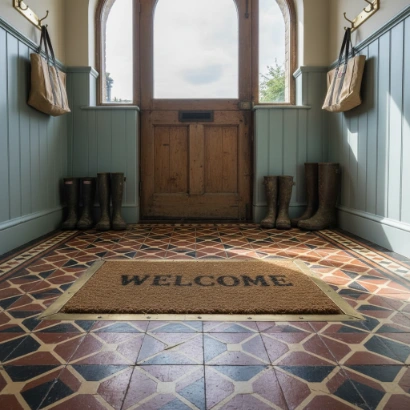
An original Victorian encaustic tile floor is the most historically authentic, most decoratively magnificent, and most permanently beautiful flooring available to the English country mudroom, preserving in its inlaid geometric patterns and warm natural pigment colors the full decorative ambition of the Victorian period’s extraordinary achievement in the revival and development of medieval encaustic tile-making as a medium of domestic interior decoration of the highest artistic quality and material permanence. Source original Victorian encaustic tiles from specialist reclamation yards, architectural salvage companies, or period tile specialists who stock genuine reclaimed examples of the geometric and Gothic patterns produced by the Minton, Maw, Godwin, and Craven Dunnill tile works that supplied the Victorian market with encaustic tiles of extraordinary range, quality, and decorative sophistication. The encaustic tile’s defining characteristic — its inlaid geometric or foliate pattern formed from differently colored clays pressed into the tile body rather than applied as a surface glaze — gives it a decorative durability and surface depth that centuries of wear only improve and develop rather than destroying, as the gradual polishing of the tile surface by foot traffic reveals an increasingly beautiful translucency in the inlaid clay colors.
Clean and consolidate existing encaustic tile floors using pH-neutral stone cleaning products and a specialist tile sealer appropriate to the specific clay body and surface condition of the particular tiles, avoiding the inappropriate application of wax or oil-based sealers that would darken the tile colors and obscure the geometric pattern’s most delicate details. Install a traditional brass mat frame with a removable coir insert directly inside the exterior door threshold to capture the most concentrated mud deposits from arriving boots before they reach the encaustic tile surface, protecting the most heavily trafficked area of the floor from the abrasive mud particles that cause the most rapid surface wear. This Victorian encaustic tile mudroom floor earns exceptional Pinterest engagement because it is the most decoratively spectacular and most historically valuable of all English country mudroom flooring options — a floor whose beauty has survived more than a century of practical use and whose remaining quality only increases in value and visual significance with every year of continued life in a household that appreciates and properly maintains it.
8. Herb Drying Rack Above the Doorway
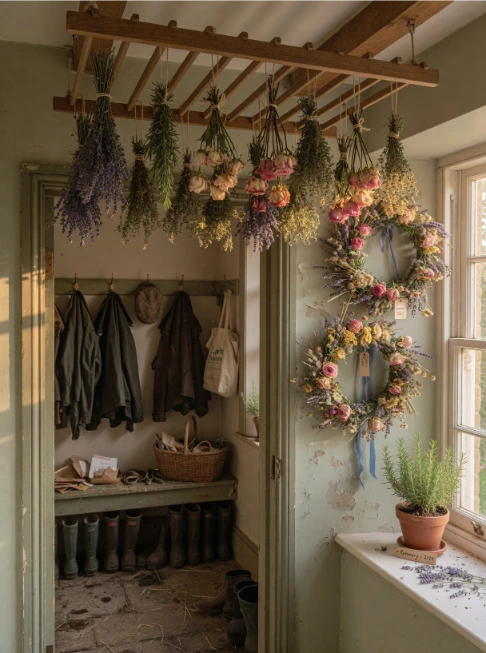
A traditional wooden herb drying rack suspended from the ceiling above the mudroom doorway is the most fragrant, most romantically beautiful, and most characteristically English country addition to any practical mudroom, connecting the daily functional space of boot removal and coat hanging to the wider agricultural and horticultural life of the English country household through the ancient domestic practice of preserving garden herbs and flowers by air-drying them in the warm, gently moving air of the mudroom’s frequently opened door environment. Install a traditional suspended airer or a custom-built timber drying rack using slatted oak or pine bars on rope or iron drop-rods from ceiling hooks, positioning the rack at a height that allows easy passage beneath it while keeping the hanging herb bunches safely above head height and in the warm air zone that accumulates near the ceiling where drying conditions are most favorable. Hang freshly cut bunches of lavender, rosemary, thyme, oregano, mint, sage, and chamomile upside down from the rack’s bars using natural twine, adding bunches of drying garden roses, hydrangea heads, statice, and sea lavender for decorative color and visual variety alongside the culinary and medicinal herbs.
Allow the herb bunches to overlap slightly and hang at varying heights to create a lush, abundantly fragrant ceiling display of considerable rustic beauty that scents the entire mudroom with the complex, layered fragrance of the drying garden and makes every passage through the space a small but genuinely pleasurable sensory experience. Replace each herb bunch as it dries completely and loses its fragrance with fresh garden cuttings, maintaining a continuous cycle of hanging and drying that keeps the rack perpetually supplied with the most beautiful and most fragrant combination of herbs and flowers available from the garden at any given season. This herb drying rack mudroom idea earns devoted Pinterest engagement because it introduces the most quintessentially English countryside domestic tradition of kitchen garden herb preservation into the most practically functional room of the house in a way that is simultaneously visually beautiful, genuinely fragrant, practically useful, and completely authentic to the English country household’s deep and enduring connection to its garden and its seasonal harvest.
9. Painted Cupboard with Mesh Door Panels
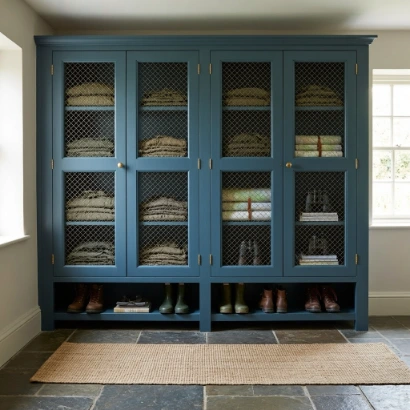
A large painted fitted cupboard with decorative wire mesh door panels is the most practically versatile and most architecturally resolved storage solution available to the English country mudroom, providing generously proportioned concealed storage behind beautifully made painted timber doors that contribute substantially to the mudroom’s decorative character while allowing the essential air circulation necessary for the proper drying and ventilation of stored outdoor clothing, damp waterproofs, and the various slightly odoriferous items of countryside equipment that require air rather than sealed confinement to remain in good condition between outings. Build the cupboard floor-to-ceiling across the widest uninterrupted wall of the mudroom, specifying full-height paneled doors in solid timber with inset wire mesh panels — either a traditional diamond wire mesh in galvanized steel or a more refined square mesh in black-painted or brass-finished wire — that provide visible evidence of the cupboard’s organized interior while admitting the continuous air flow that damp outdoor clothing requires for effective drying. Paint the entire cupboard in a deep, saturated heritage color that establishes the mudroom’s primary decorative tone — Hague Blue, Railings charcoal, Studio Green, or Mole’s Breath — using a hard-wearing paint formulation with a satin or eggshell finish that resists the inevitable knocks, fingerprints, and damp contact of daily mudroom use.
Organize the cupboard interior with adjustable timber shelving at various heights to accommodate the full range of stored items — folded waterproof trousers on one shelf, rolled OS maps and walking guides on another, spare dog leads and collars in a basket, shooting accessories in a wooden tray, and seasonal items on the highest shelf — and mount a small internal hook rail on each door interior for hanging smaller items that benefit from the ventilated door position. This painted mesh-door cupboard mudroom idea earns strong Pinterest engagement because it delivers the most complete and most aesthetically satisfying concealed storage solution available to the English country mudroom — a cupboard of beautiful painted appearance, generous practical capacity, and completely appropriate ventilated construction that organizes the mudroom’s most challenging storage requirements behind a facade of genuine decorative quality and architectural intention.
10. Slate Shelf with Labeled Mason Jars
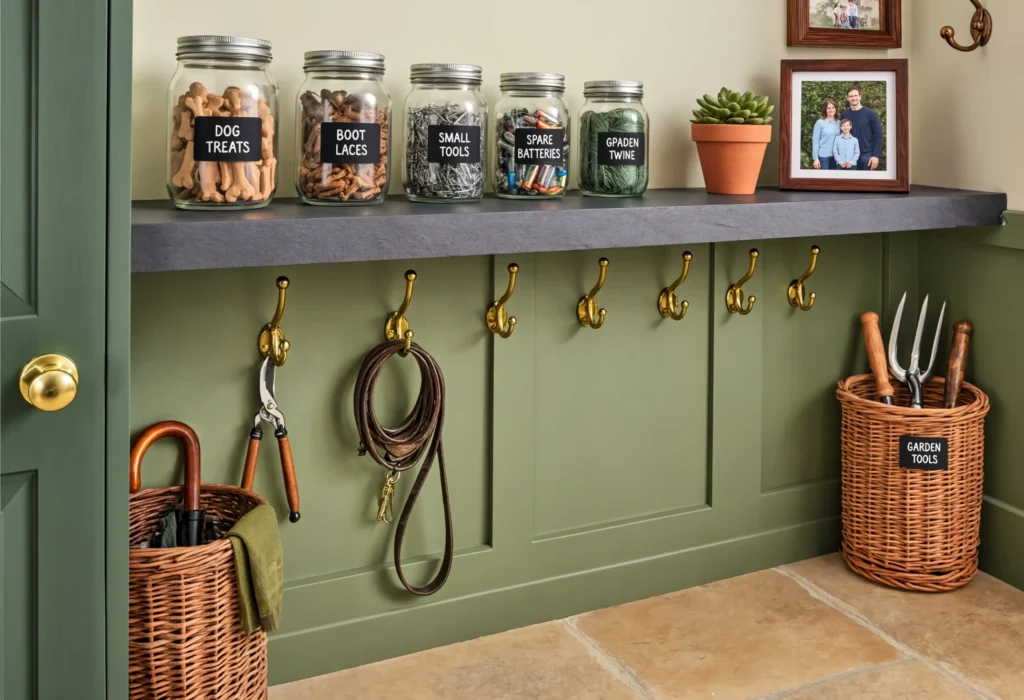
A slate shelf running at shoulder height along the mudroom wall and holding a collection of labeled mason jars is one of the most practically inventive and most visually charming organizational features available to the English country mudroom, combining the beautiful grey-green warmth of natural slate as a shelf material with the satisfying clarity and visual honesty of glass mason jars displaying their varied contents through transparent walls that make every item immediately identifiable without the need to open, search, or rummage. Source a natural slate slab of sufficient thickness — at least 30mm — and appropriate length from a specialist stone supplier or a reclamation yard, choosing a piece with the characteristic subtle color variation, visible cleavage planes, and slightly irregular edges of genuinely natural Welsh or Cumbrian slate rather than a uniformly perfect machine-cut piece that lacks the natural material’s most beautiful and distinctive visual qualities. Mount the slate shelf on generously dimensioned iron or brass brackets fixed firmly to the wall studs behind the paneling or plasterboard, ensuring the mounting is sufficiently robust to bear the considerable combined weight of the slate slab and its fully loaded collection of stored jars and equipment without any risk of movement or instability.
Fill a collection of wide-mouth mason jars with the most essential and most frequently needed small mudroom supplies — dog treats in one jar, spare boot laces in another, garden twine in a third, small tools and Swiss army knives in a fourth, spare batteries in a fifth — labeling each jar with a handwritten ink label or a brass-stamped leather tag that identifies the contents with confident, practiced lettering of the kind that transforms a functional storage system into a genuinely beautiful and personally expressive domestic display. Hang brass S-hooks from the slate shelf’s front edge to create additional hanging storage for small items — a pair of secateurs, a dog lead, a small trowel, a bunch of keys — that benefit from immediate accessibility without requiring a dedicated hook or storage position on the adjacent wall. This slate shelf and mason jar mudroom idea earns wonderful Pinterest engagement because it represents the most creatively resourceful and most visually satisfying approach to small-item mudroom organization — a storage system of genuine beauty, complete practical clarity, and the most pleasingly honest and personal character of any organizational feature in the English country mudroom.
11. Reclaimed Timber Coat Hook Board
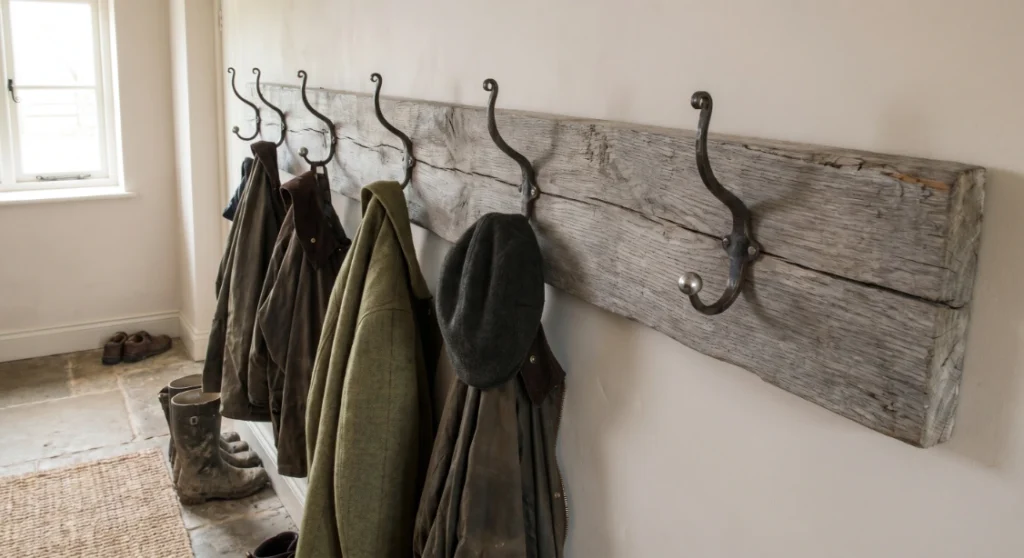
A coat hook board made from a wide reclaimed barn timber plank fitted with hand-forged iron hooks is the most materially authentic and most individually characterful coat hanging feature available to the English country mudroom, combining the extraordinary surface beauty of genuinely weathered and aged reclaimed timber with the artisanal warmth and decorative variety of individually hand-forged iron hooks to create a coat-hanging installation of completely unique character that no manufactured product however attractively designed can replicate or rival in its specific combination of natural material beauty and craft-made metalwork quality. Source a wide reclaimed oak, elm, or chestnut plank from an architectural salvage company, a barn conversion specialist, or a timber merchant dealing in reclaimed structural timber, selecting a piece of sufficient width — ideally 200 to 300mm — and interesting surface character — saw marks, mortise holes from original structural connections, beetle tracks in the surface, and the beautiful grey-silver weathering of timber long exposed to outdoor conditions — that makes the plank a visually compelling and historically interesting object in its own right before any hooks are attached to its surface. Clean and stabilize the plank with a light application of raw linseed oil that deepens and enriches the timber’s color and grain without creating a shiny, varnished surface inappropriate to the reclaimed material’s naturally weathered character.
Commission or source hand-forged iron hooks from a blacksmith working in the traditional English rural ironworking tradition, specifying hooks of varying decorative forms — simple curved tips, ball finials, scrolled ends, and perhaps one or two with more elaborate decorative detail — that give the coat board visual interest and individual character across its full length without introducing a uniformity inconsistent with the genuinely made, individually varied quality of genuinely hand-forged work. This reclaimed timber coat hook board earns magnificent Pinterest engagement because it is the most materially honest and most individually crafted single feature available to the English country mudroom — a coat hook installation that carries within its weathered timber surface and hand-forged iron hooks the visible evidence of real material history, real craft skill, and the genuinely unique character of objects made by hand from materials rescued from the agricultural landscape of the English countryside.
12. Built-In Dog Bed Nook Under the Bench
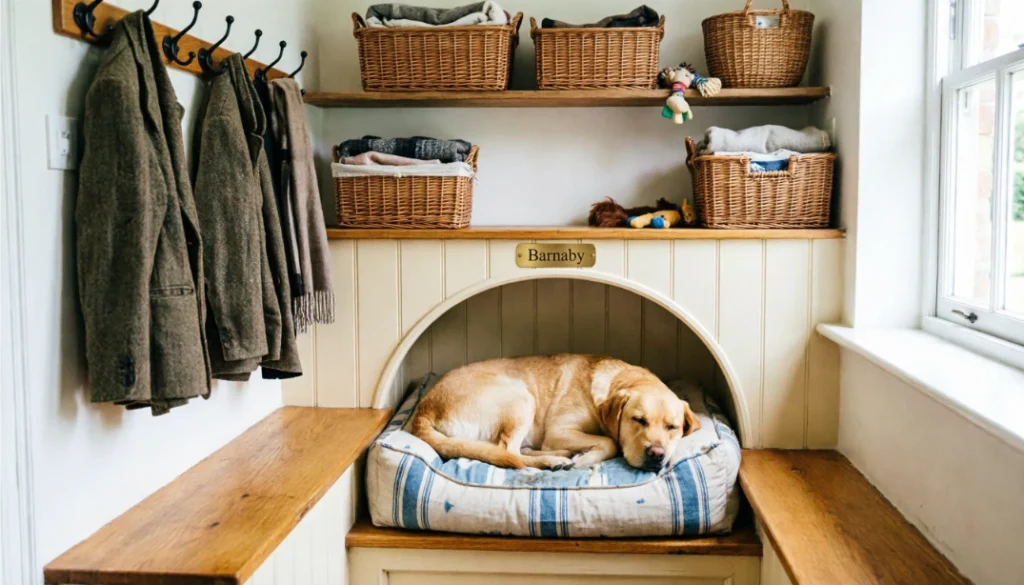
A built-in dog bed nook constructed beneath a wide mudroom bench with an arched opening and a fitted washable cushion is the most charming, most architecturally considered, and most genuinely English country addition to the mudroom’s furniture program, acknowledging with affectionate formality the beloved dog’s status as a full and permanently valued member of the English country household by providing a dedicated, beautifully made, and permanently positioned sleeping space within the household’s most dog-frequented room. Design the dog bed nook as an integral element of the mudroom bench structure — the bench providing the boot-removal seating above while the nook beneath provides the dog’s sleeping space below — with an arched or rectangular opening of dimensions generously proportioned to the household’s specific dog breed, lined in tongue-and-groove paneling or smooth painted timber and fitted with a purpose-made washable cushion in a durable, dog-appropriate fabric of sufficient thickness and firmness to provide comfortable, supportive sleeping for a working dog that spends long days on its feet. Fit a small engraved brass nameplate above the nook’s opening as the most delightfully formal and most characteristically English finishing touch, giving the dog bed the same architectural seriousness and personal acknowledgment as any other named and designated space within the well-ordered English country household.
Select a washable linen or canvas cushion cover in a robust country fabric — faded blue stripe, houndstooth wool, or plain natural canvas — that is visually appropriate to the mudroom’s wider textile palette and sufficiently durable and easily laundered for the inevitable regular washing that a working dog’s sleeping cushion requires. Position the nook opening to face into the room rather than toward the exterior door, so the resting dog maintains a comfortable view of all mudroom activity and feels included in the household’s comings and goings from its sleeping position. This dog bed nook mudroom idea earns devoted and enthusiastic Pinterest engagement because it represents the most affectionately English and most architecturally charming expression of the English country household’s deep and enduring love for its dogs — a love formalized in beautifully made timber and brass with the same serious decorative intention applied to every other beloved and permanently occupied space within the English country home.
13. Window Seat with Outdoor Book Storage
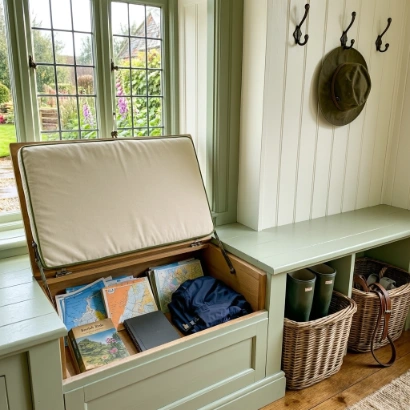
A mudroom window seat with a hinged storage compartment specifically organized for outdoor reading materials and reference books is the most practically considered and most intellectually warm storage feature available to the English country mudroom, creating a dedicated library of the countryside that positions the household’s collection of OS maps, field guides, plant identification books, and walking literature in the most logically appropriate location — the mudroom where every outdoor expedition begins and ends — rather than dispersing these frequently consulted reference materials throughout the main house where they are invariably less accessible and less consistently returned after use. Build the window seat in painted timber or reclaimed oak with a seat height of 450 to 500mm and a depth sufficient for comfortable sitting, specifying a hinged lid mechanism with a slow-closing hydraulic stay that prevents the heavy lid from falling unexpectedly and fitted with a recessed finger-pull handle that allows easy one-handed opening with muddy or gloved hands. Cover the seat with a cushion in a robust, wipe-clean outdoor fabric — oilcloth, treated canvas, or a waterproof linen-look fabric — that withstands the inevitable damp contact of outdoor clothing and muddy hands without requiring the delicate handling appropriate to interior upholstery fabrics.
Organize the seat’s interior storage compartment with the most practically useful and most frequently consulted outdoor reference materials available to the household — a complete set of OS Explorer maps for the surrounding countryside organized in geographical sequence, the current year’s edition of the primary field guide to British birds, a wildflower identification guide with well-illustrated regional coverage, a waterproof notebook and pencil for field observations, and a spare waterproof jacket permanently stored for emergency use — creating an instantly accessible countryside reference library of genuine practical value at the precise point where it is most needed and most likely to be consulted. This mudroom window seat outdoor book storage idea earns consistent Pinterest engagement because it is the most intellectually warm and most personally revealing of all English country mudroom storage features — a storage solution that communicates with quiet but unmistakable clarity the English country household’s passionate, knowledgeable, and continuously active engagement with the surrounding countryside landscape and all its extraordinary botanical, geological, ornithological, and topographical richness and interest.
14. Painted Tongue-and-Groove Ceiling
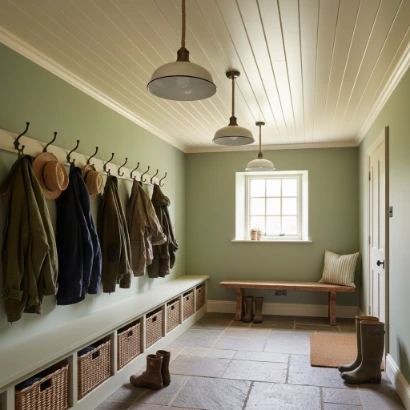
A painted tongue-and-groove boarded ceiling in soft white or warm cream is the most architecturally complete and most visually warm ceiling treatment available to the English country mudroom, extending the room’s characteristic tongue-and-groove wall paneling upward across the ceiling plane to create a fully lined, fully painted interior of continuous timber character that makes the mudroom feel properly finished, genuinely warm, and architecturally resolved rather than merely functional and provisionally decorated. Install tongue-and-groove boards across the full ceiling area running perpendicular to the room’s length for the most visually dynamic orientation, fixing the boards to ceiling joists with secret nailing that conceals all fixings and presents a smooth, uninterrupted board face of clean, consistent appearance. Use boards of the same profile and width as those used for the wall paneling below to create material continuity between wall and ceiling surfaces, and paint the ceiling boards in the same color as the wall paneling — or in a close tonal variation two shades lighter — for the most harmonious and architecturally unified overall interior effect.
Install simple pendant lights on fabric-covered braided flex dropped from ceiling rose fittings fixed directly to the tongue-and-groove boards, choosing enamel or ceramic shade designs of simple, honest character appropriate to the mudroom’s utilitarian-with-charm aesthetic — white enamel dome shades, green enamel industrial pendants, or simple cream ceramic pendants — and specifying bulbs of warm color temperature that illuminate the painted timber ceiling with the most flattering and most characteristically English country amber glow. This tongue-and-groove ceiling mudroom idea earns strong Pinterest engagement because it represents the most architecturally complete and most decoratively resolved approach to the English country mudroom ceiling — a ceiling treatment that transforms the most functional room in the house into a properly finished interior of genuine timber warmth, consistent material character, and the most complete expression of the English country paneled interior tradition applied from floor to ceiling with total, satisfying commitment.
15. Vintage Map Gallery Wall
A gallery wall of framed vintage Ordnance Survey maps of the surrounding countryside is the most geographically specific and most intellectually engaging decorative feature available to the English country mudroom wall, transforming a section of practical storage wall into a continuously fascinating cartographic display of the household’s beloved local landscape that provides both navigational reference for planned walks and a permanently absorbing visual record of the paths, contours, woodlands, villages, and features of the countryside through which the household moves on every outdoor expedition throughout the year. Source vintage one-inch or two-and-a-half-inch Ordnance Survey maps from specialist map dealers, old bookshops, and online vintage marketplaces, selecting editions from the 1950s, 1960s, and 1970s whose characteristic cream and color printing, elegant typography, and the particular conventions of their surveying and representation give them a visual beauty and period character that the current digital-derived OS maps entirely lack. Frame each map in a simple dark oak or slim metal frame with a cream mount cut to display the most interesting and most locally relevant section of each map sheet — the area containing the house, the surrounding footpaths, the nearest village, and the most frequently walked routes — creating a framed map gallery of genuine personal significance and navigational value.
Arrange the framed maps in a consistent grid formation — four maps in a two-by-two arrangement, or six in a two-by-three grid — for the most architecturally resolved and visually satisfying gallery composition, aligning the frames with the precision that the maps’ own geometric surveying conventions seem to demand and deserve. Mount a small shelf below the map gallery to hold a brass compass, a magnifying glass for map reading, a walking distance measurer, and a small notebook for planning and recording walks, completing the map gallery’s practical navigation reference function with the most appropriate and most beautifully made instruments of countryside exploration. This vintage map gallery mudroom idea earns exceptional Pinterest engagement because it is the most geographically personal, most intellectually engaging, and most continuously rewarding decorative feature available to the English country mudroom wall — a gallery that tells the complete story of the household’s relationship with its surrounding landscape in the most beautifully precise, most visually rich, and most permanently fascinating cartographic language imaginable.
16. Copper Umbrella and Walking Stick Stand
A tall cylindrical copper umbrella and walking stick stand with naturally developed verdigris patination is the most materially beautiful and most characterfully English country entrance accessory available to the mudroom corner beside the exterior door, providing practical, organized storage for the considerable collection of walking sticks, shooting sticks, and umbrellas that the active English country household accumulates across many years of outdoor life while contributing a focal point of warm, aged metalwork beauty to the mudroom’s most frequently observed corner position. Source a genuine antique copper coal scuttle, a large copper preserving pan, or a purpose-made cylindrical copper stand from a specialist antique dealer or a country house auction, choosing a piece that has been allowed to develop its natural verdigris patination rather than being polished to a bright, artificially maintained surface that lacks the material depth, historical authenticity, and visual warmth of genuinely weathered copper. The verdigris-patinated copper’s characteristic surface — areas of bright reddish-gold original copper beneath streaks and blooms of green-blue carbonate patination — creates a material surface of extraordinary color complexity and historical interest that improves continuously and indefinitely with every year of indoor life and gentle handling.
Arrange the walking stick collection in the copper stand with the most decorative and visually interesting examples positioned toward the front — a carved wooden crook handle, a knobbled blackthorn, a thumb stick in hazel, a silver-tipped malacca cane — allowing the varied handles to form an informal but visually pleasing arrangement of different heights and materials above the stand’s rim. Add a pair of rolled umbrellas in the household’s preferred colors — a classic black or a tartan-covered handle — and perhaps a shooting stick whose leather seat, when folded, extends above the stand’s rim as an additional decorative element of characteristic country field sports culture. This copper umbrella stand mudroom idea earns devoted Pinterest engagement because it represents the most materially beautiful and most instantly character-establishing single accessory available to the English country mudroom — a piece of genuinely aged copper whose warm, complex, beautifully patinated surface makes the mudroom’s most functional corner into a focal point of authentic, unhurried, and permanently lovely material beauty.
17. Terracotta Pot Collection on External Windowsill
A collection of terracotta pots in varying sizes arranged on the mudroom’s external windowsill is the most immediately welcoming and most botanically connected exterior detail available to the English country mudroom facade, creating a small but visually significant planted composition at the most frequently observed and most intimately accessible level of the house exterior that announces the household’s gardening engagement and love of growing things with cheerful, unpretentious, and completely authentic botanical charm. Choose frost-resistant terracotta pots of genuinely good quality — hand-thrown Italian terracotta from Impruneta or English-made pots from traditional regional potteries — in a range of sizes from small 100mm diameter pots through medium and large examples up to a generous 300mm pot as the windowsill’s most visually dominant planting position, allowing the varied sizes to create a naturally tiered arrangement of different heights and visual weights across the sill’s full length. Allow the terracotta to weather naturally without sealing or painting, as the gradual development of white mineral salt deposits, green moss growth, and the beautiful orange-to-grey weathering of exposed clay provides the most visually interesting and most horticulturally authentic pot surface — the visible record of time, weather, and growing that makes an old terracotta pot immeasurably more beautiful than any newly purchased example however well made.
Plant the windowsill pots with year-round interest in mind — clipped box balls as the permanent evergreen anchor of the composition, a small rosemary topiary trimmed to a compact column, trailing ivy spilling over the sill edge, seasonal bulbs pushing through in spring, and frost-hardy pansies and violas providing winter color during the months when the garden beyond has retreated from its summer magnificence. This terracotta windowsill collection earns consistent Pinterest engagement because it provides the most accessible, most immediately achievable, and most genuinely charming exterior improvement available to any English country mudroom facade — a planted composition that costs relatively little, requires modest horticultural knowledge to maintain, and delivers an immediate, visible, and continuously pleasurable expression of the English country household’s instinctive, deeply rooted, and completely natural love of growing things at every scale and in every available space.
18. Antique Mirror for Last-Minute Checks
A large antique mirror in a distressed gilt or painted wooden frame mounted at full-length beside the exterior door is the most practically indispensable and most decoratively generous single wall feature available to the English country mudroom, providing the essential last-minute appearance check before departure that prevents the considerable social embarrassment of arriving at any social engagement with mud on the face, hay in the hair, or a dog lead still attached to the coat belt, while simultaneously expanding the mudroom’s visual space and reflecting the room’s natural light, coat hook arrangement, and overall decorative character in a continuously engaging mirror image of considerable depth and atmospheric beauty. Source a large antique mirror — ideally full-length or at least three-quarter length — in a painted or gilt wooden frame showing the beautiful surface distressing of genuinely aged decorative paint or water gilding, as the mirror’s frame character contributes as much to the mudroom’s decorative
Mount a small painted shelf or a projecting stone corbel shelf directly below the mirror’s lower frame edge to provide a convenient surface for a natural bristle hairbrush, a clothes brush, a lint roller, a small vase of dried flowers or a potted herb, and perhaps a small ceramic dish for loose change and forgotten pocket items accumulated on the most recent country walk. Position the mirror at an angle slightly away from the wall’s flat plane if the mudroom’s depth allows, as the slight tilt creates a more flattering reflection angle and increases the sense of spatial depth that the mirror contributes to the mudroom’s often compact floor area. This antique mirror mudroom idea earns outstanding Pinterest engagement because it delivers simultaneously the most practically useful and the most decoratively beautiful single mudroom wall feature available to the English country interior — a mirror that serves the most essential daily function of departure preparation while contributing a focal point of genuine antique beauty, atmospheric warmth, and the most characteristically English countryside domestic elegance to the room’s overall decorative program.