15 Screen Partition Ideas to Create Stylish Functional Spaces
1. Rattan and Bamboo Folding Screen
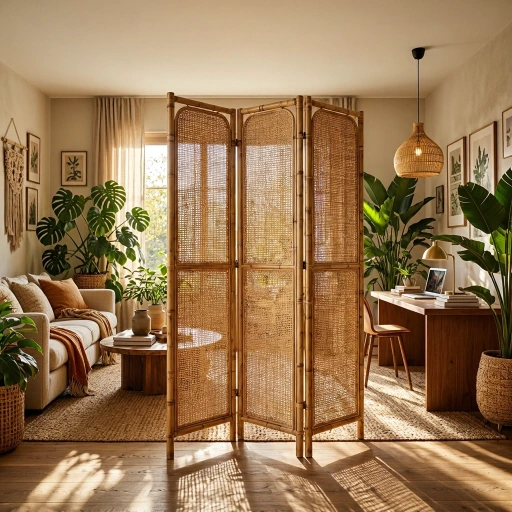
A rattan and bamboo folding screen is the screen partition idea that most warmly, most naturally, and most versatilely introduces the organic material richness of natural fiber craft into the domestic interior while simultaneously performing the practical space division function that contemporary open-plan living increasingly and urgently requires. The rattan and bamboo folding screen’s specific aesthetic value derives from its combination of visual lightness — the woven rattan panels allowing light to pass through while filtering it into the complex, shifting shadow patterns of interwoven organic fiber — and the material warmth of genuine natural materials whose specific tactile character, warm amber color, and visible handcraft quality create an immediate sense of organic hospitality that no synthetic screen material can replicate or approach with comparable genuineness. The folding format provides the additional practical advantage of complete reconfigurability — the screen can be extended to its full width, angled at various configurations to create curved division lines, collapsed to a narrow footprint when temporary division is not required, and repositioned to any point in the space without the permanence of an architectural partition.
Choose a rattan and bamboo screen with a panel count of at least four — a minimum panel number that provides sufficient width for genuine space division at a typical doorway or open-plan living zone boundary without requiring an impractically large individual panel width that would make the screen unwieldy to configure and reposition. Source the screen from a specialist rattan furniture maker or a quality home goods retailer who can confirm the authenticity of the materials and the robustness of the hinge connections between panels — the hinges being the structural element most likely to fail with regular repositioning in a quality rattan screen and the point of construction quality most clearly distinguishing a genuine, long-term investment piece from a decorative object with a limited functional lifespan. Style the screen in its room placement context with flanking plants — large tropical-leaf specimens like monstera, bird of paradise, or fiddle-leaf fig whose own organic character and botanical abundance create a visual narrative of natural material gathering that makes the rattan screen feel like a considered, cohesive element of a complete interior design vision rather than a functional addition inserted without aesthetic integration into an existing space.
2. Macramé Hanging Curtain Partition
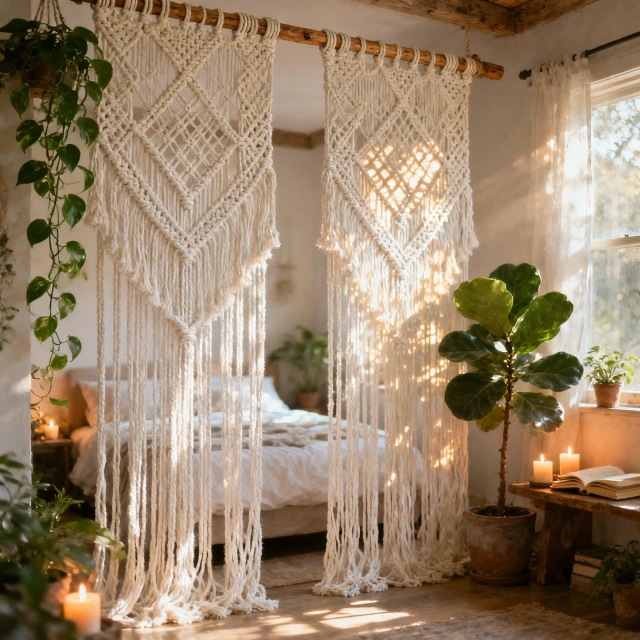
A floor-to-ceiling macramé hanging curtain partition — its intricate knotted cotton rope construction creating a semi-transparent wall of textile art that simultaneously divides and connects the spaces on either side of it — is the screen partition idea that most completely and most beautifully realizes the bohemian interior design aspiration of replacing the hard edges and visual opacity of conventional walls and screens with a permeable, textile-based boundary whose character is simultaneously decorative, functional, and handcraft-celebratory in a way that no manufactured partition system can approach. The macramé partition’s specific quality as a space divider is its ability to create the psychological impression of a distinct spatial zone on each side of the textile boundary without the visual closure or light interruption of a solid screen — the open knotwork allowing both light and visual connection between the divided spaces while the hanging textile’s presence as a physical and visual plane creates sufficient boundary definition for the functional purpose of establishing separate zones within an open-plan interior.
Commission the macramé partition from a working textile artist — either locally or through one of the many skilled macramé makers whose work is available through online craft marketplaces — specifying the exact installation dimensions required for the specific spatial context, the knotwork density desired for the balance between openness and privacy that the particular space division purpose requires, and the fringe and tassel details at the bottom edge that create the partition’s most visually dramatic feature. Natural cotton rope in a three-millimeter diameter is the most widely used and most visually appealing macramé cord for large-scale hanging partitions — its natural cream color working harmoniously with virtually every interior color palette while its matte, slightly textured surface catching the ambient light of the room with the specific soft quality of natural fiber rather than the harder reflection of synthetic alternatives. Install on a sturdy wooden dowel or a blackened steel curtain rod of sufficient diameter and wall bracket strength to support the considerable weight of a full-height macramé partition — the weight per linear meter of dense macramé knotwork being significantly greater than most standard curtain rod systems are designed to accommodate without the additional structural support that a custom installation bracket provides.
3. Industrial Steel and Glass Panel Divider
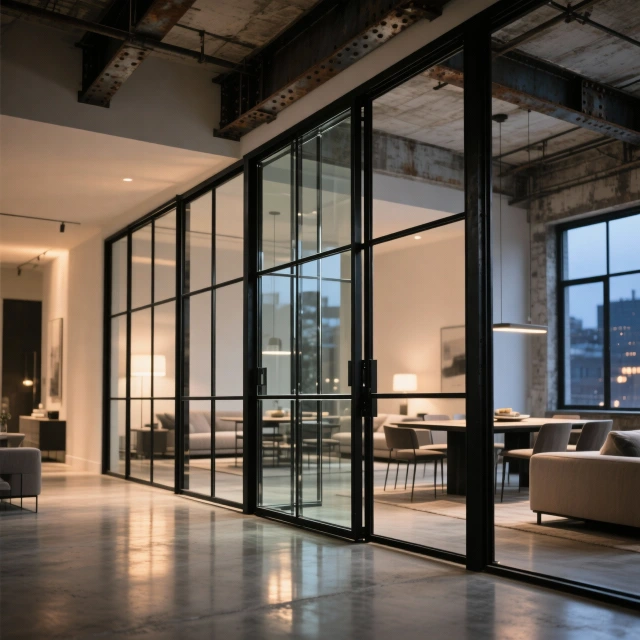
A floor-to-ceiling steel and glass panel partition — its blackened steel frame carrying multiple panels of clear float glass in a regular grid pattern — is the screen partition idea that most architecturally and most permanently transforms the spatial organization of an open-plan interior while maintaining the specific quality of visual and light connectivity that distinguishes this approach from a conventional solid wall partition that would completely separate the divided spaces from each other’s light, view, and spatial presence. The steel and glass partition achieves the most sophisticated and most architecturally resolved version of the screen partition concept by using the specific material combination of structural steel and transparent glass to create a boundary that is simultaneously fully present as a physical and visual plane and completely transparent as a barrier to light and view — making the partition genuinely visible as a design element while making the space genuinely unified as a light environment.
Fabricate the steel frame from square or rectangular hollow steel section in a blackened finish — the matt black surface of oxidized or powder-coated steel creating the most dramatic visual contrast with the glass panels and the most architecturally assertive presence within the room’s material palette. Size the individual glass panels within the frame according to the grid proportion that creates the most visually balanced and most architecturally coherent composition for the partition’s specific width and height dimensions — a square grid of panels creates the most formal and most architecturally classical partition aesthetic, while a rectangular grid with taller-than-wide panels creates the most elegant and most currently fashionable proportion that references the industrial warehouse window as its aesthetic origin. Specify the glass in a clear, low-iron float glass to minimize the slight green cast of standard float glass — the low-iron specification producing genuinely colorless glass whose transparency is maximally pure and whose color neutrality is most compatible with the full range of interior color palettes that the partition will be seen against from both sides of its installation. Use genuine structural glazing — glass held in the steel frame by structural glazing tape and structural silicone rather than mechanical glazing beads — for the most architecturally refined result with the minimum visible hardware at the glass perimeter.
4. Hanging Plant and Moss Wall Divider
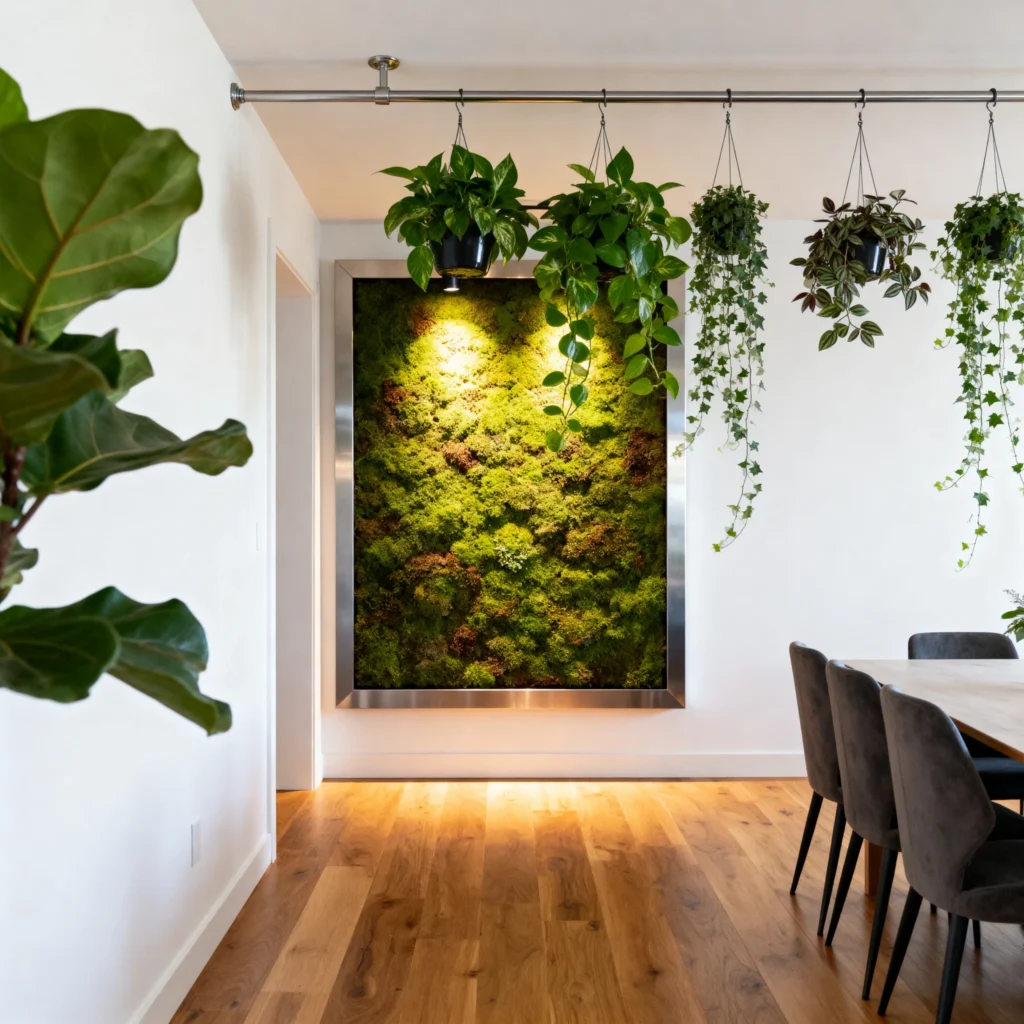
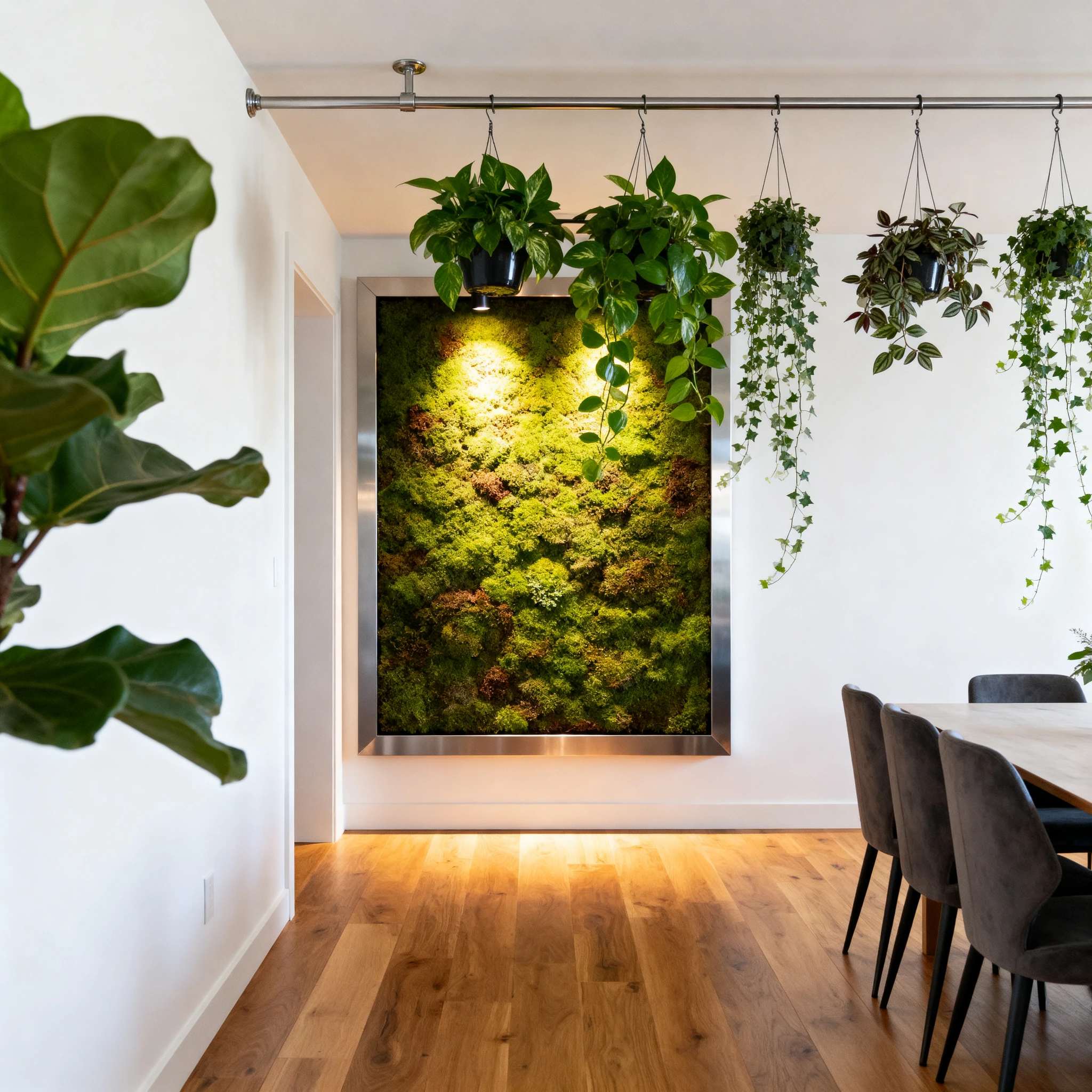
A hanging plant and moss wall divider — trailing plants suspended from a ceiling-mounted steel rod system at varying heights, creating a cascading green curtain of living foliage, backed by preserved moss panels that provide a dense, textured green wall surface between the hanging plant positions — is the screen partition idea that most completely and most genuinely realizes the biophilic interior design aspiration of integrating living botanical material directly into the architectural fabric of the domestic interior rather than placing plants as decorative objects within a space designed without regard for their presence. The living plant partition creates a genuinely dynamic, genuinely alive space division element whose character changes daily as the plants grow, develop new leaves, and respond to the specific quality of light in their installation position — providing the aesthetic quality of constant gentle change and organic development that no static partition material can deliver regardless of its visual beauty.
Install the ceiling mounting system using a robust steel rod suspended on adjustable drop hangers from the ceiling structure — the rod’s diameter and wall bracket fixings specified to support the combined weight of the hanging plant pots, the growing medium, the plant material, and the additional weight of watering saturation — allowing the hanging height of individual plant positions to be adjusted independently for the varied, multi-level hanging composition that creates the most visually rich and most spatially immersive plant curtain effect. Select trailing plants whose growth habit naturally creates the cascading, downward-flowing foliage that makes the hanging plant partition most effective as a visual boundary — golden pothos for its vigorous trailing growth and warm yellow-green variegated leaves, heartleaf philodendron for its deep green glossy heart-shaped leaves and rapid trailing extension, string of pearls for its otherworldly bead-like trailing stems that create a uniquely delicate visual texture, and spider plants for their arching, fountain-like growth that creates particularly graceful silhouette lines at the partition’s hanging points. Supplement the hanging plants with preserved moss panels — sheets of naturally harvested and chemically preserved reindeer moss or sheet moss in their natural green color — mounted on a backing panel positioned behind the hanging plant system to create the dense, textured green backdrop that makes the partition’s visual boundary more complete and more spatially defining than hanging plants alone can achieve.
5. Bookshelf Room Divider
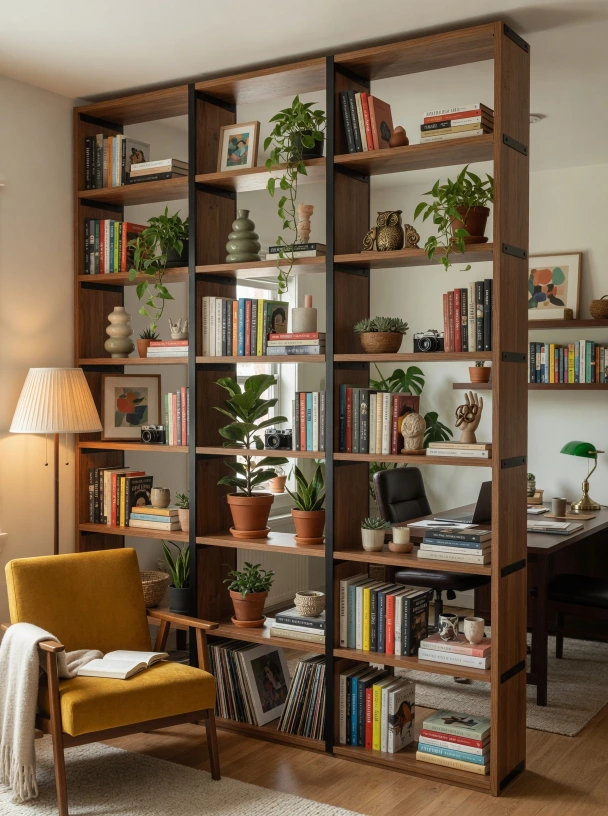
A floor-to-ceiling open bookshelf unit used as a room divider — its shelves filled with books, plants, decorative objects, and personal collections, accessible from both sides of the partition and creating a uniquely functional boundary that provides storage, display, and aesthetic richness simultaneously alongside its primary function of defining two distinct spatial zones within an open-plan floor area — is the screen partition idea that most intelligently and most efficiently combines spatial organization, storage provision, and interior decoration into a single architectural element whose value to the daily life of the interior far exceeds the simple room division that any simpler partition could provide at lower cost and with less visual complexity. The bookshelf divider is the screen partition concept that most completely transforms the space division challenge from a purely spatial organization problem into a genuine interior design opportunity — the books and objects that populate its shelves telling the story of the household’s intellectual life, aesthetic sensibilities, and personal history in a display that enriches both sides of the divided space simultaneously.
Design the bookshelf unit with a combination of open shelves, closed cabinet sections, and pass-through openings that serve both the storage and division functions with the greatest possible versatility and the most thoughtful attention to the specific activities occurring on each side of the partition. The open shelf configuration allows visual connectivity between the divided spaces through the shelf’s openings — maintaining the sense of spatial relationship between the zones that complete visual closure would eliminate — while the books and objects populating each shelf level create a variable, layered visual filter whose opacity depends on how densely the shelves are filled rather than the fixed transparency of a glass or screen panel. Include a minimum of two pass-through openings at counter height — open sections without shelves that allow objects, documents, and conversation to pass freely between the divided spaces without requiring physical movement around the entire unit — creating the practical connectivity between the zones that maintains their functional relationship despite their visual and spatial separation. Construct the unit from solid hardwood or high-quality veneered plywood with a painted or stained finish selected to harmonize with the room’s existing color palette rather than imposing a new material color that the room’s established design language must accommodate and negotiate.
6. Japanese Shoji Screen Partition
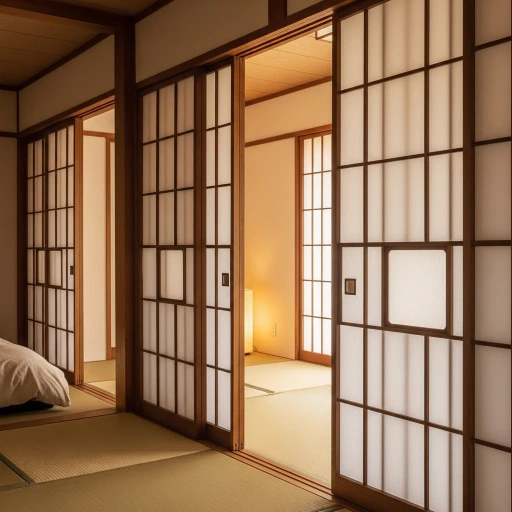
A Japanese shoji sliding screen partition — its translucent rice paper panels set within a regular grid of thin wooden frames mounted on a floor track and ceiling guide that allows smooth, silent horizontal sliding — is the screen partition idea that most completely and most authentically imports the specific spatial philosophy of traditional Japanese interior architecture into the Western domestic interior, creating a partition system whose beauty, spatial intelligence, and material quality derive from a design tradition with millennia of considered development and refinement rather than the shorter history of Western room partition design. The shoji screen’s defining characteristic — its rice paper panel’s ability to transmit light diffusely through its translucent surface while completely blocking clear vision between the divided spaces — creates the most spiritually and aesthetically refined version of the screen partition concept: a boundary that maintains the visual sense of light connection between the spaces while providing genuine visual privacy, simultaneously serving the separated spaces with an equal quality of soft, diffused, paper-filtered light.
Source authentic shoji screens from a specialist Japanese furniture maker or a quality Japanese import supplier — the specific quality of the joinery, the rice paper’s translucency and surface texture, and the precision of the sliding track system being the three elements that most clearly distinguish genuine Japanese craftsmanship from the lower-quality decorative approximations that much of the Western market offers under the shoji name without the genuine material quality or construction precision of the authentic product. Specify the rice paper panels in a genuine washi — the handmade Japanese paper produced from kozo, mitsumata, or gampi fibers whose specific translucency, surface texture, and warm off-white color create the particular light quality that makes shoji screens so atmospherically distinctive — rather than the machine-made rice paper substitutes that approximate the visual appearance with less material authenticity and less specific light-transmission quality. Install the floor track and ceiling guide in a material and finish that complements the screen’s wooden frame — natural timber in the same species and finish as the screen frame for the most cohesive and most authentically Japanese aesthetic, or blackened steel for the more contemporary interpretation that connects the shoji screen to the current minimalist interior design context without the full reproduction of a traditional Japanese interior.
7. Fabric Curtain on Ceiling Track
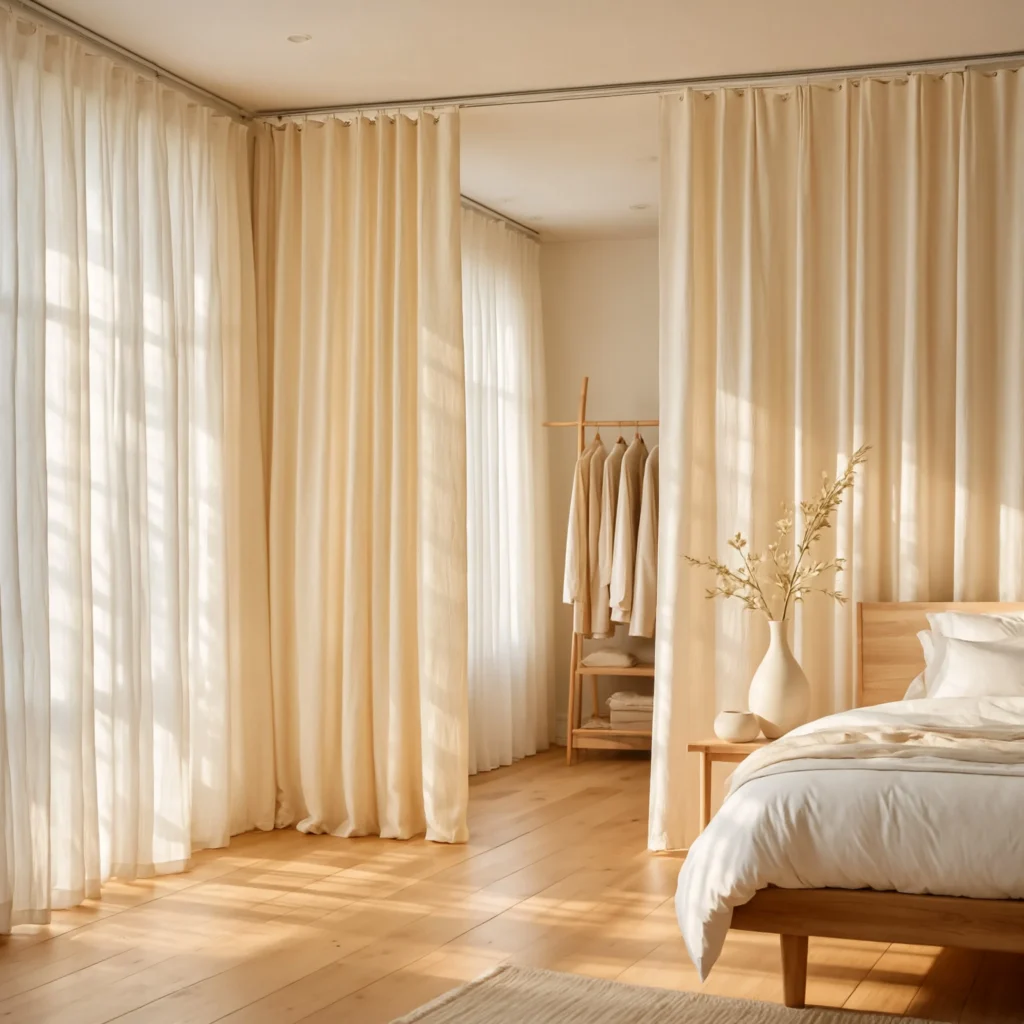
Floor-to-ceiling linen curtain panels suspended from a ceiling-mounted track system — their soft, billowing fabric creating a gentle, movable boundary between the bedroom’s sleeping zone and an adjacent dressing area, the linen’s natural translucency in direct light creating the specific quality of soft, diffused illumination that allows natural light to penetrate both zones while maintaining visual privacy between them — is the screen partition idea that most gracefully, most softly, and most flexibly divides a domestic space with the specific quality of textile warmth and movement that hard screen partitions of every material type fundamentally cannot provide. The fabric curtain partition is the most inherently adaptive and most practically versatile of all room division methods — its track-mounted panels opening completely to a single point at the track’s end when full spatial openness is desired, closing across the track’s full span when complete division is required, and adjustable to any intermediate configuration the specific moment’s activity or privacy requirement suggests.
Install the ceiling track in a recessed slot cut into the ceiling surface — the recessed installation hiding the track hardware completely within the ceiling plane so that only the curtain fabric and its suspension rings are visible from the room below, creating the clean, floating-fabric appearance that most beautifully expresses the ceiling curtain partition concept without the industrial-quality track hardware interrupting the visual elegance of the hanging fabric panels. Source the linen in a genuinely heavyweight woven fabric — a minimum weight of 300 grams per square meter for panels of standard ceiling height — to achieve the satisfying visual weight, the natural drape, and the genuine opacity in indirect light that lightweight linen cannot provide. The fabric weight is the single most critical specification decision for a ceiling-height curtain partition — too light and the panels billow uncontrollably in the room’s air movement, fail to hang in the straight, vertical lines that the partition concept requires, and transmit too much light for practical privacy use; appropriately heavy and the panels hang with the authority, the visual presence, and the graceful drape that makes this partition type genuinely beautiful. Choose a fabric color from the neutral range — warm white, cream, natural linen, soft grey, or pale sage — that reads as a genuine architectural element of the space rather than a decorative textile addition to it.
8. Laser-Cut Metal Screen Panel
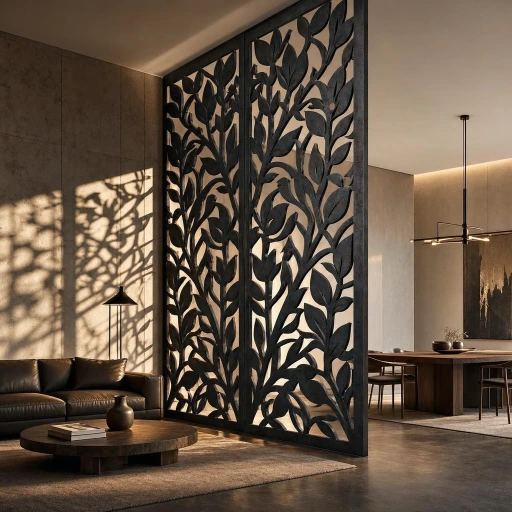
A floor-to-ceiling laser-cut steel panel partition — its intricate geometric or botanical pattern cut precisely through the metal surface by computer-controlled laser cutting, creating a screen whose visual complexity and shadow-casting qualities are as impressive and as artistically refined as the most accomplished decorative screen traditions of any culture’s craft history — is the screen partition idea that most dramatically and most contemporarily combines the architectural authority of a permanent, structural-grade metal panel with the decorative richness of a surface whose every square centimeter contains the visual complexity of the laser-cut pattern’s intricate openwork. The laser-cut metal screen’s specific quality as a room divider derives from its ability to use a single, thin material plane to create a spatial boundary of extraordinary visual richness — the cut pattern creating thousands of individual openings whose combined effect is simultaneously semi-transparent and visually dense, allowing light and air to pass through while maintaining a visual boundary whose complex surface pattern draws the eye with constant, detailed interest from any viewing distance.
Commission the panel from a specialist metal fabrication company with laser-cutting capabilities — the design of the cut pattern being the most creatively significant decision of the entire commission and deserving the same careful, considered development as any other significant artwork or architectural element. Choose between geometric patterns — the precise, mathematical regularity of repeated geometric forms creating the most architecturally formal and most contemporarily minimal aesthetic — and botanical patterns — the organic, growth-referencing forms of leaves, vines, and flowers creating the most warmly natural and most visually rich alternative. Request a sample cut of the proposed pattern at full material thickness before committing to the full panel production — the sample allowing the precise assessment of the pattern’s shadow quality, the opening-to-material ratio that determines the panel’s light transmission and visual transparency, and the specific visual character of the cut pattern at normal interior viewing distances that no digital rendering can accurately convey. Specify the panel material in a minimum three-millimeter mild steel for sufficient structural rigidity to support the panel’s weight in a floor-to-ceiling installation without flexing or warping — applying a blackened oxidation finish or a specialist matt black powder coat that creates the most visually dramatic contrast between the cut openings and the surrounding metal surface.
9. Wooden Slat Vertical Partition
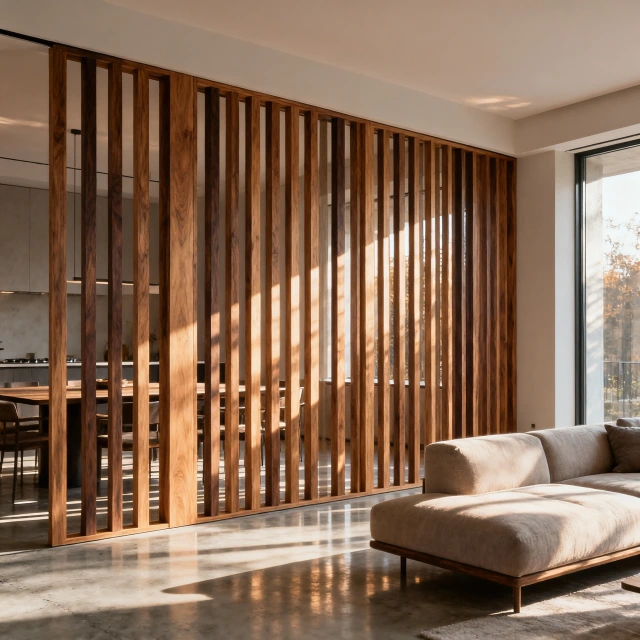
A floor-to-ceiling wooden vertical slat partition — its evenly spaced individual slats in natural oak or walnut creating a regular rhythm of solid timber and open air gaps that simultaneously defines the spatial boundary between two zones and maintains visual and air connectivity between them through the consistent, measured intervals of the slat spacing — is the screen partition idea that most elegantly and most architecturally expresses the contemporary Scandinavian and Japanese design influence on the Western residential interior, creating a space division element whose beauty derives entirely from the precision of its geometry, the quality of its natural timber material, and the specific ratio of solid to void that the slat spacing creates in the visual and physical relationship between the divided spaces. The wooden slat partition is the contemporary architectural language of deliberate, honest material expression — no concealment of the wood’s natural grain and color, no applied surface decoration, and no complexity of form beyond the simple, repeated vertical line of individual slats suspended with precision between a ceiling-mounted head rail and a floor-mounted base rail.
Specify the slat dimensions with careful attention to the solid-to-void ratio that the partition’s specific functional requirements and spatial context demand — a narrow slat width relative to the gap width creates maximum visual transparency and maximum light transmission at the cost of spatial definition and acoustic separation, while a wide slat width relative to the gap width creates stronger spatial definition and greater visual privacy at the cost of the open, connected quality that distinguishes the slat partition from a solid wall. A slat width of approximately forty to sixty millimeters with an equal gap width of forty to sixty millimeters creates the most balanced and most broadly applicable ratio for typical residential applications where both visual connectivity and functional zone definition are equally important requirements. Select timber species whose natural color and grain character are appropriate for the specific interior aesthetic context — white oak with its straight grain and warm blonde color for the Scandinavian minimalist interior, American walnut with its rich chocolate-brown color and dramatic grain figure for the warmer, more luxurious contemporary interior, or painted MDF in a color matched to the surrounding walls for the most architecturally recessive installation that emphasizes the partition’s spatial function over its material presence.
10. Beaded Curtain Partition
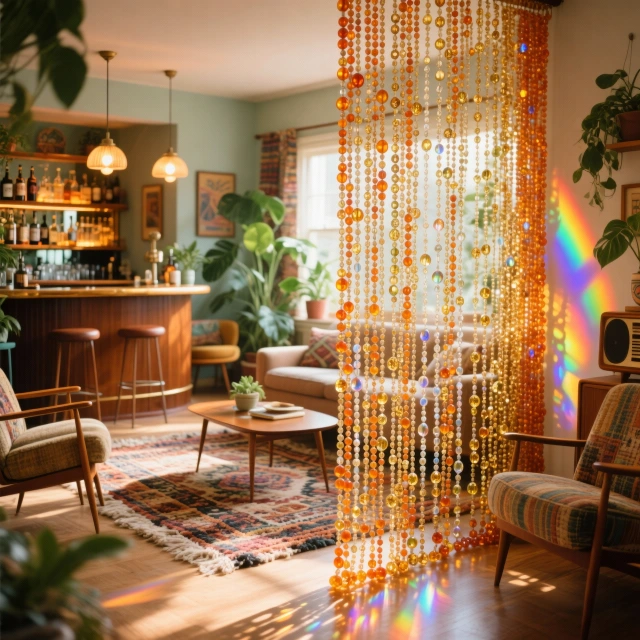
A beaded curtain partition — floor-to-ceiling strings of amber, clear, and gold glass beads hanging in a dense, touchable curtain that moves and sounds with every passage through it, refracting the room’s light into prismatic color patterns on the surrounding walls and floors — is the screen partition idea that most playfully, most sensory-richly, and most unapologetically celebrates the partition’s presence as a genuinely physical, tactile, and auditory experience rather than simply a visual and spatial one. The beaded curtain’s specific quality as a room divider is its complete integration of functional partition and experiential threshold — every passage through the curtain is both a physical transition between spaces and a sensory event whose gentle sound, touching contact, and momentary visual disruption mark the threshold crossing as a genuine, momentary rite of passage between one space and the next in a way that no silent, passive screen partition can approach. The beaded curtain is the room divider that turns the act of moving between spaces into a small ceremony of tactile, auditory, and visual pleasure.
Source genuine glass beads rather than the cheaper plastic alternatives that approximate the visual appearance while entirely lacking the specific weight, sound, and light-refracting quality that make glass beaded curtains so distinctively beautiful and so genuinely sensory in their experiential character — the glass bead’s mass producing the satisfying, musical sound of bead-on-bead contact during passage, its hardness creating the crisp, clear click rather than the soft, muffled sound of plastic, and its refractive index creating the specific prismatic light dispersal that sends rainbow patterns across surrounding surfaces in a way that plastic beads’ lower refractive index cannot replicate. Design the color composition of the curtain with the same deliberate visual planning as any significant decorative element — choosing a palette of two or three bead colors that create a cohesive, internally harmonious color story rather than the visually chaotic rainbow of multiple colors that low-quality beaded curtains often employ. Amber, clear, and gold glass beads create the most sophisticated and most universally space-appropriate combination — the amber’s warm, honey tones providing the dominant color, the clear glass providing transparency and light refraction, and the gold providing the festive metallic accent that connects the curtain to the luminous, party-adjacent atmosphere that the beaded curtain has always most naturally and most convincingly created.
11. Pegboard and Storage Panel Divider
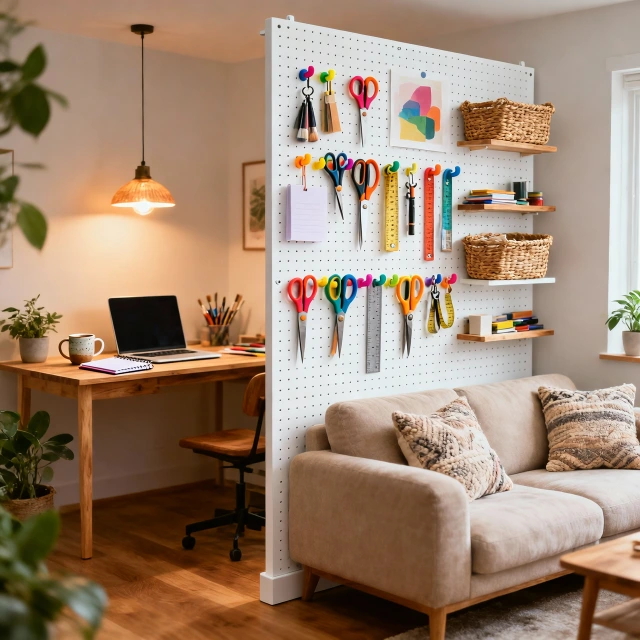
A pegboard partition panel — a floor-to-ceiling installation of interlocking pegboard panels mounted on a freestanding or ceiling-anchored frame, its evenly spaced holes accommodating an infinitely reconfigurable system of hooks, shelves, baskets, and tool holders on both faces simultaneously — is the screen partition idea that most intelligently and most efficiently transforms the room division requirement into a genuine storage and organization opportunity, creating a double-sided functional wall whose available surface area on both faces is fully utilized for practical storage while the panel’s physical presence performs the spatial division that the installation’s primary purpose requires. The pegboard partition is the most practically ambitious of all screen partition concepts — its ambition being not merely to divide a space but to transform the division plane into the room’s most organized, most functionally rich, and most visually interesting surface simultaneously.
Construct the pegboard panel installation on a lightweight steel tube frame that provides the structural rigidity the panel requires to resist the cantilever forces exerted by filled shelves, hanging tools, and mounted baskets without flexing or tipping — the frame being freestanding on leveling feet that protect the floor surface without requiring permanent fixation into the floor structure, allowing the partition to be repositioned as the room’s functional needs evolve. Paint the pegboard panels in a color that is either consistent with the surrounding wall color for a visually recessive installation that emphasizes the attached accessories over the panel itself, or in a bold accent color that makes the partition a visual feature of the room’s decoration scheme. The panel color decision is the single most powerful visual design choice available in the pegboard partition’s relatively simple formal vocabulary — a white or neutral panel creates the most versatile backdrop for accessories of any color, while a deep green, navy, or warm terracotta panel creates the most visually dramatic and most decoratively confident installation whose color presence contributes actively to the room’s aesthetic rather than simply supporting the accessories mounted upon it. Design the accessory configuration on both faces of the panel with the specific organizational needs of each divided space — the home office side carrying pen holders, paper trays, and reference material, the living room side carrying books, plants, and decorative objects — for a double-sided display whose two faces tell genuinely different organizational stories appropriate to the specific activities they serve.
12. Stacked Books Partition Wall
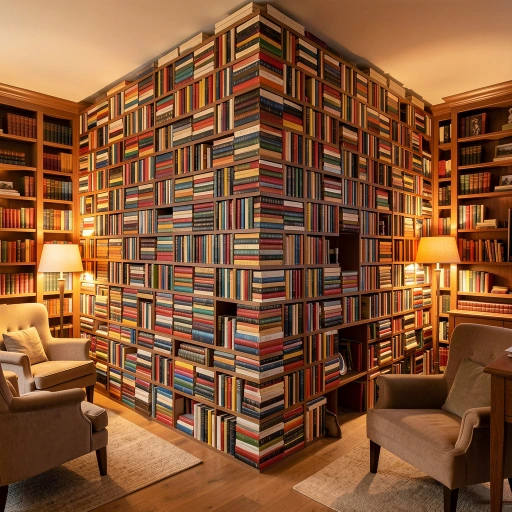
A partition wall created entirely from stacked books — individual books laid horizontally and stacked in a stable, interlocking grid pattern to create a solid, structurally self-supporting wall of sufficient height and density to function as a genuine room divider whose entire visual surface is composed of colorful book spines visible from both sides of the installation — is the screen partition idea that most creatively, most personally, and most culturally richly transforms the utilitarian room division function into a genuine statement of intellectual identity, aesthetic personality, and the specific kind of domestic ambition that belongs to people who consider their book collection one of the most important and most revealing self-representations they possess. The stacked book wall is simultaneously a piece of architecture, a piece of furniture, a storage system, and a portrait of the household’s intellectual life — its specific composition of titles, spines, and colors making it a completely unique installation that cannot be replicated anywhere else because no two book collections are identical.
Plan the structural integrity of the stacked book partition with genuine engineering attention — the horizontal stacking orientation providing the most stable, most interlocking arrangement for a freestanding book wall, with each layer offset by half a book length from the layer below in the traditional brick-bond pattern that maximizes the wall’s resistance to lateral forces and prevents the vertical joint alignment that would allow the wall to split and collapse along a continuous vertical weakness. Calculate the load-bearing capacity of the floor beneath the proposed installation before proceeding — a floor-to-ceiling book wall of one meter width at a typical domestic ceiling height of 2.4 meters contains approximately 600 to 800 books whose combined weight of 600 to 1000 kilograms must be distributed across the floor area beneath the installation without exceeding the floor’s structural load capacity. Curate the visible spine composition of the installation with the same deliberate visual attention that a gallery curator brings to the arrangement of artworks — organizing books by spine color for a visual gradient effect, by height for a stepped silhouette, or by subject for the intellectual organizational logic that creates the most personally meaningful and most visually coherent composition of the installation’s inevitably complex and richly varied visual surface.
13. Terrarium and Plant Display Divider
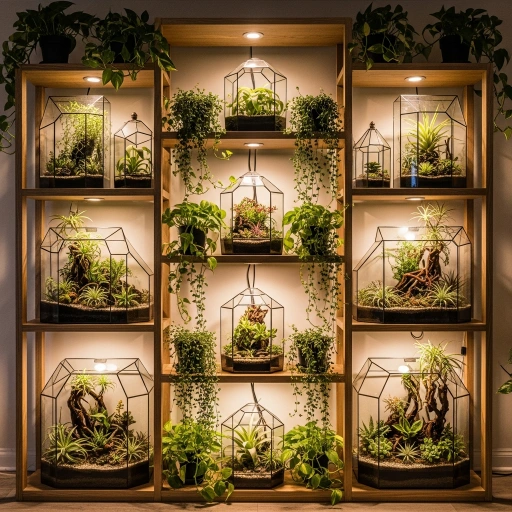
A custom terrarium and plant display shelving system — multiple geometric glass terrariums of varying shapes and sizes arranged at different heights within an open shelving structure, filled with succulents, woodland ferns, tropical air plants, and miniature botanical landscapes, with trailing plants cascading from the open shelf spaces between the terrariums — is the screen partition idea that most completely and most immersively creates the biophilic interior environment that contemporary residential design increasingly recognizes as genuinely beneficial to human physical and psychological wellbeing, using the space division requirement as the organizing principle for the most ambitious and most visually spectacular indoor plant installation that a domestic interior can accommodate. The terrarium partition is the room divider that transforms the act of passing between spaces into an experience of moving through a miniature botanical world — each terrarium presenting a complete, enclosed ecological narrative at close viewing range that rewards extended examination and reveals greater botanical detail the more attentively it is observed.
Design the shelving structure with the botanical display as its primary spatial and structural consideration — the shelf heights, depths, and spacing determined by the specific size and visual requirements of the terrarium and plant collection it will house rather than by the standard dimensions of general storage furniture that was designed without botanical display in mind. Ensure each shelf position provides sufficient access for the routine maintenance tasks that a living terrarium collection requires — watering, pruning, misting, and the periodic replanting that healthy plant growth necessitates — without requiring the removal of surrounding terrariums to access the one requiring attention. Install supplementary grow lighting within the shelving structure — LED grow light strips recessed under each shelf edge and directed downward onto the shelf below — to ensure that every shelf position in the display receives the light intensity and spectrum that the specific plant species housed at that position require for sustained health and continued growth, regardless of the natural light levels available from the room’s windows.
14. Architectural Arch Screen Partition
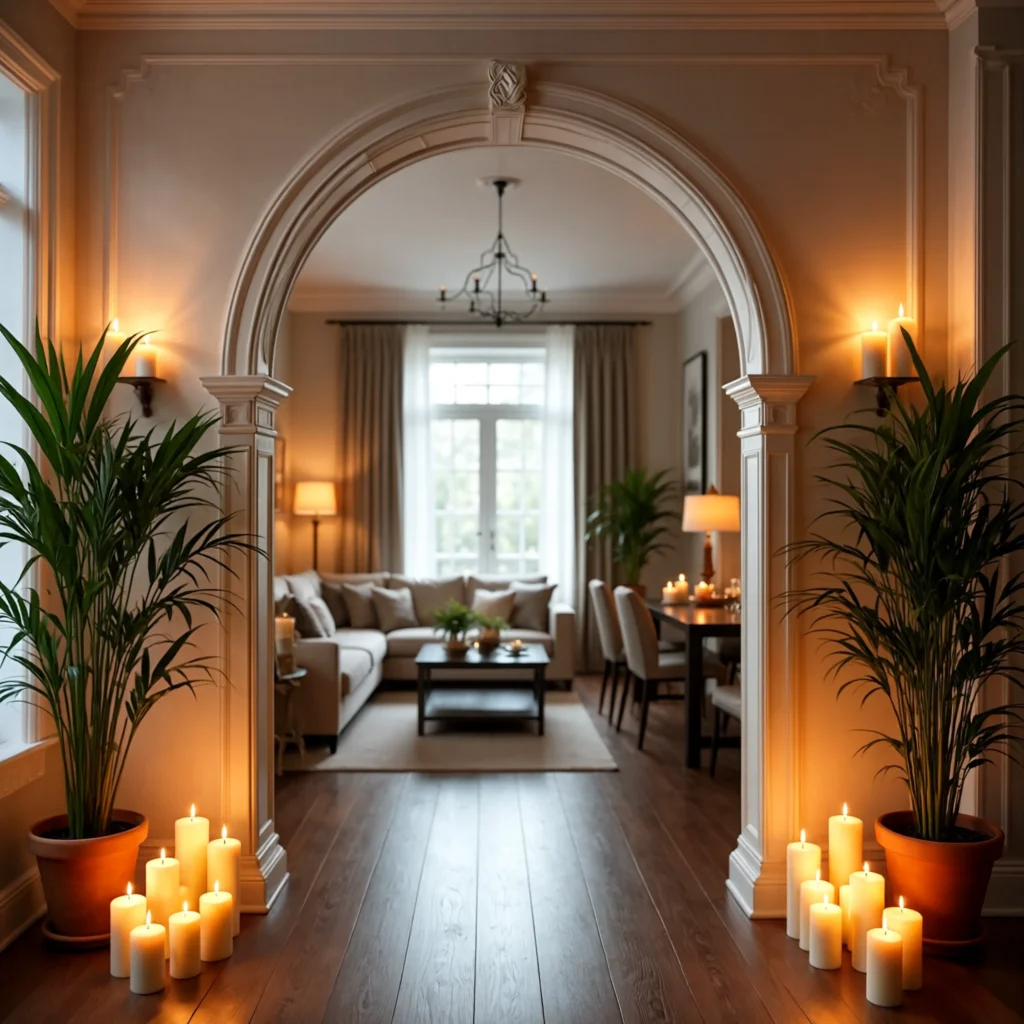
A freestanding architectural arch partition — a structurally self-supporting plaster or MDF arch form painted in warm white with subtle decorative molding detail, wide enough to create a genuine threshold experience but narrow enough in its solid wall sections on either side of the arch opening to function as a decorative partition rather than a full-width wall — is the screen partition idea that most grandly and most architecturally transforms the spatial relationship between two connected rooms by replacing the open, undefined transition of an open-plan floor with a framed, ceremonial threshold that makes the passage between the living room and the dining room or the kitchen and the sitting area feel like a genuine spatial event rather than an indeterminate drift from one zone to the next. The architectural arch partition borrows the vocabulary of traditional residential architecture — the through-wall arch that connects the formal rooms of a classical house — and deploys it as a freestanding object within a contemporary open-plan interior, creating the visual and spatial drama of architectural scale without the permanence of structural construction.
Construct the freestanding arch partition from a structural steel tube skeleton that carries the plaster or plasterboard surface cladding — the steel frame providing the structural rigidity that allows the arch to be genuinely freestanding at full architectural scale without the thickness of a solid masonry wall that would create an excessive visual bulk inappropriate for a partition that is meant to frame and connect spaces rather than physically and visually separate them. Design the arch’s proportional geometry with careful attention to the classical rules of arch proportion — the arch’s spring line at shoulder height (approximately 1.8 to 2 meters from the floor), the arch’s crown at ceiling height or slightly below it, and the arch’s width proportioned to allow comfortable two-person passage through the opening without the crowding that an undersized arch would create and the diminished sense of grandeur that an oversized arch relative to its solid wall sections produces. Apply the plaster surface finish in the fine, smooth skim coat that most authentically replicates the appearance of genuine architectural plaster rather than the texture of plasterboard joints and paper that a less carefully finished surface would reveal at close viewing range and in raking light.
15. Pegboard Hexagon Panel Modular Divider
A modular hexagonal panel partition — individual hexagonal frame modules in bold, contrasting colors arranged in a honeycomb grid pattern, some panels closed with solid color panels and others open as framed voids, connected to each other at their shared edges to create a structurally self-supporting modular wall of adjustable height, width, and visual density — is the screen partition idea that most playfully, most graphically, and most creatively uses the formal possibilities of the modular screen system to create a partition whose visual character is simultaneously architecturally bold and genuinely joyful, whose geometric regularity is sophisticated enough for adult interior design contexts while being sufficiently colorful and animated to create a genuinely engaging visual environment for children’s spaces. The hexagonal format is the specific geometric choice that most dynamically and most visually richly builds into a large-scale partition installation — its six equal sides creating more connecting points per module than a square or rectangular grid, its honeycomb packing efficiency creating the densest possible visual surface with the minimum number of individual modules, and its natural association with the organic geometry of bee architecture creating a visual reference of constructive, collaborative, nature-inspired building that gives the installation its specific thematic and aesthetic character.
Source the hexagonal modules from a specialist modular furniture manufacturer or fabricate them in-house from powder-coated steel wire rod — bending the wire into precise hexagonal forms at a consistent size and connecting adjacent hexagons with simple linking hardware that is invisible in the assembled installation. Choose the solid panel inserts — the colored hexagons that close selected modules within the overall open framework — in a bold color palette derived from the surrounding room’s existing design language rather than an arbitrary color selection that would make the partition feel visually disconnected from the space it inhabits. Arrange the solid and open modules in a pattern that serves the partition’s specific spatial function — concentrating solid panel coverage at the partition’s lower section where visual privacy between the divided spaces is most practically important, transitioning to more open modules at upper levels where visual connection between the spaces above head height maintains the spatial relationship and light connectivity that prevents the partition from reading as an oppressive solid barrier.