17 Contemporary Kitchen Ideas We Absolutely Adore
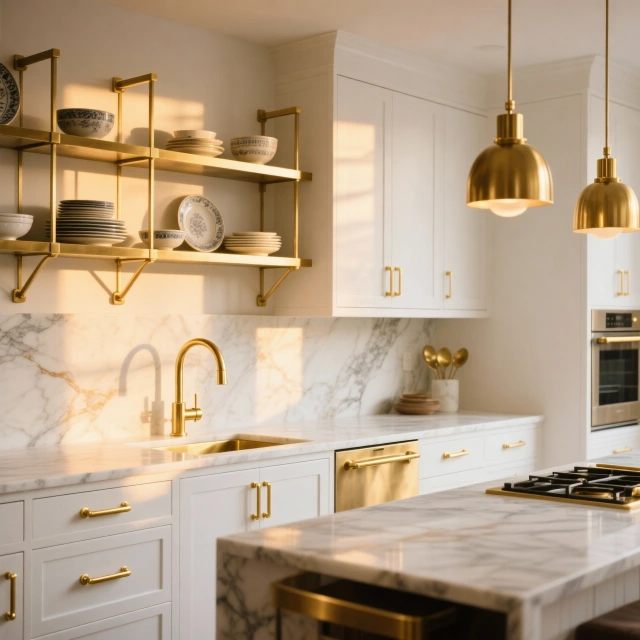
1. Handleless Cabinetry with Integrated Appliances
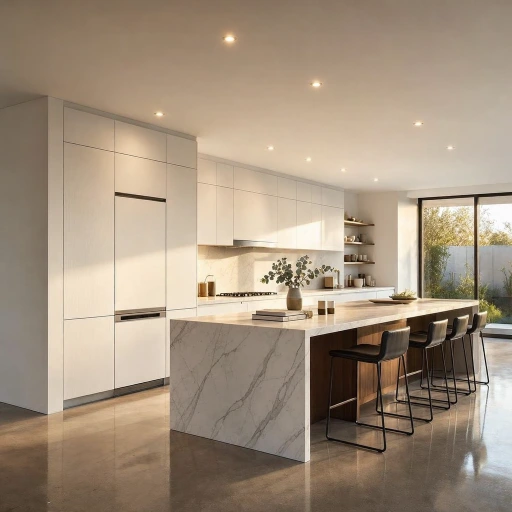
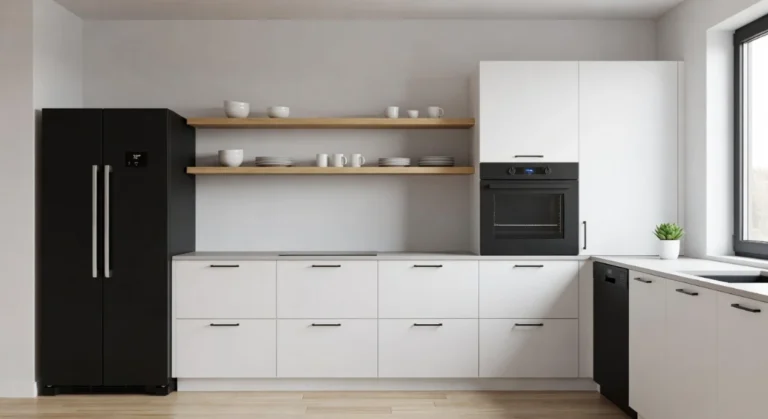
Handleless cabinetry with fully integrated appliances — the refrigerator, dishwasher, and oven concealed behind panels that match the surrounding cabinet doors precisely in material, color, and surface texture, their presence revealed only by the subtle outlines of their door edges — is the contemporary kitchen design idea that most completely and most architecturally realizes the minimalist kitchen aesthetic’s defining ambition: the elimination of every visible element whose presence is not architecturally necessary and the reduction of the kitchen’s complete visual program to a continuous, uninterrupted surface of cabinet fronts that reads as a single, unified architectural plane rather than a collection of individual appliances and cabinets assembled within a kitchen space. The handleless format — achieved through push-to-open mechanisms, recessed J-pull channels cut into the cabinet front’s upper or lower edge, or integrated grip channels routed into the door’s face — removes the visual interruption of protruding handles from the cabinet front plane, maintaining the surface’s unbroken quality across every door and drawer regardless of the individual element’s function or dimension.
Specify the integrated appliance panels with the same level of precision and the same material quality as the cabinet doors they are designed to match — ensuring that the grain direction, color batch, and surface finish of the appliance panel and the surrounding cabinet doors are identical in every visually detectable respect. The single most common failure in integrated appliance installation is the slight color or texture variation between the appliance panel and the surrounding cabinet doors that results from sourcing the appliance panel and the cabinet doors from different production batches or different suppliers — a variation that is imperceptible on specification sheets and material samples but becomes conspicuous and aesthetically undermining on the installed kitchen’s complete facade. Commission all cabinet doors and appliance panels from the same manufacturer in the same production run wherever possible, and request sample panels for physical color and texture comparison before committing to the complete installation. Choose a push-to-open mechanism with the touch response sensitivity and the opening travel distance appropriate for the specific drawer and door weight of each cabinet element — undersized mechanism springs failing to open heavy drawers fully, and oversized springs sending lightweight doors swinging open beyond the controlled, deliberate opening gesture that the contemporary kitchen’s precise aesthetic requires.
2. Statement Island with Waterfall Countertop
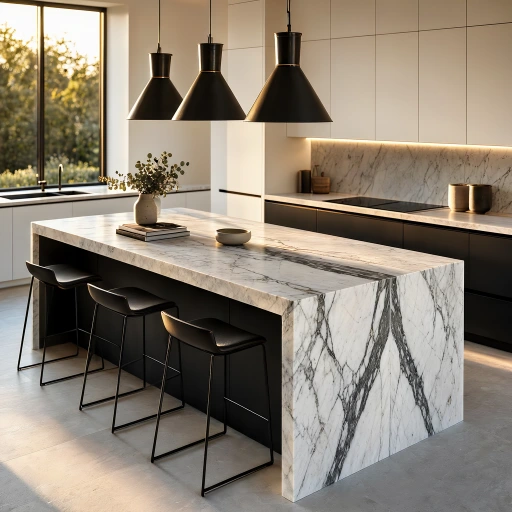
A statement kitchen island with a waterfall countertop — the island’s surface material, whether marble, quartz, or porcelain, continuing uninterrupted over the edge and down the full height of both island ends to the floor in a single, continuous vertical panel that appears to flow like a frozen waterfall from the horizontal work surface to the floor plane — is the contemporary kitchen design idea that most dramatically and most sculpturally transforms the functional kitchen island from a work surface supported on a cabinet base into a genuinely architectural object whose material presence and formal completeness give it the visual authority of a designed piece rather than a piece of furniture placed within a designed room. The waterfall countertop’s specific visual power derives from the continuity of the material plane from horizontal to vertical — the single stone or composite slab’s uninterrupted flow around the island’s corner creating a material gesture of formal completeness that the conventional countertop with exposed cabinet sides below it cannot approach regardless of the quality of the countertop material itself.
Specify the waterfall countertop in a material with sufficient visual complexity and natural variation to justify the extensive visible surface that the waterfall format creates — a plain, solid-color material in a waterfall format simply has more of the same visual information, while a veined marble or dramatically patterned quartz creates a different and genuinely spectacular visual event on each face of the waterfall, whose horizontal and two vertical surfaces present the stone’s pattern from three different orientations simultaneously. Book-matched marble — two consecutive slabs from the same stone block, cut and opened like a book so that their pattern is mirrored across the joint — creates the most visually spectacular and most deliberately designed waterfall countertop effect, its symmetrical pattern at the joint between the two slabs communicating the intentionality and the material investment of the specification with immediate visual impact. Specify the book-matched slabs at a joint position that places the mirror line precisely at the island’s visible corner — the point where the horizontal surface transitions to the vertical waterfall panel — for the most technically precise and most visually satisfying execution of the book-matched waterfall concept.
3. Two-Tone Cabinet Color Scheme
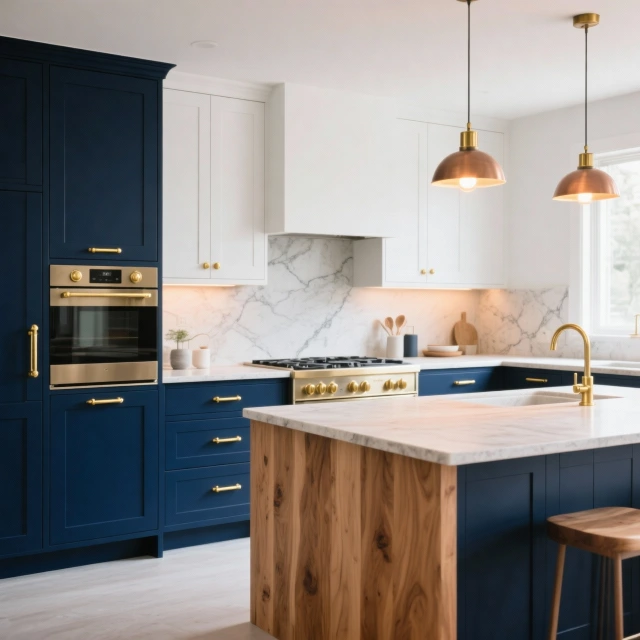
A two-tone cabinet color scheme — deep navy blue lower cabinets combined with crisp white upper cabinets, separated by the countertop’s horizontal plane that acts as the color change line between the two palette decisions — is the contemporary kitchen design idea that most elegantly and most color-intelligently resolves the visual monotony of a single-color kitchen without introducing the visual complexity and potential aesthetic incoherence of multiple unrelated colors that can make a kitchen feel busy and unresolved rather than deliberately, confidently designed. The two-tone approach’s specific design intelligence lies in its use of the kitchen’s existing horizontal division — the countertop level that already separates upper and lower cabinet zones by function and visual hierarchy — as the natural and logically motivated line along which the color transition occurs, making the color change feel architecturally justified rather than arbitrarily imposed on the kitchen’s composition.
The navy and white combination is the most sophisticated and most universally appealing two-tone kitchen palette currently dominating contemporary interior design for reasons that are both visually logical and culturally resonant — the deep, authoritative navy of the lower cabinets creating the visual grounding that prevents the kitchen from feeling top-heavy or spatially unstable, the clean white upper cabinets maintaining the visual lightness and reflective brightness that the kitchen’s upper zone requires for practical light quality and spatial openness, and the combination of the two as a complete color palette referencing the historical association of navy and white with craftsmanship, quality, and the specific aesthetic tradition of the classic American and European painted kitchen. Add a natural oak wood island as the third tonal element that mediates between the navy and white through its warm, organic character — its wood grain and amber tones creating the material warmth that the painted cabinet surfaces lack and that prevents the two-tone painted kitchen from feeling cold or industrial despite its precise color contrasts. Specify brass hardware throughout — on both the navy lower cabinets and the white upper cabinets — for the metallic accent that connects the two cabinet zones into a single, unified hardware vocabulary.
4. Floor-to-Ceiling Window Wall Overlooking Garden
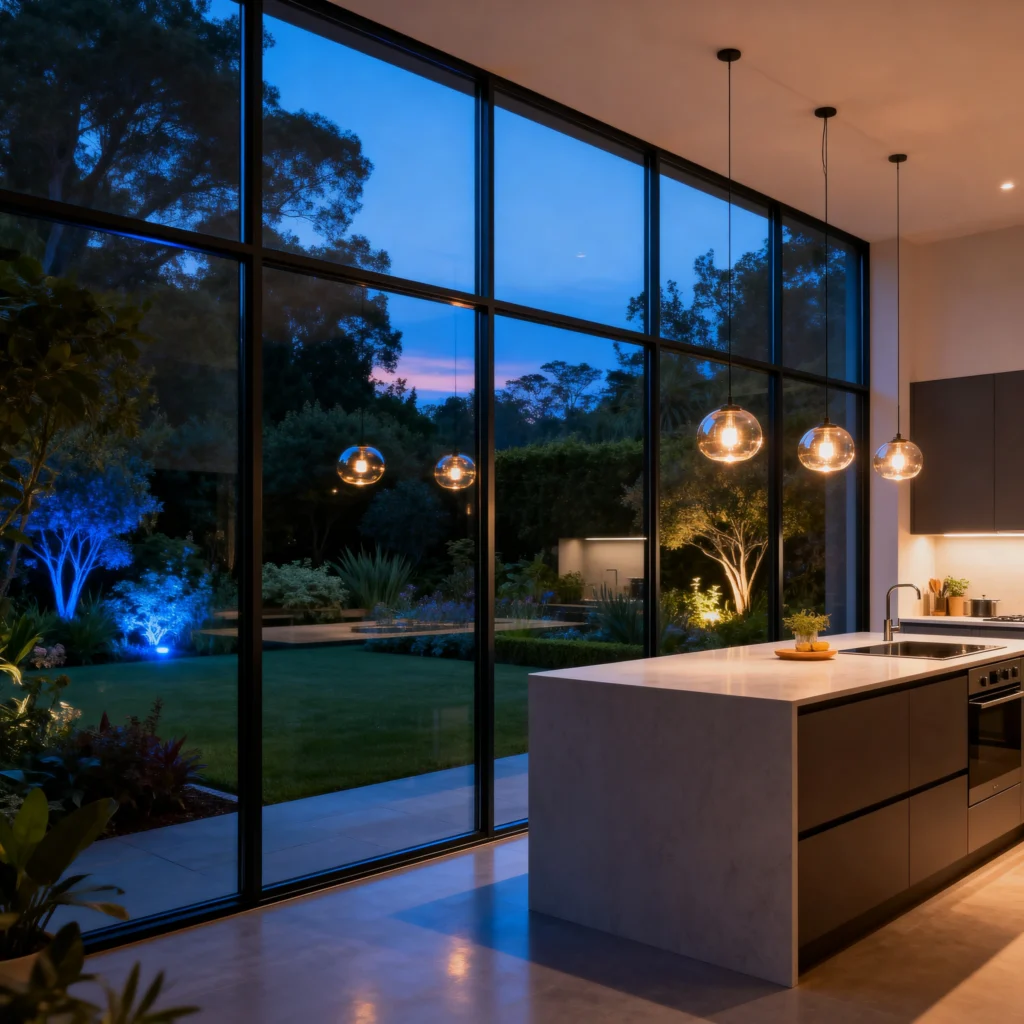
A floor-to-ceiling glazed wall — steel-framed glass panels extending from the kitchen’s floor plane to its ceiling height across the garden-facing facade, the garden visible in its entirety from every position in the kitchen, the boundary between interior cooking space and exterior garden landscape dissolved to the greatest extent that architecture and weather protection physically allow — is the contemporary kitchen design idea that most fundamentally and most permanently transforms the kitchen’s spatial and experiential character by replacing the wall that most kitchens present to their garden with the most generous possible visual connection to the natural landscape that the kitchen directly overlooks. The floor-to-ceiling garden window wall turns the kitchen from an interior room that happens to be near a garden into a room that participates directly and continuously in the garden’s changing light, seasonal progression, and botanical life — creating a cooking environment whose specific quality of spatial generosity, natural light abundance, and visual connection to the living landscape outside makes every moment spent in it more pleasant, more restorative, and more genuinely pleasurable than any conventionally windowed kitchen can provide.
Specify the glazing in a structural glass system with the minimum visible frame profile achievable within the system’s technical and structural requirements — the thinnest available steel or aluminum section for the frame members, and the largest available single glass panel size to minimize the number of frame members interrupting the view. Specify the glass as a triple-glazed unit with a thermally broken frame for the energy performance required in a floor-to-ceiling glazed wall application — the thermal mass of such a large glazed area requiring exceptional glass U-value performance to prevent the excessive heat loss in winter and heat gain in summer that inadequately specified glazing would impose on the kitchen’s comfort and energy consumption. Orient the island or the primary work surface to face the glazed wall directly — placing the cook’s primary working position with a direct view through the glass to the garden beyond rather than facing a solid wall, a cabinet bank, or the room’s interior, for the specific quality of visual connection during food preparation that makes the cooking experience genuinely enriching rather than merely functional.
5. Fluted Glass Cabinet Fronts
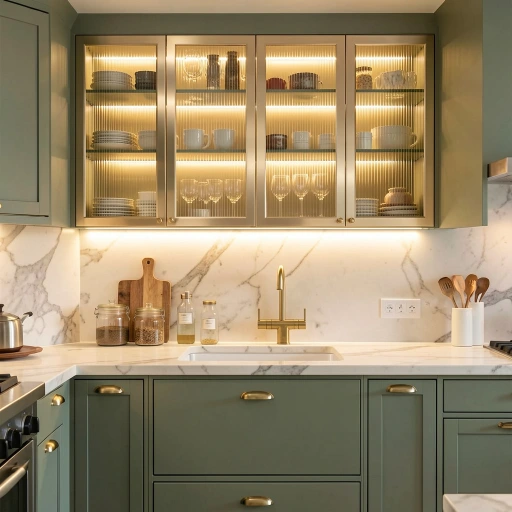
Fluted ribbed glass cabinet fronts — their vertical ribbing creating a textured, semi-transparent surface that softly and selectively reveals the cabinet’s contents while preventing the clear, detailed view that plain glass provides — are the contemporary kitchen design detail that most beautifully and most currently balances the desire for visual interest and material richness in cabinet fronts with the practical requirement for the contents’ partial concealment that prevents the open-plan kitchen from looking cluttered or disorganized regardless of the actual state of its cabinet interiors. The fluted glass’s specific visual quality — simultaneously transparent and obscuring, simultaneously revealing and concealing — creates the most sophisticated version of the glass-front cabinet concept because it uses the glass’s surface texture rather than its color or opacity to modulate visibility in a way that is visually active and materially interesting rather than simply limiting the clear glass’s full transparency with a frosted or tinted coating.
Install warm LED lighting within the cabinets behind the fluted glass fronts — the backlighting creating the specific glowing effect of illuminated glass that makes fluted front cabinets look genuinely luminous and dramatically beautiful in the kitchen’s evening atmosphere, when the backlit ribbed glass panels glow with the warm amber of the LED source filtered through the glass’s vertical ribbing and the silhouetted outlines of the cabinet’s contents become the most decorative and most evocative elements of the kitchen’s evening character. The cabinet lighting transforms the fluted glass fronts from purely daytime decorative elements into the kitchen’s most atmospheric and most beautiful nighttime feature — the backlit panels reading as a series of warm, glowing architectural panels that contribute to the kitchen’s overall ambient light while creating their own specific aesthetic drama. Specify the fluted glass in a genuine ribbed glass product rather than a textured film applied to plain glass — the genuine ribbed glass’s three-dimensional surface texture creating the specific depth and shadow quality of the ribbing that a surface film cannot replicate, and its consistent, manufactured regularity ensuring that the ribbing pattern is absolutely uniform across all cabinet fronts regardless of the individual panel’s position within the kitchen composition.
6. Integrated Herb Garden and Indoor Planting
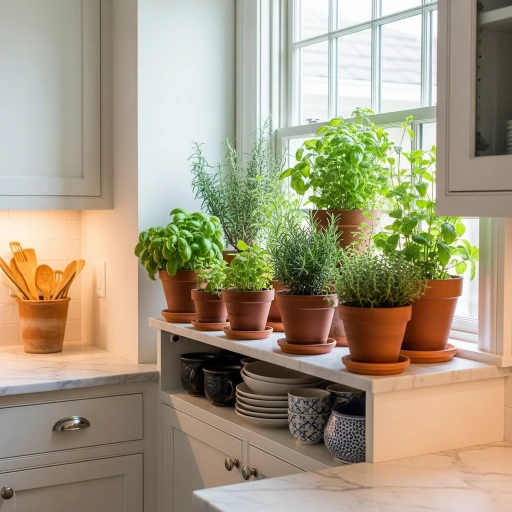
An integrated herb garden built into the kitchen’s design — a dedicated shelf unit or window sill extension specifically designed and detailed for the cultivation of fresh culinary herbs within the kitchen itself, housing terracotta pots of basil, rosemary, thyme, mint, and flat-leaf parsley in a botanical arrangement that brings living plant material, fresh fragrance, and genuine culinary utility directly into the cooking environment — is the contemporary kitchen design idea that most naturally and most genuinely integrates the biophilic design aspiration of living botanical material with the kitchen’s specific functional identity as the space where the quality and freshness of ingredients most directly determines the quality of the food that the space is designed to produce. An integrated herb garden communicates something essential and genuine about the kitchen’s design values — the recognition that genuine cooking begins with genuinely fresh ingredients, and that the most luxurious possible kitchen upgrade is the one that places those ingredients within arm’s reach of the cooking surface rather than requiring a trip to the grocery store for every small culinary addition.
Design the herb garden installation with genuine horticultural attentiveness rather than purely decorative intention — positioning the herb shelf at the kitchen’s brightest natural light source, typically a south or west-facing window that provides the minimum four to six hours of direct sunlight that most culinary herbs require for sustained, vigorous, genuinely productive growth rather than the slow decline of under-lit plants whose greenness gradually diminishes to the grey-green of photosynthetically deprived foliage. Specify the shelf depth and material with the watering and drainage requirements of container-planted herbs as the primary design parameter — a minimum shelf depth of 200 millimeters to accommodate standard herb pot sizes, a surface material impervious to water damage such as sealed stone, glazed ceramic tile, or marine-grade painted timber, and a drainage channel at the shelf’s back edge that directs excess watering water toward a concealed drainage outlet rather than allowing it to accumulate on the shelf surface or drip onto the cabinet below. Group herbs by their water and light requirements rather than by their alphabetical order or their visual arrangement — placing the drought-tolerant Mediterranean herbs including rosemary, thyme, and oregano together in the shelf’s sunniest position and the more moisture-requiring herbs including basil and mint in the shadier, more humid microclimate of the shelf’s less sun-exposed end.
7. Dramatic Range Hood as Sculptural Centerpiece
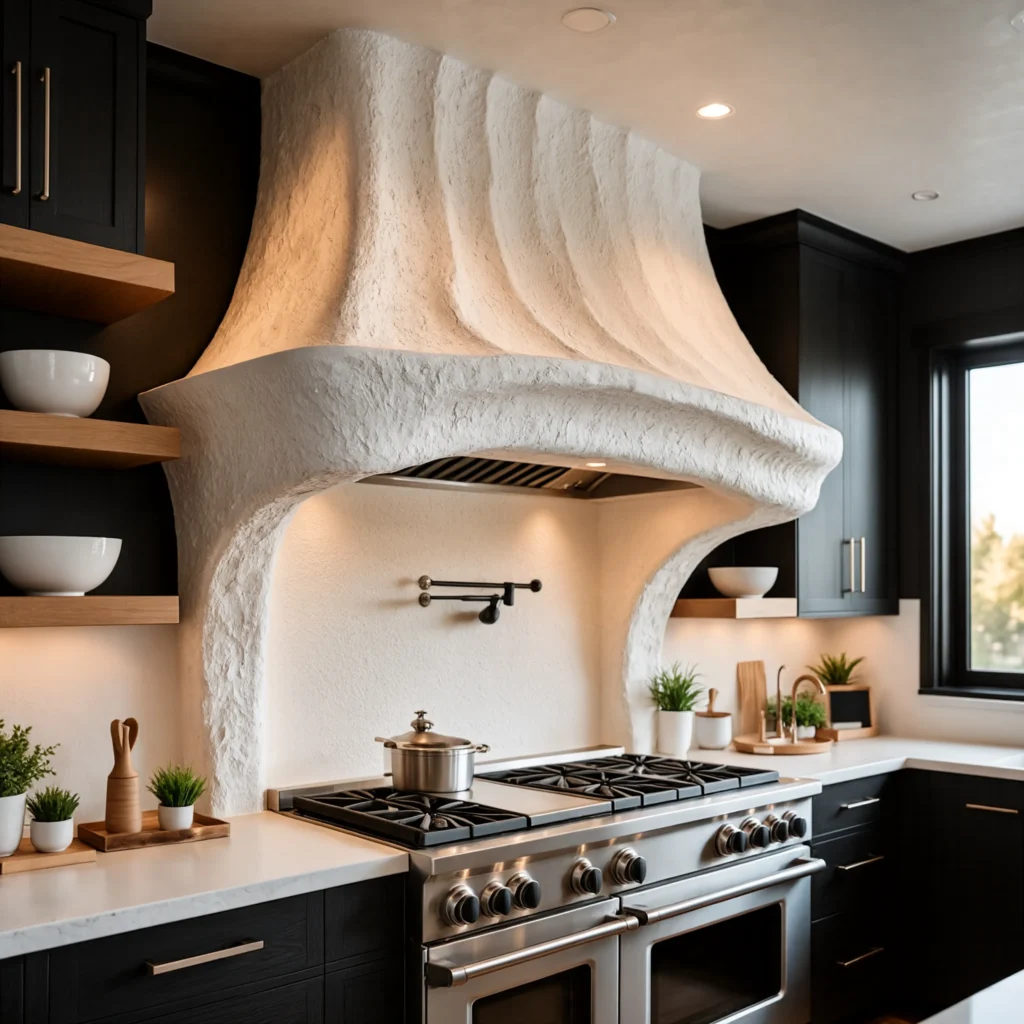
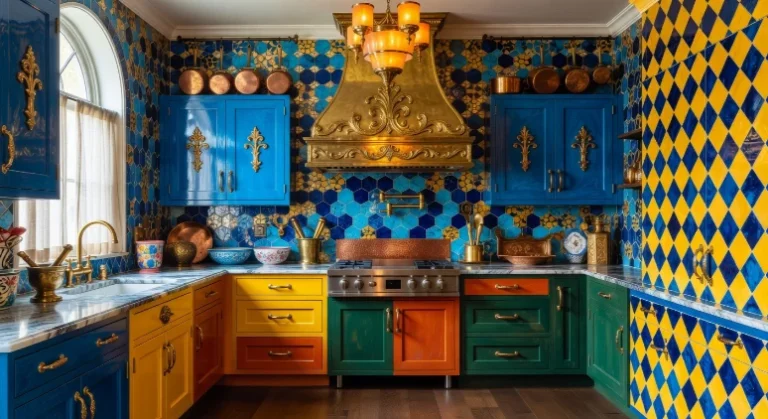
A dramatic custom range hood — formed from hand-applied plaster, carved stone, hammered copper, or blackened steel in a sculptural form whose proportions and surface character are explicitly designed as the kitchen’s primary architectural focal point rather than a functional extraction device that happens to be visible above the cooking range — is the contemporary kitchen design idea that most boldly and most effectively transforms the kitchen’s often-overlooked vertical feature wall into a genuine statement of design ambition, material quality, and aesthetic confidence. The range hood’s position above the cooking range — centered on the kitchen’s primary work wall, elevated above eye level, and visible from virtually every position in the room — makes it the kitchen’s most naturally dominant vertical element and therefore the single component whose design character most powerfully and most immediately communicates the kitchen’s complete aesthetic identity to anyone entering the space. A genuinely beautiful, genuinely designed range hood transforms the kitchen’s visual center from a functional appliance into an architectural sculpture.
Design the hood’s form with the relationship between the cooking range below and the ceiling above as the primary proportional constraint — the hood’s width matching or slightly exceeding the range’s width for visual stability and functional extraction coverage, the hood’s height between its lower exhaust face and its upper ceiling connection point being sufficient to create the bold, sculptural presence that makes the hood a genuine architectural element rather than simply a large functional box. A plaster hood in a custom curved or organic form is the most currently fashionable and most visually distinctive range hood treatment in contemporary kitchen design — its smooth, hand-applied surface with the subtle undulations of skilled plastering work creating a warm, material richness that contrasts beautifully with the precise, machined quality of the surrounding cabinetry and countertop surfaces. Integrate recessed lighting into the hood’s lower face — positioned to illuminate the cooking surface below with the precise, task-appropriate light quality that professional cooking requires — while illuminating the hood’s own sculpted surface from below with the warm, dramatic raking light that reveals the plaster’s surface character and the hood’s three-dimensional form with the maximum visual impact.
8. Open Shelving with Curated Display
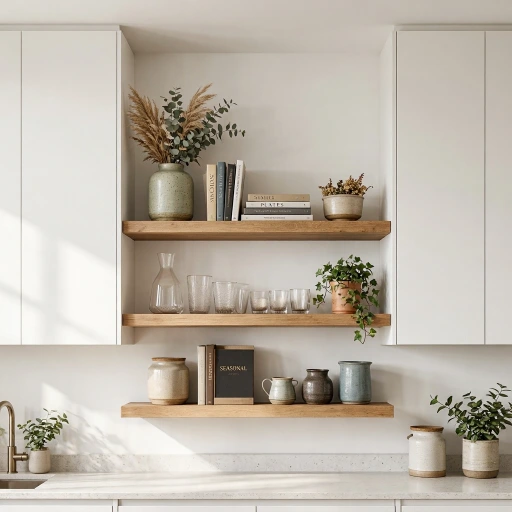
Open shelving on a dedicated section of the kitchen’s wall — floating timber shelves between sections of enclosed cabinetry, their contents a curated composition of ceramic vessels in two or three complementary colors, a small collection of cookbooks with beautiful spines, a trailing plant, and a selection of glassware — is the contemporary kitchen design idea that most personally and most expressively invites the kitchen’s functional surfaces to participate in the home’s broader decorative program rather than maintaining the strict functional segregation of kitchen storage from the household’s objects of aesthetic interest and personal meaning. Open shelving in the contemporary kitchen is not the haphazard accumulation of everyday storage items whose exposure is simply the result of omitting the cabinet door — it is a curated, deliberately assembled display of objects whose visual presence in the kitchen contributes to the room’s aesthetic identity with the same intentionality that a gallery curator applies to the selection and arrangement of artworks for public display.
Edit the open shelf contents with genuine visual discipline — removing every object that does not contribute positively to the display’s color, form, or material character, and retaining only those objects that are individually beautiful, that relate coherently to their shelf companions, and that represent a standard of visual quality consistent with the kitchen’s complete aesthetic program. The specific visual discipline required for attractive open shelving is the most significant practical challenge of this design approach — the display’s beauty being entirely dependent on the continuous editing and curation of its contents rather than the one-time installation decision that closed cabinetry requires, and the temptation to place additional objects on available shelf space being the most persistent and most damaging enemy of the curated display’s carefully managed visual composition. Adopt a consistent color palette for the shelf’s contents — limiting the ceramic vessels to three or four related earth tones, the glassware to clear or one specific color, and the plant foliage to green without additional flower colors that would introduce unwanted palette complexity — and maintain this palette discipline consistently against the daily pressures of practical kitchen use that inevitably attempt to introduce mismatched objects onto the carefully managed display surface.
9. Concrete Countertops with Raw Edge Detail
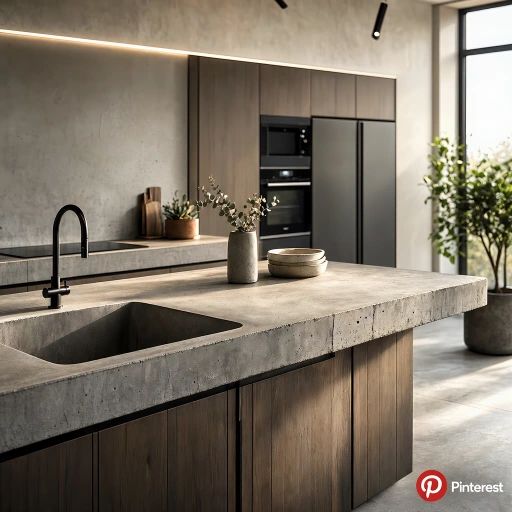
Custom-poured concrete countertops — their grey surface carrying the subtle color variations, the occasional aggregate piece proud of the surface, and the specific matte quality of a genuinely handmade concrete pour rather than the uniform, standardized appearance of a factory-cast precast concrete product — with a raw formwork-textured edge detail that reveals the actual cast concrete’s character at the countertop’s perimeter rather than the smoothed, polished edge that most countertop materials and even most concrete countertop fabricators default to, is the contemporary kitchen design idea that most directly and most honestly introduces the specific material character of concrete — its weight, its permanence, its handmade variation, and its complete indifference to the perfectionism of manufactured materials — into the kitchen’s most used and most visible surface. Concrete countertops are the contemporary kitchen’s most authentically craft-forward material choice — each pour creating a surface that is genuinely unique, genuinely the product of a specific fabrication process in a specific workshop on a specific day, carrying within its surface the evidence of that specific making in a way that no manufactured stone, quartz, or ceramic surface can replicate.
Commission the concrete countertops from a specialist concrete fabricator with demonstrated experience in countertop casting and finishing — the specific technical knowledge required for void-free casting, consistent aggregate distribution, effective surface sealing, and reliable stain resistance being genuinely specialized skills whose absence in the fabricator produces results that expose concrete’s most problematic surface characteristics without delivering its most beautiful ones. Discuss the specific water-to-cement ratio, the aggregate type and size, and the pigment additions with the fabricator before committing to a sample pour — each of these variables significantly affecting the finished countertop’s color, texture, and surface character in ways that are best understood through physical samples rather than photographs or specification sheets. Specify the raw formwork-textured edge detail by asking the fabricator to leave the outer face of the edge form board in contact with the concrete during the pour and to avoid any post-demold grinding or polishing of the edge face — the formwork texture impression in the concrete’s edge creating the specific evidence of the casting process that makes the raw edge detail so visually distinctive and so materially honest in its communication of the countertop’s genuine material identity.
10. Brass and Gold Hardware Throughout
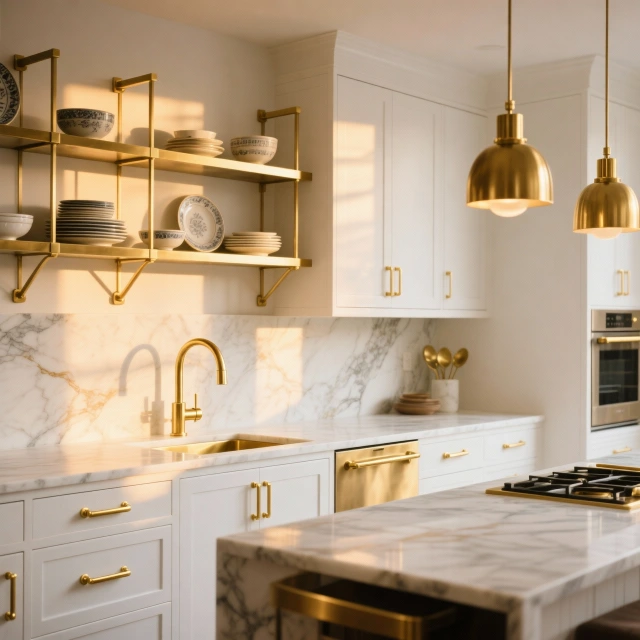
Consistent brass and gold hardware throughout the kitchen — every cabinet handle, drawer pull, faucet, pot filler, pendant light fixture, shelf bracket, and visible screw head specified in the same warm, brushed brass finish — is the contemporary kitchen design idea that most efficiently and most powerfully uses the metallic accent as a unifying design element that creates visual cohesion, warmth, and a sense of considered luxury across every individual component of the kitchen’s complete hardware vocabulary simultaneously. The power of consistent hardware specification derives from the accumulative visual effect of seeing the same metallic finish repeated across dozens of individual components throughout the kitchen — each individual handle or faucet being a relatively minor design contribution, but the collective effect of all hardware in the same warm brass creating a kitchen whose metallic story is as complete, as deliberate, and as visually rich as any single statement piece could achieve with dramatically less investment in individual component cost or design complexity.
Specify all brass hardware in the same surface treatment — brushed rather than polished for the most contemporary and most forgiving finish that develops a beautiful, natural aging character with daily use rather than the fingerprint-magnifying reflectivity of a mirror-polished surface. Genuine unlacquered brass — specified without the protective lacquer coating that prevents the natural patination of the underlying metal — will develop a living patina over the years of daily kitchen use that makes each handle and faucet progressively more beautiful, more individual, and more characterful than the uniform factory finish of their installation day, creating a kitchen whose hardware story becomes more interesting and more authentically warm with age rather than simply wearing and deteriorating toward replacement. Source all hardware from a single supplier who can confirm that all components are produced from the same brass alloy and the same surface treatment process — the subtle color variations between brass hardware from different manufacturers being immediately visible when the pieces are installed in proximity, and the visual inconsistency of slightly different brass tones across a kitchen’s complete hardware program undermining the cohesive metallic story that the consistent hardware specification is intended to create.
11. Curved Cabinet Corners and Rounded Island
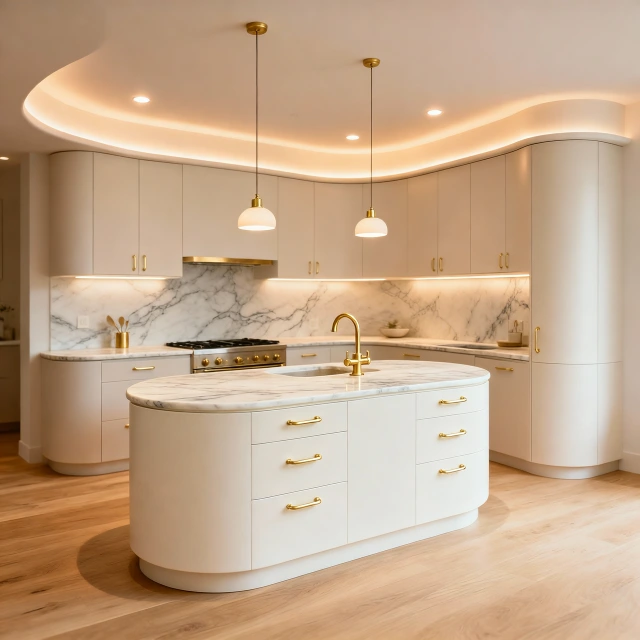
Curved cabinet corners and a rounded-end kitchen island — the perimeter cabinetry’s corner units replaced with curved radius units that eliminate the sharp ninety-degree corner in favor of a smooth, continuous curved transition, and the island’s rectangular ends replaced with a gently curved or semi-circular profile that softens the island’s formal geometry — is the contemporary kitchen design idea that most gently and most effectively introduces the softening, humanizing influence of curved form into the kitchen’s typically rectilinear spatial and cabinet composition, creating a kitchen that feels more organically welcoming, more spatially generous, and more genuinely comfortable to inhabit than the sharp-cornered kitchen whose precise right angles communicate a different and less inviting spatial quality. The curved kitchen is the contemporary design response to the recognition that the human body and human movement are fundamentally curved rather than rectilinear — that rounded corners are safer for everyday physical contact, more generous to the spatial flow of movement around the kitchen, and more visually responsive to the organic forms of the human figure that inhabits and uses the space.
Source curved corner cabinet units from a specialist kitchen manufacturer who can produce the continuous radius that matches the curve’s starting and ending tangent points precisely with the adjacent straight cabinet runs — the specific quality of a well-made curved kitchen cabinet being the invisible, continuous material flow between the curved unit and the straight cabinet without the seam gap, material offset, or surface inconsistency that a poorly made curve creates at its junction with the adjacent straight run. The island’s rounded ends require particular attention to the countertop fabrication — stone or composite countertops around curved plan forms requiring specialist template making and cutting capabilities that not all stone fabricators possess, and the quality of the curved countertop edge around the island’s rounded end being the single most visible quality indicator of the entire curved kitchen installation’s fabrication standard. Ensure that the island’s curved end profile is consistent throughout the countertop’s full thickness — the curve being as visible on the countertop’s edge face as on its plan view, and any inconsistency between the countertop edge curve and the cabinet below becoming immediately and permanently visible in the finished installation.
12. Integrated Seating at the Island
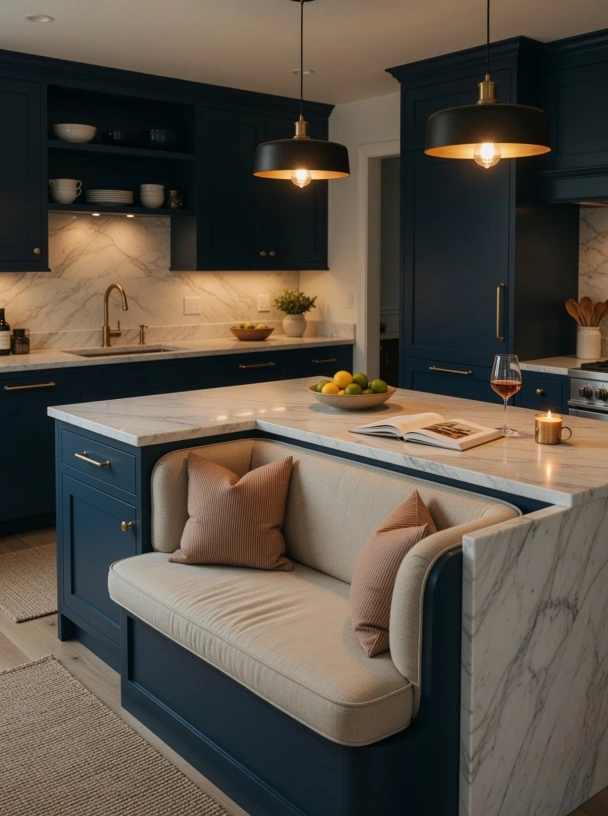
An integrated upholstered bench seat built into one end of the kitchen island — its cushioned seat and low back constructed as a permanent, designed element of the island’s cabinetry rather than a removable stool positioned beside the island’s end — is the contemporary kitchen design idea that most warmly and most hospitably transforms the functional kitchen island from a pure work surface into a genuine social hub where the kitchen’s cooking activity and the household’s social life occur simultaneously in the same architectural element, the bench seat inviting the cook’s companions to settle comfortably into the kitchen’s activity rather than perching awkwardly on bar stools positioned at the island’s counter-height opposite side. The integrated bench seat acknowledges the contemporary kitchen’s social function — the reality that the kitchen is the house’s most consistently occupied and most genuinely social room — by building social seating into the island’s primary architectural element rather than treating social accommodation as an afterthought addressed by separately purchased furniture.
Design the integrated bench seat with the specific ergonomic dimensions that distinguish genuinely comfortable kitchen island seating from seating that appears comfortable but fails in practice — a seat height of approximately 450 millimeters for the standard dining table height seating position or 650 millimeters for the counter-height island seating that most contemporary kitchen islands specify, a seat depth of minimum 450 millimeters for comfortable thigh support across the full range of adult body sizes, and a back height and angle providing genuine lumbar support for the extended social seating occasions that the kitchen’s role as the household’s primary social gathering space inevitably produces. Upholster the bench seat in a kitchen-appropriate fabric — a performance-grade, stain-resistant woven fabric in a warm neutral tone whose fiber content and surface treatment allow it to be cleaned efficiently of the food spills, cooking splashes, and general kitchen-related soiling that a kitchen bench seat inevitably accumulates — rather than the fine upholstery fabrics appropriate for formal furniture in non-kitchen rooms whose fiber content and surface structure make them genuinely impractical in the kitchen’s demanding environment.
13. Dark Dramatic Kitchen with Moody Palette
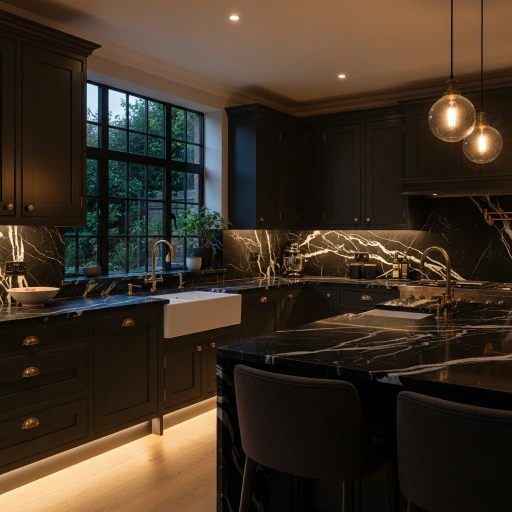
A deep charcoal or near-black kitchen — cabinetry in a saturated, dark, slightly warm-toned paint that reads as charcoal in direct light and as true black in the kitchen’s darker zones, paired with black marble countertops whose dramatic white veining creates the most visually spectacular contrast available in any natural stone surface, and completed with warm brass hardware that glows against the dark cabinetry like candlelight — is the contemporary kitchen design idea that most dramatically and most confidently departs from the kitchen design consensus of white, light, and bright to create a space whose character is genuinely unique, genuinely atmospheric, and genuinely beautiful in a completely different and completely more surprising way than any light-toned kitchen can achieve. The dark kitchen is the contemporary design choice that most clearly communicates aesthetic conviction and design confidence — the choice that is most difficult to make conventionally because it contradicts the deepest-held conventional wisdom about kitchens, and that is most rewarding when made correctly because its specific atmospheric richness and visual drama create a cooking environment of genuine sensory distinction.
Balance the dark cabinetry’s visual weight and the kitchen’s practical light requirements through the strategic placement and specification of artificial lighting that compensates for the dark surfaces’ significantly reduced light reflectivity compared to white or light-toned cabinetry. Under-cabinet lighting is particularly critical in a dark kitchen — the task lighting it provides on the countertop work surface being the most practically important light source in the kitchen’s complete lighting program, and the warm glow it creates at the interface between the dark cabinet base and the marble countertop creating the most atmospherically beautiful lighting detail in the kitchen’s evening character. Specify warm white LED under-cabinet lighting in a continuous strip rather than individual spot lights — the continuous strip providing uniform task illumination across the countertop’s full width without the shadow pools between individual spot positions that disrupt visual assessment of the cooking surface. Add recessed ceiling spotlights in a warm color temperature — 2700 to 3000 Kelvin for the warm, amber-toned light that flatters the dark cabinetry and the brass hardware most sympathetically — positioned specifically above the work surfaces and the island rather than distributed uniformly across the ceiling in the kitchen lighting convention that serves light-toned kitchens well but under-lights the darker zones that accumulate around a dark kitchen’s cabinet faces.
14. Terrazzo Flooring and Backsplash
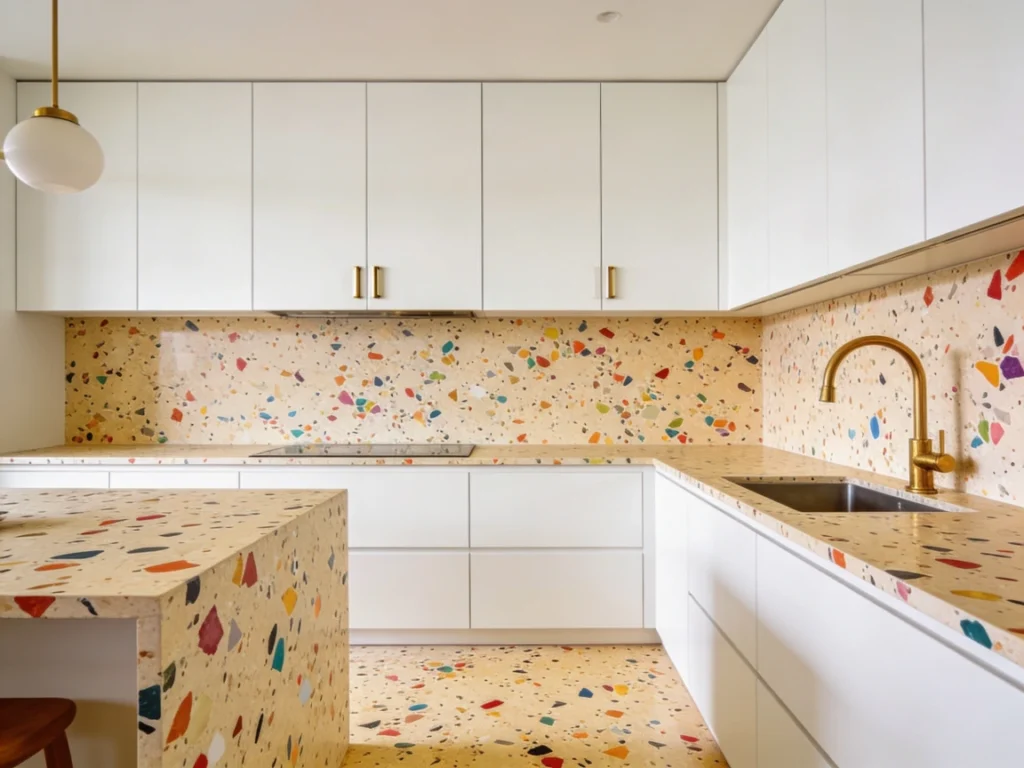
Terrazzo — its surface of marble, granite, and glass chips set in a cement or resin matrix, ground and polished to a smooth, reflective finish that reveals the chips’ color and pattern as a continuous, varied surface of endless small-scale visual interest — used as the kitchen’s flooring material and continued up the backsplash as a single, unified surface treatment is the contemporary kitchen design idea that most richly and most genuinely introduces the specific material beauty and the historical craft depth of one of the world’s oldest architectural surface materials into the most used and most visible surfaces of the contemporary domestic kitchen. Terrazzo’s specific aesthetic quality — its surface of individual colored chips embedded in a contrasting matrix, whose collective visual effect creates a surface of controlled complexity that rewards close examination while reading as a unified, coherent material at normal viewing distances — makes it the most visually active and most perpetually interesting of all kitchen surface materials, providing the kitchen with a floor and backsplash whose beauty is genuinely inexhaustible.
Specify a terrazzo chip composition whose color palette connects to the kitchen’s broader material story — for a white and brass kitchen, a terrazzo with cream matrix and chips of soft rose, warm grey, and gold creates the most harmonious material relationship, while for a sage green kitchen, chips of green marble, white marble, and black granite in a light grey matrix create the most botanically resonant and most visually sophisticated chip composition. The matrix color is the single most important specification decision in terrazzo design — the matrix occupies the majority of the terrazzo’s visible surface area and its color establishes the background tone against which the individual chips’ colors are read. A warm, slightly off-white cream matrix is the most universally applicable matrix color for residential terrazzo in kitchen applications — its warmth preventing the clinical coldness of a pure white matrix while its near-neutrality allowing the chip colors to be read clearly without the matrix color competing with them for visual dominance. Specify the same terrazzo composition for both the floor and the backsplash — the continuity of material across the horizontal floor plane and the vertical backsplash surface creating the most architecturally resolved and most visually cohesive kitchen surface treatment available through the use of a single, unified material in two different planes.
15. Scalloped Tile Backsplash
A scalloped ceramic tile backsplash — its overlapping fan-shaped tiles creating a continuous surface of rhythmic, dimensional texture whose curved edges cast small, regular shadows that give the backsplash a three-dimensional visual richness that flat tiles in the same color and glaze cannot approach — in a warm sage green that simultaneously references the botanical world and the great tradition of colored ceramic tile in domestic architecture, is the contemporary kitchen design idea that most playfully and most visually richly introduces the specific design language of shaped tile — the awareness that the tile’s form, profile, and edge character can contribute as much to the backsplash’s visual character as its color and glaze — into the kitchen’s most consistently observed and most detail-demanding surface. The scalloped tile is the contemporary backsplash material that generates the most genuine visual delight and the most extended visual interest of any single-material tile choice — its repeated fan form creating a surface pattern whose individual units are each simple and legible, whose combined effect is complex and richly textured, and whose shadow quality changes with the changing angle of the kitchen’s natural light throughout the day.
Source scalloped tiles from a specialist ceramic tile manufacturer whose production quality ensures consistent tile dimensions, consistent edge profiles, and consistent glaze application across the production batch — the visual quality of a scalloped tile installation being entirely dependent on the precision with which each tile’s scallop profile aligns with its neighbors’, and any dimensional inconsistency between tiles creating the misaligned edges and uneven shadow lines that make an otherwise beautiful scalloped installation look poorly made. Specify the tiles in a genuine ceramic body with a glossy or semi-glossy glaze — the glaze’s light reflection creating the most beautiful interaction between the tile’s curved surface and the kitchen’s ambient light, with the scallop’s convex upper surface catching the light and the concave lower edge casting a crisp shadow in the most visually dramatic and most consistently beautiful expression of the scalloped form. Install the tiles in the traditional overlapping arrangement where each tile’s lower scallop edge overlaps the tile below it — the overlapping installation creating the three-dimensional effect of scales or fish fins that gives the scalloped backsplash its specific visual depth and its most characterful shadow pattern.
16. Smart Kitchen Technology Integration
A kitchen whose smart technology integration is genuinely seamless — touch-controlled induction cooktops flush with the countertop surface with no raised edges or visible mechanical controls, under-cabinet LED lighting tunable from warm to cool and dimmable through voice control or a concealed wall panel, a large touchscreen display integrated into a cabinet panel face for recipe access and kitchen management rather than a tablet propped awkwardly against a backsplash tile, and smart appliances that communicate with each other and with the household’s broader home automation system through a unified interface — is the contemporary kitchen design idea that most completely and most authentically realizes the genuine potential of contemporary technology to improve the kitchen’s functional performance without imposing the visual complexity, the cable management challenges, and the aesthetic incompatibility of consumer technology products designed for individual function rather than integrated kitchen application. Smart kitchen technology integration is only genuinely valuable when the technology’s presence is invisible in the kitchen’s aesthetic while its function is comprehensively available in the kitchen’s operation.
Specify all technology components from manufacturers whose design brief explicitly includes seamless integration with kitchen cabinetry and architectural surfaces — the most important distinction in smart kitchen technology specification being between consumer technology products that are designed to sit on countertops and are therefore inevitably visible as foreign objects within the kitchen’s architectural composition, and genuinely integrated technology products that are designed from the outset for flush installation within the cabinet panel, countertop surface, or wall surface and that disappear completely into the kitchen’s architectural fabric when installed. The flush induction cooktop is the kitchen technology integration that most clearly demonstrates the value of this distinction — a flush-mounted induction surface whose glass face is level with the surrounding countertop surface, whose controls are embedded in the glass surface without any raised mechanical interface, and whose edge detail creates a continuous countertop plane interrupted only by the cooktop glass’s material boundary, represents a fundamentally different aesthetic and functional achievement from the conventional built-in cooktop whose frame, raised edges, and separate control panel create visible physical discontinuity in the countertop surface regardless of the quality of the surrounding material.
17. Banquette Dining Nook Adjacent to Kitchen
A built-in banquette dining nook adjacent to the kitchen — an L-shaped or U-shaped upholstered bench built into the kitchen’s corner or into a dedicated alcove, its seat cushions in a warm, tactile boucle or performance linen fabric, with storage drawers integrated beneath the bench seat, a round marble-topped pedestal table at the bench’s center, and a warm pendant light hanging directly above the table — is the contemporary kitchen design idea that most warmly and most generously creates the specific quality of casual, gathered dining that the built-in banquette provides more successfully than any free-standing table and chair arrangement can approach: the intimate enclosure of the built-in bench, the visual continuity of its upholstered surfaces, and the practical storage of its under-seat drawers combining to create a dining space that is simultaneously more comfortable, more spatially efficient, and more genuinely inviting than the conventional kitchen dining table whose free-standing chairs and open floor surround create a less enclosed, less cozy, and less specifically welcoming dining environment. The banquette nook is the contemporary kitchen’s most human-scale design gesture — its intimate proportions, warm upholstery, and built-in enclosure creating a space within the larger kitchen volume whose specific quality of sheltered comfort invites lingering, conversation, and the long, unhurried breakfasts and casual family meals that constitute the kitchen’s most genuinely pleasurable and most personally significant daily events.
Design the banquette with the seat height, seat depth, and table height proportions that create genuinely comfortable extended seating for the full duration of a meal — a seat height of 450 millimeters above the floor, a seat depth of minimum 500 millimeters for comfortable back support when the diner leans against the built-in back cushion, and a table height of 730 to 750 millimeters above the floor for the standard dining table ergonomics that allow comfortable elbow positioning and plate access for seated diners. Upholster the seat and back cushions in a genuinely performance-grade fabric whose fiber content and surface treatment are specifically designed for high-use, food-proximity applications — Sunbrella fabric, Revolution performance fabrics, or Crypton-treated upholstery all providing the specific combination of stain resistance, moisture resistance, and durability that kitchen banquette seating requires for genuinely long-term practical service without the constant maintenance and replacement that non-performance upholstery in the kitchen’s demanding environment would inevitably necessitate within a frustratingly short period of enthusiastic daily use.