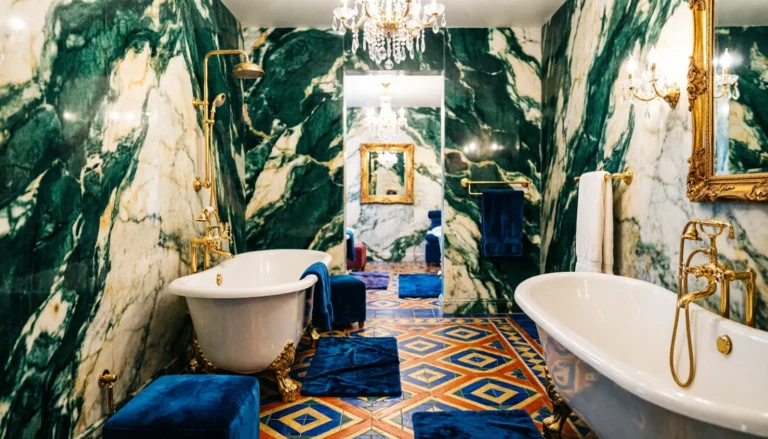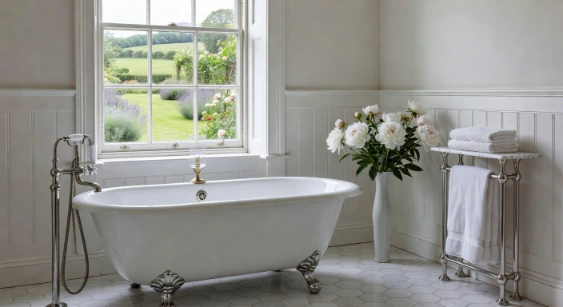
15 Victorian Downstairs Toilet Ideas Full of Character
1. Classic Black and White Encaustic Floor Tiles
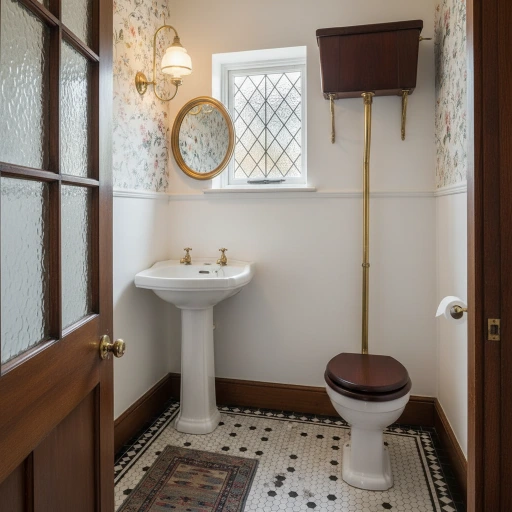
Classic black and white encaustic floor tiles represent the single most defining and most instantly recognizable element of authentic Victorian bathroom design, transforming the floor of even the smallest downstairs toilet into a surface of extraordinary geometric beauty and unimpeachable period accuracy that anchors the entire room’s Victorian character with an authority no other design element can quite replicate. The intricate geometric patterns of original Victorian encaustic tiles — diamonds, hexagons, Greek key borders, and elaborate compass rose motifs arranged in combinations of mathematical precision and decorative richness — were developed during the mid-nineteenth century as the industrial tile manufacturing revolution made beautifully patterned floor surfaces accessible to the rapidly expanding Victorian middle class, democratizing a luxury previously available only to ecclesiastical and aristocratic buildings. Their beauty has required no updating whatsoever in the century and a half since their original production.
Contemporary encaustic and cement tile manufacturers including Fired Earth, Topps Tiles, and specialist Victorian tile restoration companies produce faithful reproductions of original Victorian geometric patterns in the authentic color combinations — black and white, terracotta and cream, deep navy and buff — that provide new installations with genuine period accuracy and the visual depth of the original designs without requiring the considerable expense and logistical complexity of sourcing sufficient quantities of reclaimed original tiles for complete floor coverage. The key to maximizing the visual impact of Victorian encaustic floor tiles in a small downstairs toilet lies in maintaining clean, uncluttered wall surfaces that allow the intricate floor pattern to breathe and read with full geometric clarity rather than competing with busy wallpaper or excessive decorative additions that diminish the floor’s considerable independent beauty and historic decorative authority.
2. Dark Moody Victorian Wallpaper
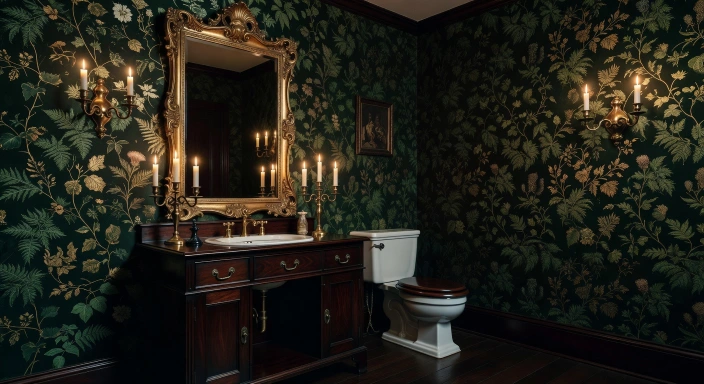
Dark, moody Victorian wallpaper in deep jewel tones — forest green with gilded botanical illustrations, midnight navy with metallic damask patterns, rich burgundy with exotic bird and palm motifs, or deep charcoal with elaborate Aesthetic Movement peacock feather designs — transforms the downstairs toilet from a purely functional domestic space into the most dramatically atmospheric and characterful room in the entire Victorian house, its small size working in perfect favor of the bold, enveloping wallpaper treatment that would feel overwhelming in a larger room but achieves precisely the right balance of rich intimacy and decorative grandeur within the compact proportions of a period cloakroom. The Victorians understood instinctively that small rooms deserve especially bold decoration precisely because their limited square footage concentrates the visual experience with an intensity that larger, more diffuse spaces cannot achieve.
The most historically authentic Victorian downstairs toilet wallpaper designs draw from the extraordinary range of decorative movements that characterized the nineteenth century’s restlessly creative design culture — William Morris’s nature-inspired flat pattern designs featuring stylized leaves, flowers, and birds in earthy organic colors, the Anglo-Japanese Aesthetic Movement’s exotic peacock, fan, and cherry blossom motifs in deep teal and gold, the Gothic Revival’s architectural pointed arch patterns and medieval heraldic imagery, and the Arts and Crafts movement’s handcrafted botanical honesty that rejected industrial mechanization in favor of natural forms rendered with artisanal directness. Contemporary reproduction wallpaper specialists including Morris and Co, Cole and Son, Farrow and Ball, and Anaglypta offer museum-quality reproduction designs that bring authentic Victorian decorative sophistication to the modern downstairs toilet with historically accurate pattern and colorway fidelity.
3. High Level Victorian Cistern and Pull Chain
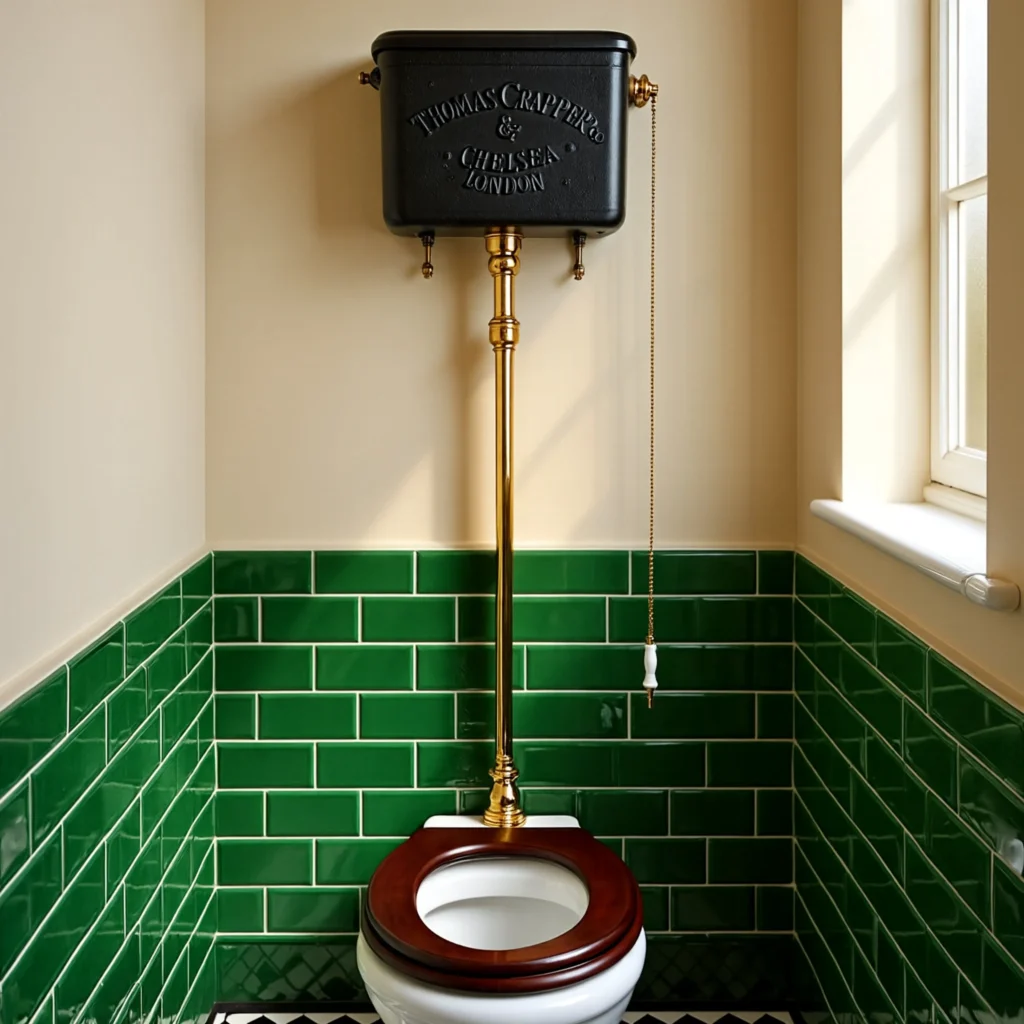
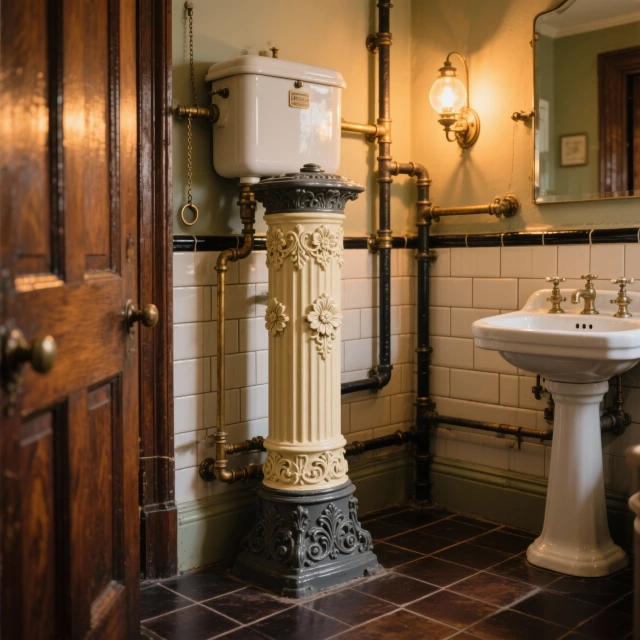
A high level Victorian cistern mounted near the ceiling with a polished brass pull chain and decorative ceramic handle represents the single most dramatically period-accurate and most characterful plumbing statement available to the Victorian downstairs toilet, restoring the original functional arrangement of the Victorian water closet in a way that communicates genuine historical knowledge and confident architectural commitment to authentic period detailing rather than the superficial application of decorative Victorian elements over fundamentally modern bathroom infrastructure. The high level cistern arrangement — developed during the mid-Victorian period as indoor plumbing technology evolved from novelty to domestic standard — was designed to use gravity’s assistance to generate adequate flushing force without mechanical pumping, its elevated position making the physics of the Victorian bathroom visible and honest in a way that concealed modern cisterns entirely abandon in favor of a tidiness that sacrifices considerable character.
Specialist Victorian bathroom suppliers including Thomas Crapper and Co, Burlington Bathrooms, and Catchpole and Rye produce museum-quality high level cistern systems in authentic cast iron with beautifully detailed original-pattern molding, paired with precisely reproduced polished brass pull chains, decorative floral ceramic chain pulls, and matching brass pipe work that connects cistern to pan with the unhidden, proudly functional honesty of Victorian plumbing engineering. The gentle, musical sound of a properly functioning high level Victorian cistern filling after use — water entering the iron tank with a satisfying resonance quite different from the muted mechanics of a concealed modern cistern — adds an unexpected but genuinely charming auditory dimension to the period bathroom experience that Victorian enthusiasts consistently identify as one of the most authentically atmospheric details of a properly restored period cloakroom.
4. Ornate Gilt Framed Mirror
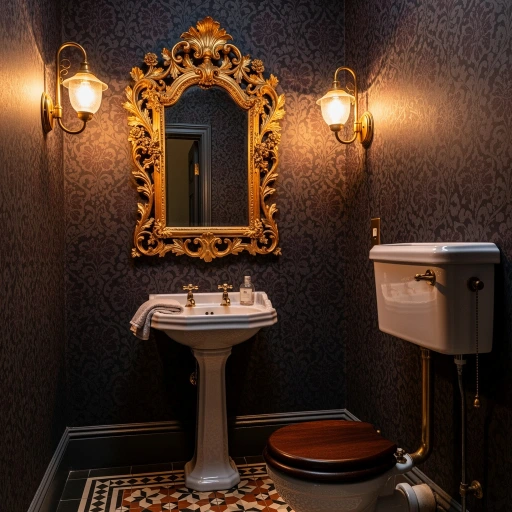
An ornate gilt framed mirror — its elaborately carved frame bearing acanthus leaves, scrolling foliage, shell cartouches, and architectural molding profiles executed in plaster or wood and finished in water-gilded gold leaf — brings to the Victorian downstairs toilet an immediate sense of domestic grandeur and decorative ambition that transforms the functional experience of this most utilitarian room into something approaching the refined, carefully appointed atmosphere of the Victorian drawing room from which the best decorative impulses of the entire house should theoretically descend through every space including the most intimate and most private. The Victorians applied their considerable decorative ambitions to every room without exception, understanding that the character of a home was expressed with particular clarity in the rooms where visitors were least expected to form judgments and hosts were therefore most freely themselves.
Positioning an ornate gilt mirror above a period-appropriate ceramic hand basin or painted cast iron console table creates the defining Victorian cloakroom vignette of mirror, basin, and flanking wall lights that combines practical hand-washing functionality with genuine decorative theatre in a composition whose classical arrangement has been satisfying visitors to well-appointed Victorian houses for well over a century. The slightly foxed and subtly rippled mirror glass of genuine antique gilt mirrors — available through architectural salvage specialists, antique dealers, and auction houses at prices spanning an enormous range depending on age, size, and condition — adds an atmospheric visual depth and age-authenticity that newly manufactured reproduction mirrors, however carefully gilded, cannot achieve without the irreplaceable patina of genuine Victorian production and the decades of domestic witness that follow.
5. Victorian Pedestal Basin with Column
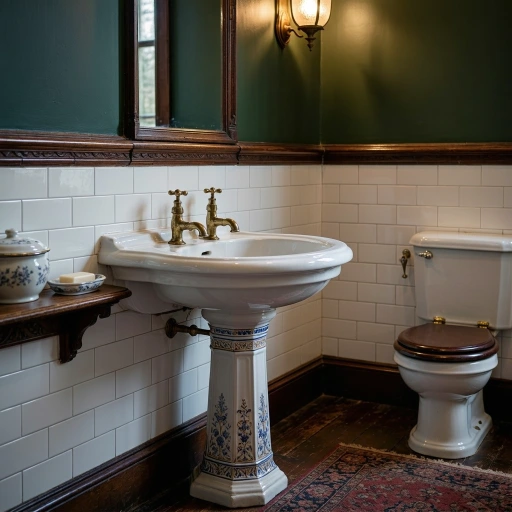
A Victorian pedestal basin mounted on a decorative ceramic column represents one of the most beautifully resolved and most practically satisfying period bathroom fixtures available for the authentic Victorian downstairs toilet, combining the functional requirements of hand washing with a sculptural elegance of considerable architectural quality that the humble pedestal basin form has maintained with remarkable consistency across one hundred and fifty years of continuous production. The Victorian pedestal basin’s characteristic features — its deep, generously proportioned bowl with overflow, its decoratively molded column providing stable support while concealing the plumbing connections within its hollow center, and its crisp white porcelain surface bearing the particular luminous quality of high-fired Victorian ceramics — create a bathroom fixture of timeless functional beauty that never appears dated because its design achieved genuine formal perfection at its first successful expression.
Traditional Victorian basin manufacturers including Burlington Bathrooms, Lefroy Brooks, and Arcade Bathrooms continue to produce pedestal basin designs of genuine period accuracy in high-quality vitreous china with the proper proportions, molding profiles, and surface qualities that distinguish authentic Victorian-style basins from the generic white basins that merely happen to include a pedestal support without engaging seriously with the formal language of Victorian sanitary ware design. Pairing the pedestal basin with properly period-accurate pillar taps in polished or antique brass — their cross-head handles and ceramic hot and cold indices communicating the functional clarity and decorative honesty of Victorian plumbing hardware — completes the basin installation with the authentic period detailing that elevates the entire Victorian downstairs toilet from a decoratively themed modern bathroom to a genuinely convincing period interior of real historical authenticity and considerable daily aesthetic pleasure.
6. Dado Rail with Contrasting Paint Treatment
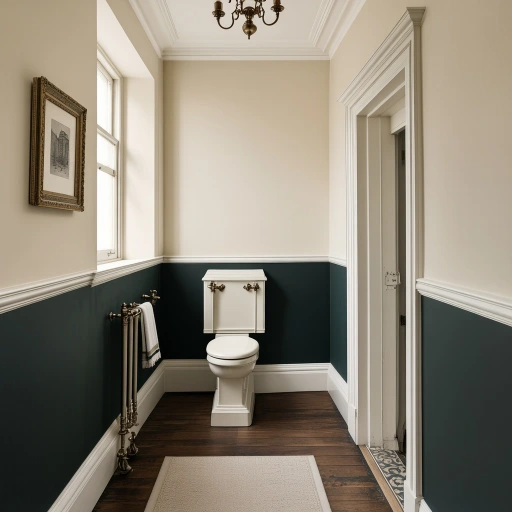
A painted dado rail dividing the Victorian downstairs toilet wall into a darker, more robustly decorated lower section and a lighter, airier upper zone above represents one of the most historically authentic and most practically intelligent decorative treatments available for the period cloakroom, both replicating the original Victorian approach to wall surface division that was developed partly for practical reasons — protecting the lower wall from chair backs, clothing contact, and general domestic wear — and creating a proportional wall composition of considerable visual sophistication that makes small toilet spaces feel taller, more architectural, and more deliberately designed than simple full-height paint or wallpaper treatments achieve. The Victorian dado rail is simultaneously a piece of architectural woodwork, a practical wall protector, and a compositional device of genuine design intelligence.
The most characterful Victorian downstairs toilet dado treatments combine a dark, richly colored lower wall — deep bottle green, warm burgundy, midnight navy, or earthy Victorian terracotta — with a lighter but equally considered upper treatment of complementary wallpaper, warm white paint, or a paler version of the lower color, the dado rail itself painted in gloss white or in the accent color of the period fixtures to create a clean, definitive visual boundary between the two treatments. Authentic Victorian dado rail profiles — ovolo, ogee, torus, and bullnose molding shapes in their correct period proportions — are available from architectural molding specialists and most quality timber merchants, and installing them at the historically accurate height of approximately one meter from the floor level recreates the proper Victorian wall proportional relationship between dado zone and field zone that characterizes the most architecturally convincing period interior restorations.
7. Victorian Cast Iron Radiator
An ornate cast iron column radiator — its multiple vertical sections of elaborately detailed casting rising from decorative feet through rhythmically repeated column units to an elegantly profiled top rail, providing both practical central heating warmth and a sculptural decorative presence of considerable visual authority — adds to the Victorian downstairs toilet a period-appropriate heating element of genuine architectural beauty that flat panel radiators and concealed underfloor heating systems entirely fail to provide in terms of visual character, historical authenticity, and the incomparable warm-to-the-touch physical pleasure of a cast iron surface holding heat with the slow, generous, long-lasting quality unique to the material’s extraordinary thermal mass. Cast iron radiators heat rooms differently — more slowly, more evenly, and more persistently — than modern alternatives.
Original reclaimed Victorian and Edwardian cast iron radiators available through architectural salvage specialists — their surfaces bearing the beautiful evidence of multiple paint layers, the slight surface corrosion of genuine age, and the manufacturing quality of a period when cast iron components were designed for multigenerational service rather than planned replacement — bring an authenticity of material presence and historical weight to the Victorian downstairs toilet that even the finest newly cast reproduction radiators cannot fully replicate. Painting a cast iron column radiator in a period-appropriate color — traditional cream, deep anthracite, warm bronze, or a color coordinated to complement the toilet’s wall treatment — integrates this practical heating element into the overall decorative scheme with the effortless naturalness that distinguishes genuinely considered period room design from merely accessorized modern bathrooms with Victorian-themed decorative additions.
8. Moody Dark Painted Ceiling
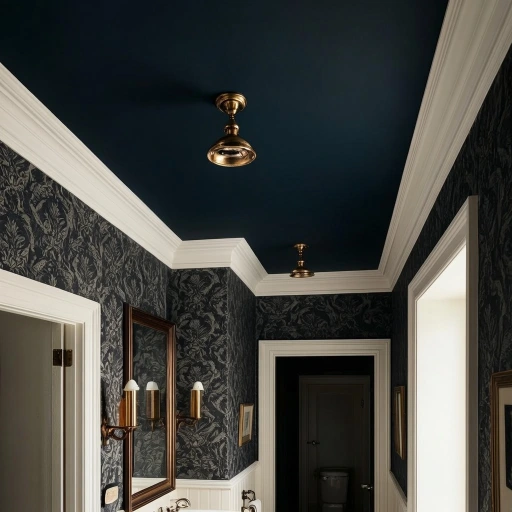
A dark painted ceiling in a deep, richly saturated Victorian color — midnight navy, forest green, warm charcoal, deep plum, or the particular shade of warm black that appears almost like concentrated color rather than simple darkness — transforms the Victorian downstairs toilet into an experience of genuine atmospheric drama and deliberate decorative courage that the majority of conventional bathroom designs entirely fail to attempt, their cautious preference for white or neutral ceilings sacrificing the extraordinary opportunity presented by the small, intimate proportions of a downstairs cloakroom to create a genuinely enveloping, ceiling-close environment of concentrated decorative ambition. A dark ceiling in a small room does not make the space feel oppressive but rather intimate and jewel-box rich — a distinction that requires experiencing rather than imagining to fully appreciate.
The combination of a dark painted ceiling bounded by crisp white plaster cornice molding, Victorian patterned wallpaper on the walls, and warm brass or bronze light fixtures creates a Victorian downstairs toilet of almost theatrical atmospheric power — a room that seems to glow from within its own deep color and concentrated warm light in a way that genuinely distinguishes it from every other room in the house and leaves visitors with a lasting impression of being briefly transported into a particularly beautiful, richly imagined Victorian domestic interior. Farrow and Ball’s deep colors including Railings, Hague Blue, Brinjal, and Down Pipe translate beautifully to Victorian downstairs toilet ceilings, their complex, slightly chalky pigment formulations providing the depth and sophistication that Victorian interior color demands.
9. Framed Victorian Botanical and Natural History Prints
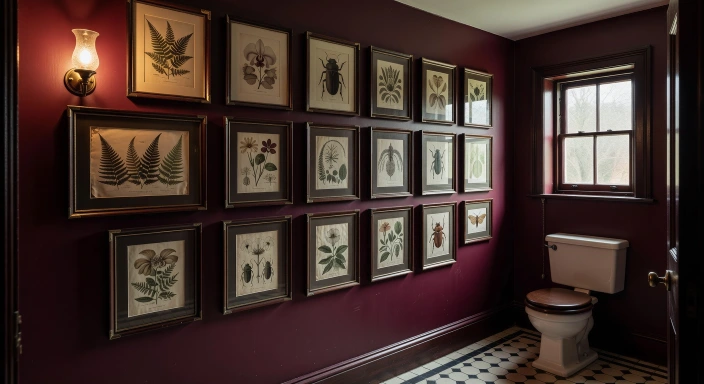
A gallery of framed Victorian botanical and natural history prints — the precisely rendered, beautifully hand-colored scientific illustrations of exotic plants, insects, birds, sea creatures, and geological specimens produced in extraordinary quantities for the Victorian public’s insatiable appetite for natural history education and the visual pleasure of the natural world rendered with scientific accuracy and artistic skill — brings to the Victorian downstairs toilet the period’s most characterful and most intellectually appropriate wall decoration, filling what might otherwise be a single-purpose utilitarian space with the visual richness, conversational interest, and genuine decorative beauty of the Victorian age’s greatest popular graphic art form. The Victorian natural history print is simultaneously a scientific document, a piece of graphic art, and a window into the era’s passionate, sometimes obsessive engagement with the natural world.
Original Victorian natural history prints from publications including Curtis’s Botanical Magazine, John James Audubon’s Birds of America, Ernst Haeckel’s Kunstformen der Natur, and the numerous Victorian natural history encyclopedias that furnished millions of middle-class drawing rooms with their engraved and hand-colored illustrations are available through antique print dealers, specialist natural history bookshops, and auction houses at prices ranging from modest to significant depending on the publication, artist, and condition. Grouping six to twelve prints in coordinating dark wood or gilded frames across a single feature wall of the Victorian downstairs toilet creates a miniature natural history museum installation of considerable visual richness and genuine period authenticity, the collection’s cumulative effect of accumulated scientific imagery and hand-colored beauty transforming a functional room visit into a brief, genuinely pleasurable encounter with the Victorian age’s magnificent visual culture.
10. Victorian Wooden Toilet Seat and Cistern Box
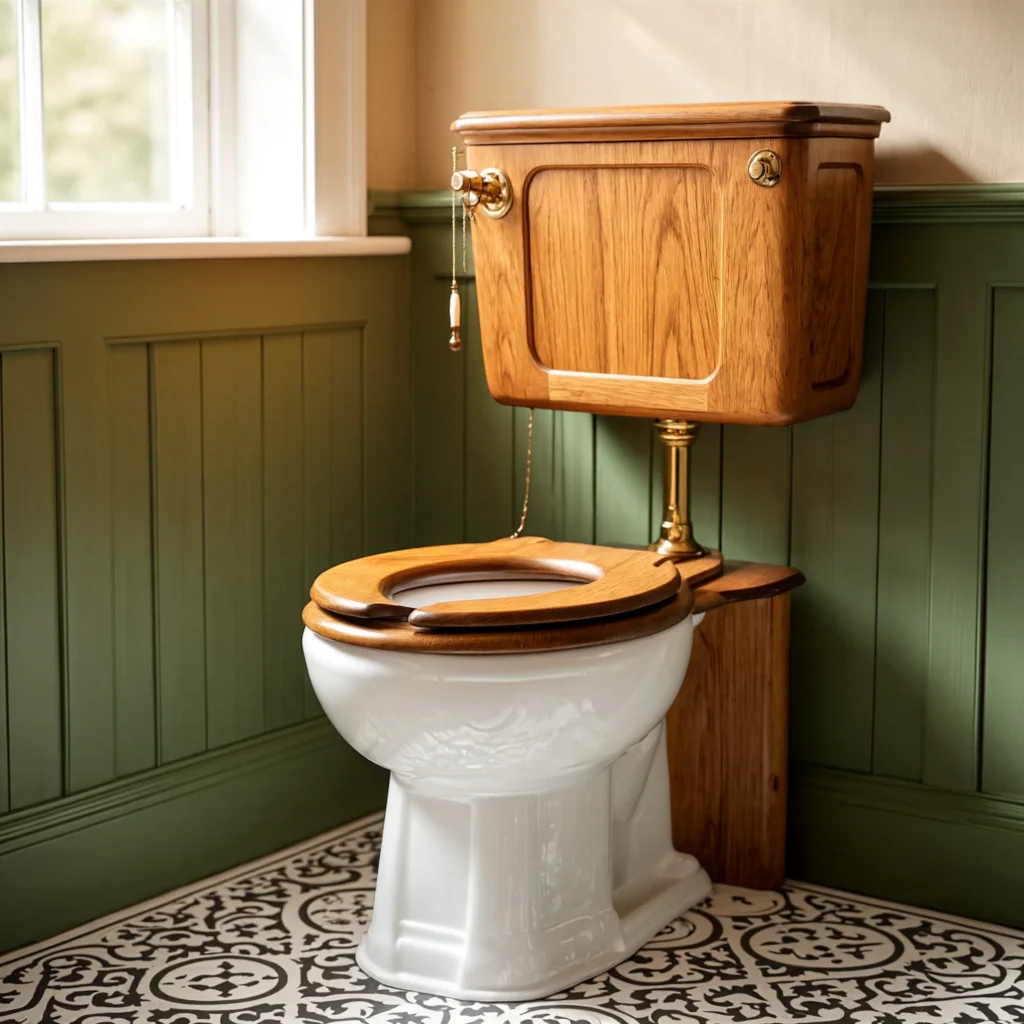
A solid oak or mahogany wooden toilet seat and matching wooden cistern box enclosure — their warm honey or rich dark wood grain communicating the material quality and craft tradition of Victorian joinery with immediate and unmistakable authenticity — provide the Victorian downstairs toilet with its most intimately personal period detail, restoring the material quality of the original Victorian water closet furniture in a way that transforms the modern toilet installation from a purely functional white ceramic object into a piece of genuine furniture whose wooden components contribute warmth, craftsmanship, and material beauty to the overall period interior composition. The Victorians applied the same furniture-making traditions to their bathroom woodwork that they applied to their drawing room cabinetry, treating the toilet seat and cistern enclosure as legitimate expressions of domestic joinery craft.
Specialist Victorian bathroom woodwork suppliers produce wooden toilet seats and cistern boxes in properly proportioned period designs with the correct molding profiles, panel details, and hardware fittings that distinguish authentic Victorian bathroom joinery from simply shaped wood cut to fit modern toilet dimensions without engagement with the formal design language of Victorian furniture-making. The warm honey tone of solid oak provides the most historically versatile and most visually pleasing wooden finish for the Victorian downstairs toilet, its natural grain complementing both the warm cream of period porcelain sanitaryware and the darker, richer tones of Victorian wall treatments and brass fixtures with equal naturalness and material harmony that mahogany’s darker register achieves with slightly less universal compatibility across different Victorian decorative schemes.
11. Antique Brass or Copper Fixtures and Fittings
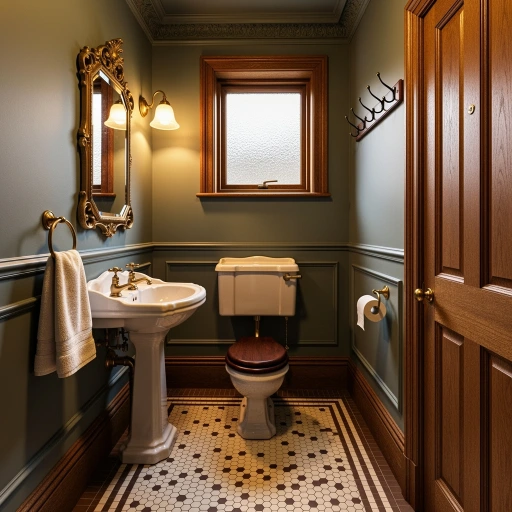
Antique brass or copper fixtures and fittings — tap pillar sets, towel rings, toilet roll holders, coat hooks, mirror frames, and light fittings all unified in the warm, aged, slightly imperfect finish of unlacquered or deliberately patinated metal — create the Victorian downstairs toilet’s most cohesive and most atmospherically warming material layer, their golden-amber tones bringing together every other decorative element of the period interior in a unifying metallic warmth that lacquered chrome, brushed nickel, and matte black contemporary finish alternatives simply cannot replicate in terms of period authenticity or the particular quality of aged, organically imperfect beauty that only metals allowed to develop their natural patina through years of honest use can achieve. The choice of metal finish unifies a room more completely than almost any other single design decision.
Unlacquered brass is particularly prized for Victorian downstairs toilet fittings because its deliberate lack of protective lacquer allows the metal to develop, with use and time, the naturally darkening, spot-lightening, subtly varied patina that characterized original Victorian brass hardware after years of domestic service — a living finish that responds to handling, cleaning, and atmospheric conditions in ways that create a continuously evolving, always slightly unique surface that connects the contemporary bathroom to the genuine material experience of the Victorian domestic interior with an authenticity that carefully preserved or newly lacquered brass entirely prevents. Sourcing a complete matched set of antique brass accessories from a single specialist supplier ensures consistent finish tone and design period across every fitting in the Victorian downstairs toilet, creating the unified material vocabulary that transforms a collection of individual period accessories into a coherent, fully designed period interior.
12. Victorian Tongue and Groove Paneling
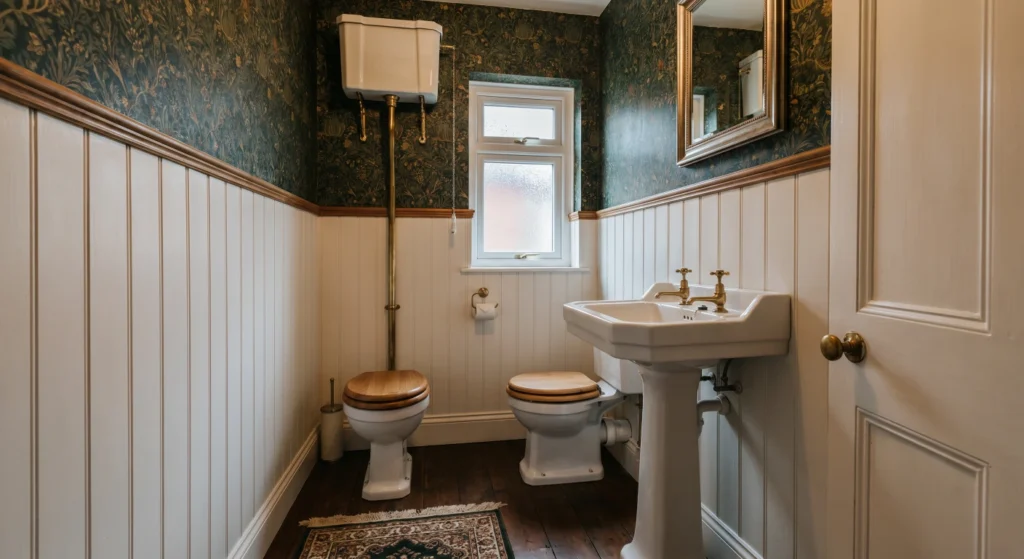
Painted tongue and groove wooden wall paneling covering the lower portion of the Victorian downstairs toilet walls — its vertical boards creating a rhythmic, textured surface of considerable material warmth and period-appropriate decorative character — provides the cloakroom interior with both the practical moisture-resistant wall protection that the Victorian bathroom required and the warm, crafted material presence that distinguishes genuinely period-accurate bathroom interiors from decoratively themed modern ones whose walls rely entirely on paint and wallpaper without the dimensional, material depth that wooden paneling contributes to the overall spatial experience. The sound qualities of a paneled room are distinctly different from those of plastered walls — slightly warmer, slightly more resonant, subtly more intimate.
Installing tongue and groove paneling to the height of the dado rail — with the upper wall above treated to period wallpaper or contrasting paint — creates the Victorian bathroom’s characteristic wall surface composition in its most complete and most historically convincing form, the lower paneled zone providing the robust, wipe-clean surface appropriate to bathroom splashing and the upper wallpapered zone delivering the decorative richness and visual interest that Victorian domestic interiors consistently prioritized above all other considerations. Painting tongue and groove paneling in a period-appropriate color — warm cream, deep sage green, dusty grey-blue, or the chalky off-white of genuine Victorian interior woodwork — rather than pure brilliant white produces a warmer, more period-accurate result that harmonizes with brass fixtures, wooden accessories, and Victorian color palettes more naturally than the cold precision of contemporary white that anachronistically modernizes period woodwork’s visual character.
13. Period Appropriate Wall Lighting
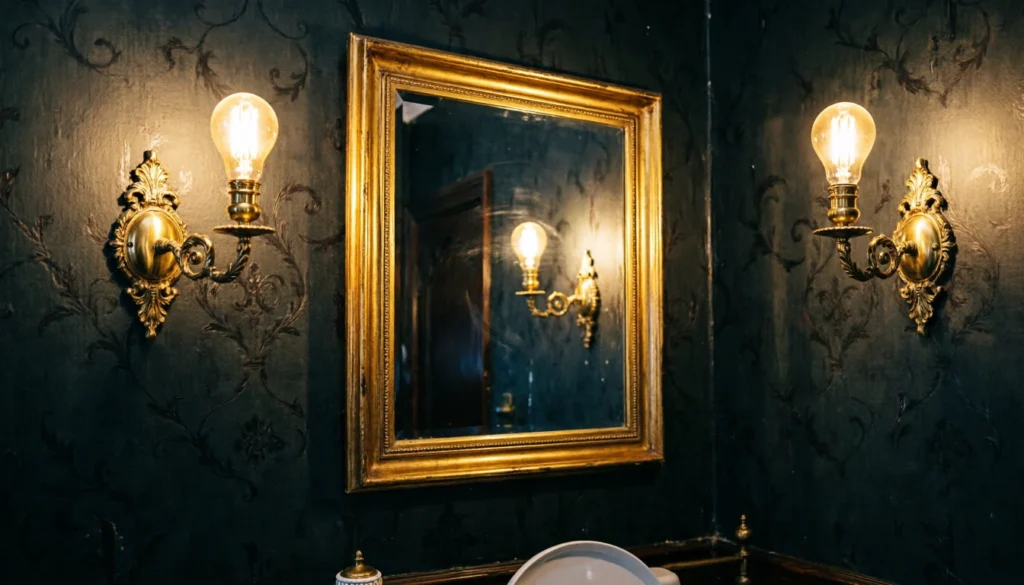
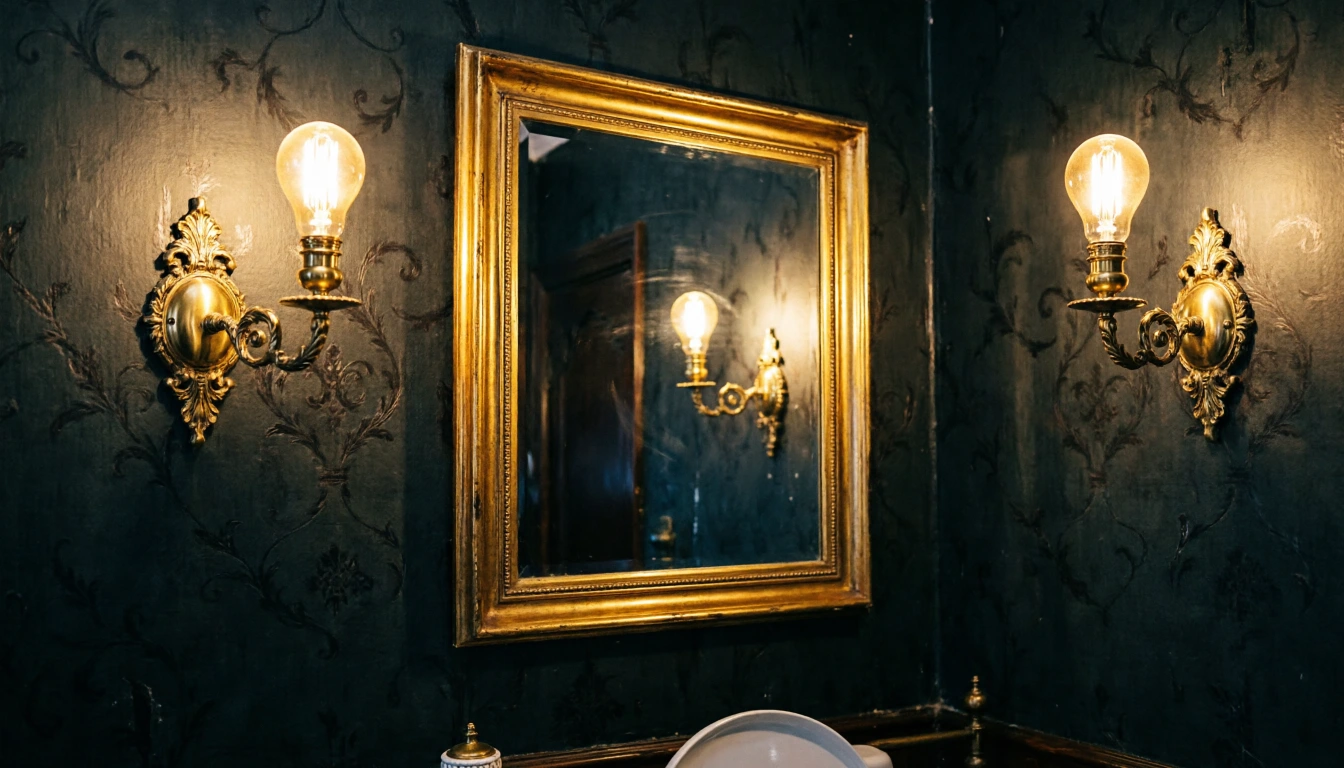
Period-appropriate wall lighting in antique brass, bronze, or copper — Victorian-style wall sconces with ornate bracket arms, decorative back plates bearing cast floral or leaf motifs, and glass shades in frosted, etched, or amber tints that diffuse warm Edison bulb light with the atmospheric quality most closely approximating original Victorian gas or early electric lighting — provides the Victorian downstairs toilet with its most important atmospheric contribution, transforming a functionally lit utilitarian space into a warmly illuminated, genuinely evocative period interior whose quality of light communicates the Victorian era’s particular domestic intimacy as effectively as any decorative element visible in natural daylight. Lighting is the design element that most fundamentally determines how a room feels rather than simply how it looks.
Positioning a pair of period wall sconces flanking the basin mirror — in faithful replication of the Victorian bathroom arrangement that provided balanced, shadow-minimizing facial illumination for shaving and grooming while simultaneously creating the bilateral symmetry and formal architectural balance characteristic of the best Victorian interior arrangements — creates a lighting composition of both practical effectiveness and considerable decorative elegance that serves the functional requirements of a downstairs toilet hand-washing space while simultaneously establishing the warm, welcoming atmospheric quality that distinguishes a beautifully designed Victorian cloakroom from one that has merely been accessorized with period decorative elements without sufficient attention to the foundational importance of appropriate, atmospherically correct period lighting in achieving the full experiential authenticity of a genuinely convincing Victorian interior.
14. Vintage Prints and Framed Ephemera
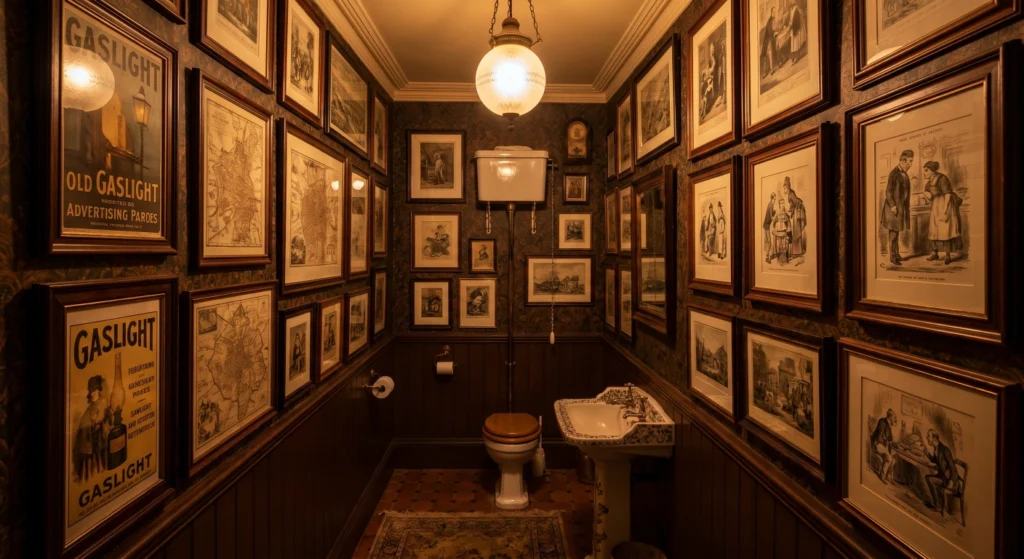
An eclectic, densely hung collection of vintage prints, framed Victorian ephemera, old maps, period advertisement lithographs, humorous Victorian Punch magazine illustrations, antique playing cards, pressed fern specimens, and any other small framed items of genuine period interest and visual charm creates the most characterful and most personality-rich Victorian downstairs toilet wall treatment available — a room that rewards repeated visits with new details to discover, new images to examine, and an overall atmosphere of accumulated, curious, deeply personal Victorian collecting that communicates genuine enthusiasm for the era’s visual culture rather than the generic application of period design vocabulary without specific knowledge or individual passionate interest. The best Victorian downstairs toilets are rooms that reveal their owners’ personalities completely.
The beauty of a Victorian ephemera gallery wall lies in its inherent democracy of sources and values — a beautifully framed original Victorian trade card from a long-defunct London draper sits with equal visual dignity beside a carefully mounted map of Victorian London, a framed pressed fern from a Victorian album, a reproduction Aesthetic Movement decorative panel, and a genuine period medicine advertisement found for pennies at a car boot sale, their apparent incompatibility of subject matter resolving into visual coherence through the unifying effect of consistent dark frame profiles and the shared quality of genuine period graphic design and production that makes every authentic Victorian printed image recognizable as a product of its specific historical moment. This deeply personal Victorian downstairs toilet decorating approach consistently generates the most genuinely enthusiastic and most genuinely curious visitor responses of any period cloakroom decorating strategy.
15. Statement Victorian Patterned Wallpaper Ceiling
Extending bold Victorian patterned wallpaper from the walls up and over the ceiling of the downstairs toilet — wrapping the entire small room in a continuous, immersive envelope of pattern, color, and Victorian decorative richness that eliminates the conventional distinction between wall surface and overhead plane in favor of a completely enveloped, jewel-box interior experience of concentrated decorative intensity — represents the most dramatically ambitious and most photographically spectacular Victorian downstairs toilet design idea available, creating a room whose total commitment to period pattern and color achieves an atmospheric completeness and sensory richness that partial decorative approaches, however beautiful their individual elements, simply cannot match in terms of overall impact and genuine decorative courage. Small rooms with papered ceilings feel curated rather than claustrophobic.
The practical execution of a wallpapered ceiling in a small Victorian downstairs toilet is considerably more achievable than in larger rooms — the limited area requires only a few rolls of wallpaper, the working height is manageable without specialist equipment, and the small room’s condensed proportions mean that the pattern repeat alignment between walls and ceiling creates a wraparound decorative effect of maximum visual impact with minimum wallpaper quantity. Choosing a botanical or damask wallpaper design in deep, saturated Victorian colors — the same paper continued from walls to ceiling without interruption or border — creates the most seamlessly immersive period room experience, while a contrasting ceiling paper in a complementary color and smaller-scale pattern provides a slightly more conventional but equally characterful alternative that maintains the Victorian commitment to decorated overhead surfaces without demanding the visual courage of total pattern immersion on every surface simultaneously.