17 Cottagecore Hallway Ideas for Cozy Homes
1. Dried Flower and Herb Bundle Wall Display
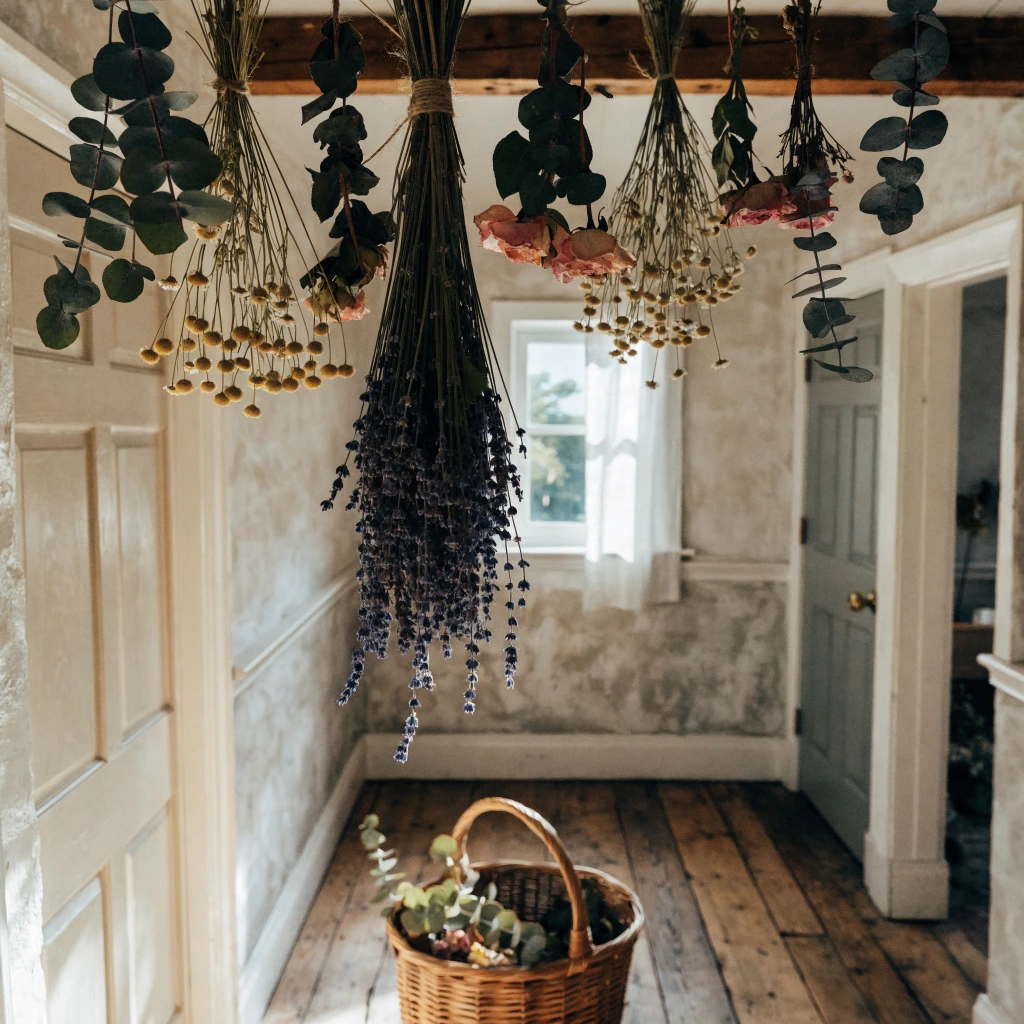
A ceiling or wall display of dried flower and herb bundles hanging upside down in generous, overlapping clusters is the cottagecore hallway design element that most completely and most immediately captures the specific sensory and aesthetic magic of the style — filling the transitional space with the delicate visual texture of preserved botanicals, the gentle fragrance of dried lavender, chamomile, and rosemary, and the warm, earthy color palette of naturally dried plant material that ranges from dusty mauve and pale wheat to silvery sage and warm amber. The tradition of hanging dried herbs and flowers in the home is among the oldest and most universally human of all domestic practices — connecting the cottagecore interior to centuries of folk medicine, harvest preservation, and the specifically feminine knowledge of plant use that has been passed through generations of rural households with the same quiet continuity as bread baking and textile making.
Gather bundles of dried botanicals from a variety of sources — dried lavender from your own garden or a local farm, chamomile and yarrow from a herbalist or farmers market, rose buds and peonies from a specialty florist who offers dried varieties, eucalyptus and feathery pampas grass from a home décor supplier — and assemble them into generous, visually abundant bundles that are substantial enough to read clearly from the hallway’s full length rather than disappearing into wispy visual insignificance. Tie each bundle with natural twine, jute rope, or a narrow velvet ribbon in a dusty rose or forest green, and hang from ceiling hooks, a length of driftwood suspended horizontally between two wall hooks, or individual nails driven into a wooden ceiling beam at varying heights and intervals to create the layered, abundant, naturally asymmetric installation that looks most authentically cottagecore and most genuinely harvested rather than artificially arranged. Refresh the display seasonally to maintain fragrance and introduce new botanical varieties that reflect the changing garden harvest throughout the year.
2. Vintage Botanical Print Gallery Wall
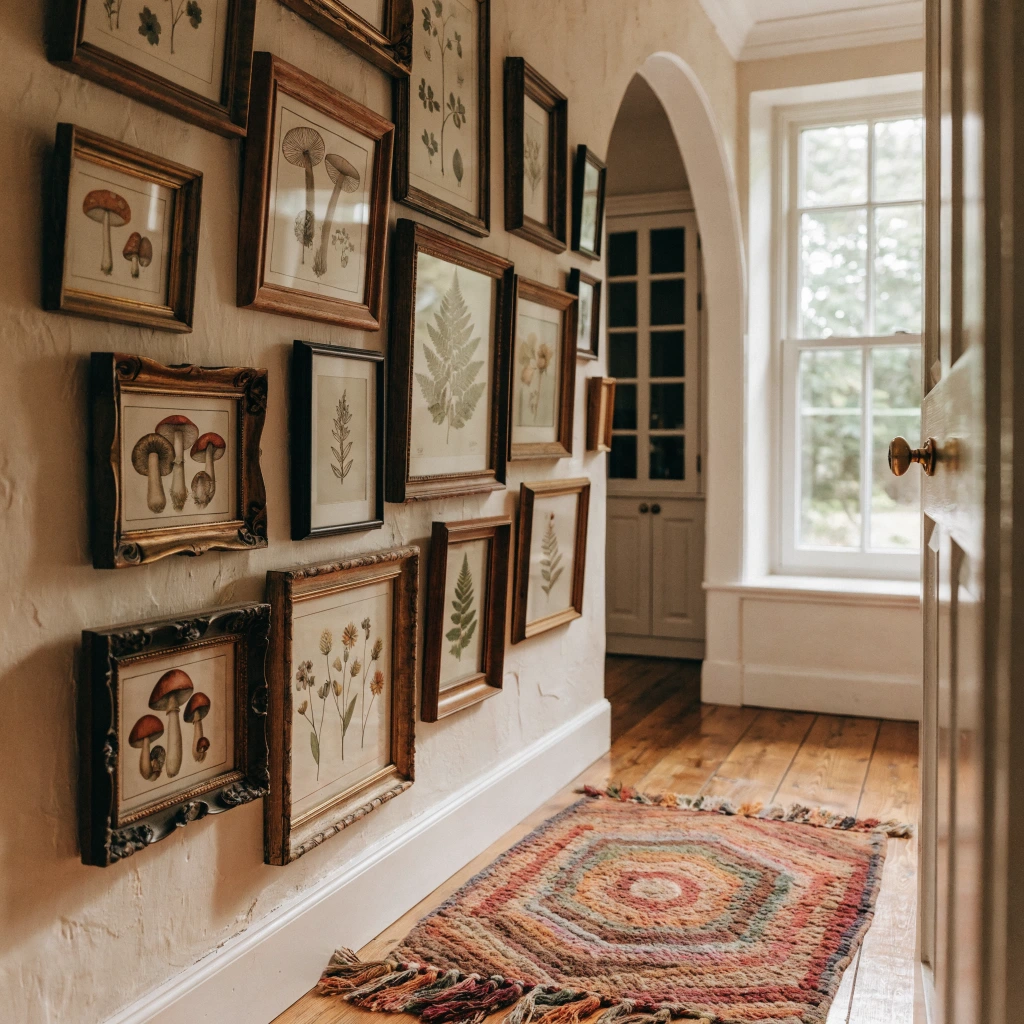
A salon-style gallery wall assembled from vintage botanical illustration prints in a deliberately mismatched collection of antique wooden frames is the cottagecore hallway design idea that transforms a simple corridor wall into an absorbing, endlessly detailed visual experience — a curated library of botanical knowledge presented in the specific visual language of nineteenth century natural history illustration, with its extraordinary precision of observation, its beautiful integration of scientific accuracy and artistic sensibility, and its quiet celebration of the natural world’s infinite variety and inexhaustible beauty. The vintage botanical print tradition — from the hand-engraved copper plate illustrations of Georg Ehret and Pierre-Joseph Redouté to the chromolithographed plates of Victorian-era horticultural journals — produced some of the most beautiful printed imagery in the history of art, and gathering a collection of these prints for a cottagecore hallway honors that tradition while bringing its specific warmth and intellectual beauty into daily domestic life.
Source prints from a variety of channels to build a collection with genuine variety and character — original antique prints from estate sales, antique markets, and specialist print dealers for the pieces with authentic aged paper, foxed margins, and the specific gravity of genuine age, supplemented by high-quality reproduction prints sourced from museum print shops and specialist botanical art publishers for species not available as originals within a reasonable budget. Include a diverse botanical range across the collection — flowering plants alongside ferns, mushroom and fungi illustrations alongside flowering herbs, tree studies alongside delicate wildflower watercolors — to create visual variety and botanical richness that rewards repeated close examination. Choose frames in natural wood tones — oak, walnut, pine, and painted cream or soft sage — and vary the frame widths, profiles, and styles deliberately to achieve the collected-over-time appearance that distinguishes a genuine personal gallery from a coordinated retail display. Add one or two pressed flower frames — real flowers sealed between glass and a backing board — as three-dimensional textural accents within the flat print collection.
3. Wainscoting with Floral Wallpaper Above
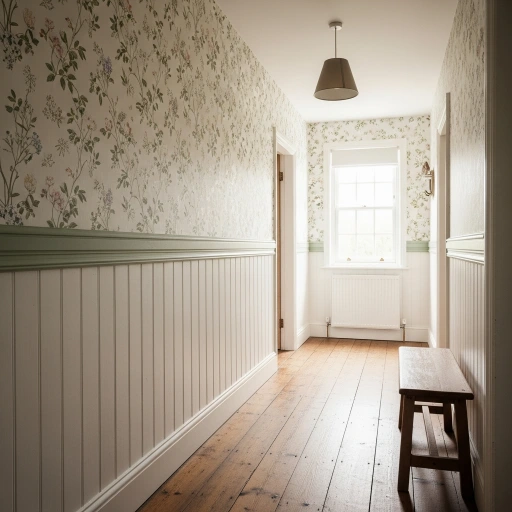
White painted wooden wainscoting on the lower half of the hallway walls with a delicate climbing rose, wildflower, or trailing botanical wallpaper above the chair rail is the cottagecore hallway wall treatment that most completely and most romantically realizes the style’s foundational visual aspiration — the dream of living within a garden, surrounded by botanical abundance, sheltered by the specific warmth and craft of a genuinely old, genuinely loved, genuinely inhabited domestic space that has accumulated its beauty over generations rather than achieving it through a single designed installation. The wainscoting provides the grounded, practical lower wall protection that genuine cottage life requires — protecting walls from chair backs, muddy boots, and the general physical energy of a household in daily active use — while the botanical wallpaper above creates the dreamy, garden-immersive upper wall experience that makes the hallway feel like a passage through a living landscape rather than a utilitarian corridor between rooms.
Choose a wallpaper that reflects genuine botanical specificity rather than generic floral pattern — a William Morris-inspired climbing rose design with the specific leaves, thorns, and hips of Rosa canina, a hand-painted wildflower meadow pattern featuring individually identifiable species of cornflower, poppy, oxeye daisy, and cow parsley, or a trailing botanical print featuring garden herbs in the specific illustrative tradition of the cottage garden planting guide. Install the wallpaper from chair rail height to ceiling, allowing the pattern’s full vertical repeat to express itself completely without the interruption of a dado or picture rail. Paint the wainscoting in a soft, chalky white or a pale sage green that connects harmoniously with one of the wallpaper’s botanical tones — the sage green wainscoting cap rail that transitions between the white wood below and the botanical paper above is the specific detail that makes this wall treatment feel thoughtfully designed rather than arbitrarily assembled. Add a simple wooden bench with a cushion in a coordinating botanical print at the hallway’s end for the complete cottagecore entry experience.
4. Repurposed Wooden Ladder as Accessory Display
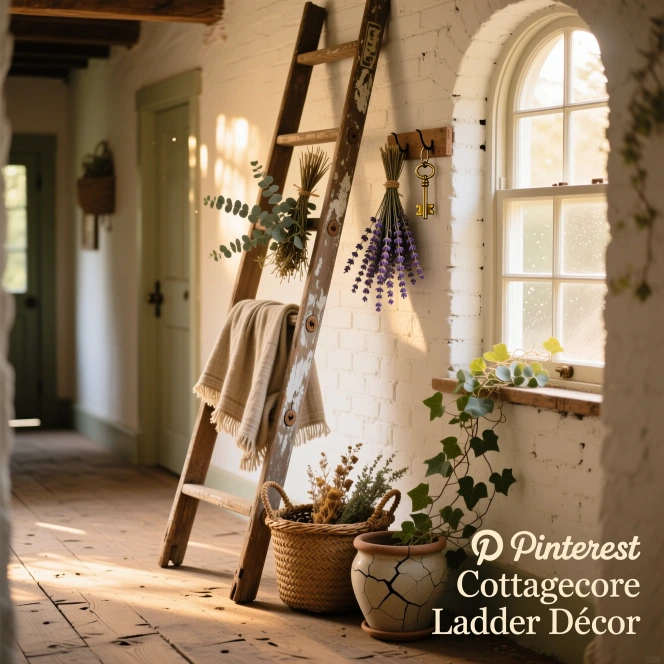
A weathered old wooden ladder leaning casually against the hallway wall and repurposed as a multi-level display structure for throws, dried botanicals, woven baskets, and small decorative objects is the cottagecore hallway design idea that most perfectly embodies the style’s core philosophy of finding beauty in functional objects, honoring the usefulness of old things, and creating visual abundance through thoughtful, unhurried accumulation rather than deliberate purchase and placement. An old wooden ladder — sourced from a barn sale, an antique market, or salvaged from a property renovation — carries with it the specific patina of genuine use and genuine age that no new decorative ladder reproduction can approximate: the worn smoothness of the rails where many hands have gripped, the paint layers accumulated and chipped across decades of working life, and the specific imperfect straightness of timber cut and assembled before machine-precision became the universal standard of woodworking production.
Drape a linen throw or a hand-knitted blanket over the top two rungs in a casual, naturally settling arrangement that suggests it was placed there for practical access rather than decorative purpose. Hang small bundles of dried lavender, rosemary, and chamomile from individual rungs using loops of natural twine. Rest small woven baskets on the wider lower rungs — fill one with pine cones, another with small river stones, another with balls of natural yarn in warm earthy tones. Hang vintage keys, a small oval mirror, or a pressed botanical specimen in a simple frame from the upper rungs using lengths of ribbon or twine. Allow a small potted trailing plant — a string of pearls, a cascading pothos, or a delicate climbing nasturtium — to begin growing toward and around the ladder’s lower rungs, gradually integrating the decorative object with the living botanical world in the slow, beautiful merger that cottagecore design celebrates as its highest aesthetic achievement.
5. Stone or Pebble Floor Mosaic Runner
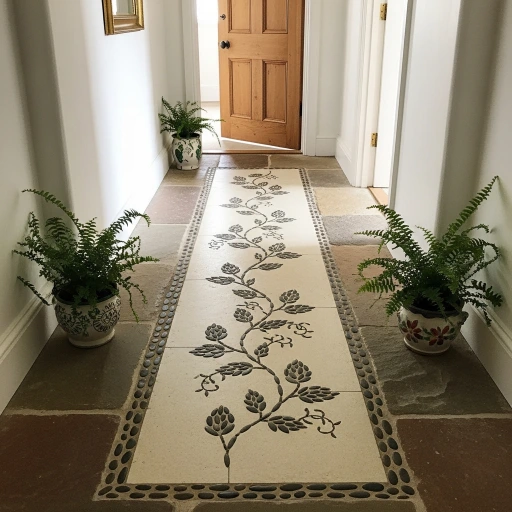
A hand-laid river pebble mosaic runner installed along the center of a cottagecore hallway floor is an extraordinary craft-forward design element that transforms the corridor’s most fundamental surface into a genuine work of handmade art — a tactile, visually intricate installation that references the ancient craft tradition of pebble mosaic flooring found in historic cottage and farmhouse floors across Britain, France, and the Mediterranean, bringing that centuries-old practice of beautiful ground-level craft into a contemporary domestic interior with complete authenticity and enduring material beauty. The specific aesthetic quality of river pebble mosaic — the smooth, water-worn surfaces of individually chosen stones in their natural color range of grey, cream, rust, and dark charcoal, arranged into botanical patterns of leaves, vines, and simple flowers — creates a visual texture at floor level that is simultaneously natural, handmade, and genuinely beautiful in a way that no manufactured floor covering can replicate.
Source river pebbles from a landscape supplier or directly from a riverbed where collection is permitted — choosing stones with interesting natural color variation within a consistent size range of approximately one to two centimeters in diameter for the most visually refined and most practically comfortable mosaic result. Design the pattern before laying — a simple trailing vine with stylized leaves is the most achievable botanical motif for a first pebble mosaic project, while a more ambitious design might incorporate identifiable flower species, a central medallion, or a continuous repeating border pattern that runs the full hallway length. Set pebbles into a flexible tile adhesive mortar on a properly prepared substrate and grout with a fine-grain grout in a natural sand tone that disappears visually between the stones and allows the pebbles’ natural colors to dominate the finished surface. Seal the completed mosaic with a penetrating stone sealer for practical durability. This floor installation becomes more beautiful with age as the grout softens in tone and the stones develop the patina of regular foot contact.
6. Arched Window with Stained Glass Botanical Panels
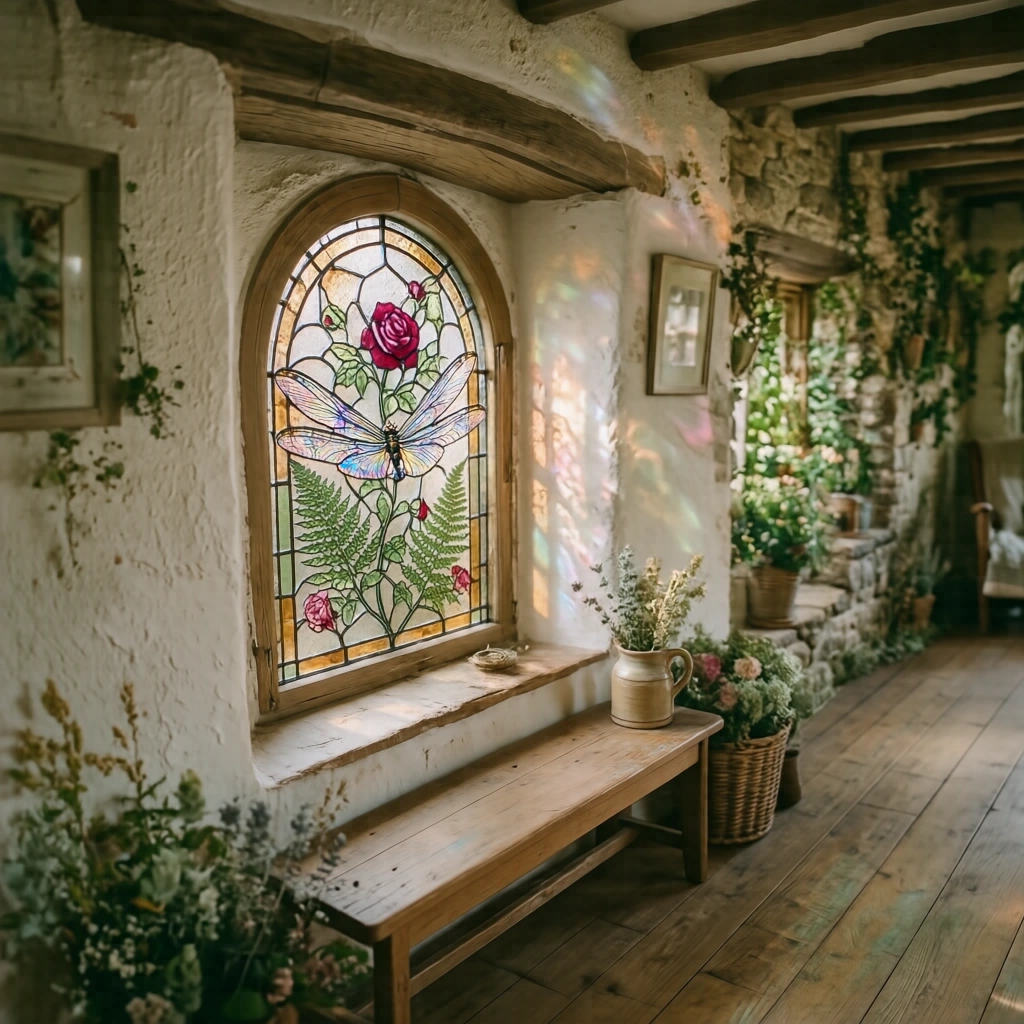
A small arched window or transom fitted with hand-made stained glass panels featuring botanical motifs — climbing roses, wild ferns, dragonflies hovering over water plants, or woodland mushrooms and berries — is the cottagecore hallway design element that most magically and most completely transforms the quality of light itself within the corridor space, filling the hallway with colored light pools in amber, sage green, and dusty rose that shift and move throughout the day as the sun’s angle changes, creating a living, atmospheric illumination that makes the passage through the hallway feel genuinely enchanted and perpetually beautiful regardless of the season or weather outside. Stained glass craft has been continuously practiced in British and European cottage and church architecture for over a thousand years, and fitting a cottagecore hallway window with handmade stained glass panels connects the domestic interior to that long, luminous tradition of using colored light as the most immersive and most spiritually powerful of all interior design mediums.
Commission panels from a working stained glass artist who is comfortable with botanical subject matter and the specific color palette appropriate for a cottagecore aesthetic — avoid the harsh primary colors of Gothic ecclesiastical stained glass in favor of the softer, more naturalistic color range of Arts and Crafts movement glass: warm amber yellows, sage and forest greens, dusty rose and mauve pinks, clear and pale blue skies, and the rich brown-black of leading lines that define botanical forms with the precision and expressiveness of fine pen illustration. The leading pattern itself — the structural network of metal cames that hold the glass pieces together — should be designed as an integral part of the botanical composition rather than simply as a structural necessity, with the leading lines following the natural contours of leaf veins, stem curves, and petal edges in a way that makes the structural element simultaneously the most decorative element of the completed panel. Install the panels in an existing window opening or create a new internal window between the hallway and an adjacent room to allow the stained glass to be backlit even without direct external daylight access.
7. Vintage Coat Hooks Made from Branches
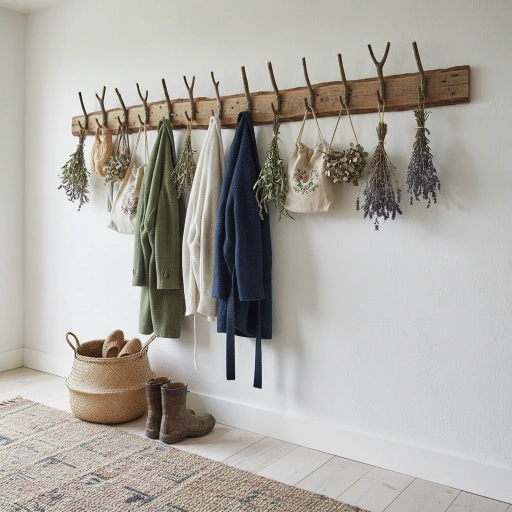
A row of coat hooks fashioned from natural forked tree branches or from salvaged hardwood with natural knots and burls, mounted on a length of reclaimed wood with a bark-edge finish, is the cottagecore hallway functional design element that most beautifully reconciles the practical demands of an entry corridor — coats, bags, umbrellas, and the accumulated paraphernalia of daily outdoor life need somewhere to live — with the cottagecore aesthetic principle that functional objects should be beautiful in themselves, made from natural materials, and carry the specific visual warmth of something shaped by both human craft and natural process rather than manufactured entirely by one or the other. The forked branch coat hook is the most direct possible expression of this principle — the fork is nature’s own hook, requiring only minimal human intervention to clean, dry, mount, and present as a functional domestic object of genuine natural beauty.
Collect forked branches from trees that have naturally shed them during storms or pruning — oak, hazel, apple, and cherry all produce branches with the appropriate diameter, strength, and surface character for coat hook use — and select forks with interesting natural character: slight curves, textural bark variations, the occasional small burl or knot that adds visual interest to an otherwise simple form. Clean the branches of loose bark and small twigs, sand lightly to remove rough edges while preserving the natural surface texture, and finish with a simple beeswax polish that enhances the wood’s natural grain and color without adding the artificial gloss of varnish or lacquer. Mount three to five hooks in an irregular, naturally spaced row on a length of reclaimed barn wood with a live edge or bark border that continues the natural material story of the hooks themselves. Install at the correct functional height for the household’s tallest coat wearers, and allow the hooks to accumulate their own patina of daily use — the scuff marks, oil from hands, and gentle wear of regular contact that transform any functional object into a genuinely lived-with piece of domestic craft over months and years of faithful, appreciated service.
8. Embroidered Linen Wall Panels
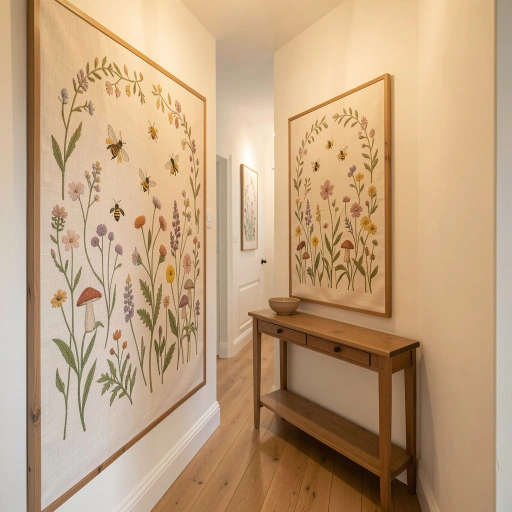
Large embroidered linen panels mounted in simple wooden frames and displayed as the primary wall art of a cottagecore hallway represent the most directly personal, most labor-intensive, and most genuinely emotionally resonant of all the handcraft-based design ideas on this list — because embroidery is the needlework tradition most deeply associated with the specific feminine domestic world that cottagecore aesthetics both celebrate and romantically inhabit, and a hallway hung with large embroidered botanical panels communicates something profound about the value of slow making, patient skill development, and the specific beauty that only comes from hours of concentrated, loving handwork applied to material that will live in the home for decades. Embroidered wall panels in the cottagecore context draw their visual language from the great traditions of English crewelwork, Scandinavian folk embroidery, and the Arts and Crafts needlework movement that William Morris championed as the highest domestic art form of the Victorian era.
Design each panel around a generous, botanically specific composition that fills the linen ground with sufficient embroidered coverage to read as a complete, considered work rather than a small motif on a large expanse of empty fabric — a full trailing rose branch with leaves, thorns, and hips worked in silk ribbon and crewel wool, a woodland floor composition featuring mushrooms, moss, ferns, and fallen leaves in naturalistic greens and browns, or a wildflower meadow scene with identifiable species of cornflower, oxeye daisy, and red clover worked in their correct botanical colors. Work the embroidery on a medium-weight natural linen ground in a color between raw and bleached — the warm cream that allows the thread colors to sing against a neutral but tonally warm background without the coldness of bright white. Stretch the finished embroidery tightly over a canvas-wrapped board before mounting in the frame to prevent sagging and to ensure the textile surface reads with the same visual presence and tension as a painted canvas. These panels, made over months and years of patient evening needlework, become some of the most treasured and most personally significant objects in any cottagecore home.
9. Reclaimed Wood Plank Walls with Whitewash Finish
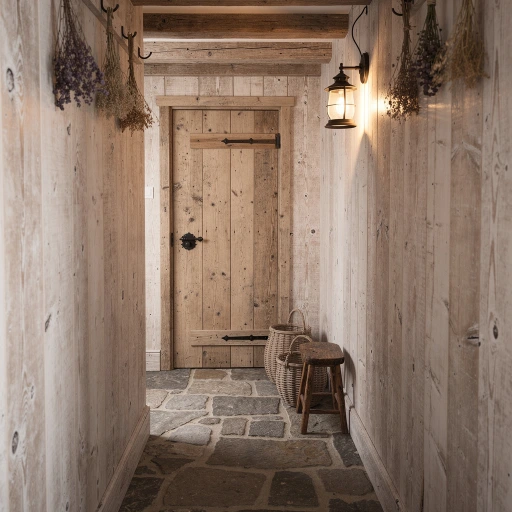
Reclaimed wood plank walls with a thinly applied whitewash finish that allows the natural grain, knot patterns, and color variations of the individual boards to remain visible beneath the translucent white coating is the cottagecore hallway wall treatment that most richly combines the visual warmth of natural wood with the brightness and visual lightness of a white wall — creating a surface that is simultaneously rustic and luminous, textured and clean, materially earthy and spatially airy in a way that neither an unpainted wood wall nor a smooth painted plaster wall can achieve independently. The whitewash technique — a diluted lime wash or thinned paint applied and immediately partially wiped away with a cloth — has been the standard finish for interior wood in vernacular British and American cottage architecture for centuries, its practical function of brightening low-ceilinged rooms with small windows combining naturally with its aesthetic quality of unifying visually varied wood surfaces into a coherent, soft-toned wall treatment.
Source reclaimed wood planks from a salvage yard, barn conversion, or specialist reclaimed timber supplier — choosing boards with genuine age indicators: the specific grey surface patina of weathered timber, nail holes and bolt marks from previous structural use, hand-saw marks that reveal pre-industrial cutting methods, and the natural splits and checking patterns that develop in timber over decades of exposure to seasonal moisture and temperature variation. The visual character communicated by these specific imperfections and aging signs is precisely what makes reclaimed wood walls in cottagecore interiors so genuinely beautiful and so impossible to replicate convincingly with new timber artificially distressed to approximate age. Install the planks horizontally for the most classic cottage wainscoting or full-wall application, varying the plank widths slightly across the installation to maintain the organic, non-uniform character of genuinely reclaimed material. Apply whitewash in a single thin coat using a wide brush in long, board-following strokes, then wipe immediately with a damp cloth to leave the white coating in the wood’s surface texture while removing it from the raised grain, creating the specific dimensional quality of whitewash that flat paint cannot produce.
10. Fairy Light Canopy and Hanging Lanterns
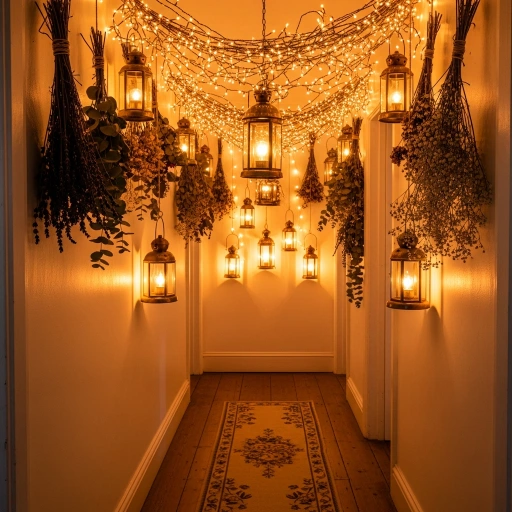
A warm fairy light canopy — copper wire fairy lights strung in loose, generously drooping swags across the hallway ceiling — combined with small brass and hand-blown glass hanging lanterns at varying heights is the cottagecore hallway lighting design approach that most completely and most atmospherically transforms the corridor from a functional transition space into a genuinely magical, warmly glowing passage that makes every movement through the home feel like walking through a twilight garden at the most beautiful moment of a summer evening. The fairy light canopy is the cottagecore interior’s most characteristic and most universally loved lighting gesture — its combination of warm amber light from dozens of tiny bulbs, the organic draping of the wire between attachment points, and the way the light reflects softly from dried botanical bundles and white plaster walls creates an atmosphere of intimate enchantment that no conventional lighting fixture, however beautiful, can produce.
Use copper wire fairy lights with genuine warm-white or amber LED bulbs rather than cool-white alternatives that would destroy the warmth and magic of the effect — the specific amber of warm-white fairy light is what makes the cottagecore ceiling canopy feel like candlelight multiplied rather than electricity deployed. String the lights in multiple parallel runs across the hallway’s width, attaching each run to small ceiling hooks and allowing generous loops and swags to form naturally between attachment points rather than pulling the wire taut. Vary the loop depth between strands — some drooping quite low, others catching higher — to create the multi-layered canopy effect that gives the installation its visual depth and its quality of enveloping, surrounding light. Intersperse brass lanterns and small glass globe pendant lights within the fairy light installation, hanging them at varying heights from independent ceiling hooks, with some lanterns containing battery-operated tea light candles for the warmest, most flickering light possible. This ceiling treatment photographs extraordinarily beautifully in the blue hour of late afternoon, when interior warm light and exterior cool ambient light create the most magical possible combination of color temperature and atmosphere.
11. Antique Mirror with Carved Wooden Frame
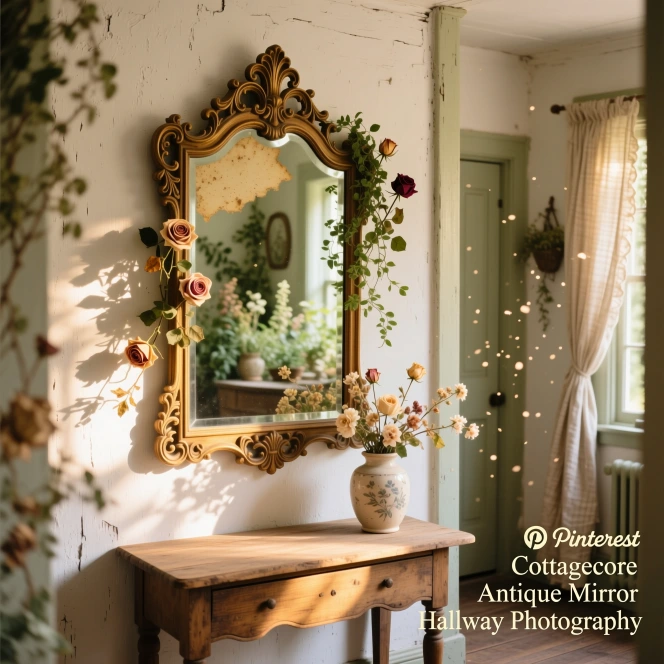
A large antique mirror with a beautifully carved wooden frame — its gilding softened and partially worn through to the gesso beneath, its mirror glass gently foxed with the brown and silver clouding of genuine age — mounted or casually leaned against the cottagecore hallway wall is the decorative element that simultaneously provides the corridor’s most useful practical function, amplifies its natural light and apparent spatial generosity, and introduces the specific aesthetic quality of beautiful decay that distinguishes genuinely antique objects from contemporary reproductions and that cottagecore design celebrates as one of the most honest and most emotionally resonant forms of beauty available in the domestic interior. The foxed mirror — its glass partially silvered by decades of moisture and chemical change that create irregular brown and silver clouding across the reflective surface — creates a quality of reflection that is softer, more dreamy, and more romantically beautiful than a perfect contemporary mirror, returning slightly imperfect, slightly flattering, slightly mysterious images of whoever stands before it.
Source the mirror from an antique dealer, auction house, or estate sale rather than a contemporary reproduction supplier — genuine antique mirrors in carved wooden frames are available at a wide range of price points depending on their period, style, and condition, with modest Victorian overmantle mirrors in painted or gilded softwood frames offering accessible entry points and genuinely beautiful decorative objects. Choose a frame with botanical carving details — scrolling acanthus leaves, carved rose garlands, vine and grape bunches, or the stylized floral ornament of Arts and Crafts furniture — that connects the mirror’s decorative character to the hallway’s botanical design story. Tuck small bundles of dried roses, sprigs of dried lavender, or pressed botanical specimens into the frame’s carved crevices and behind its outer edge for the spontaneous, abundant, living-with-nature quality that distinguishes the cottagecore approach to decorating with antiques from a more formal or museum-like presentation of historical objects. Rest the mirror against the wall rather than mounting it to the wall if the frame is particularly beautiful — the casually leaning position has its own quality of beautiful informality that suits the cottagecore aesthetic perfectly.
12. Potted Ferns and Trailing Plant Cascade
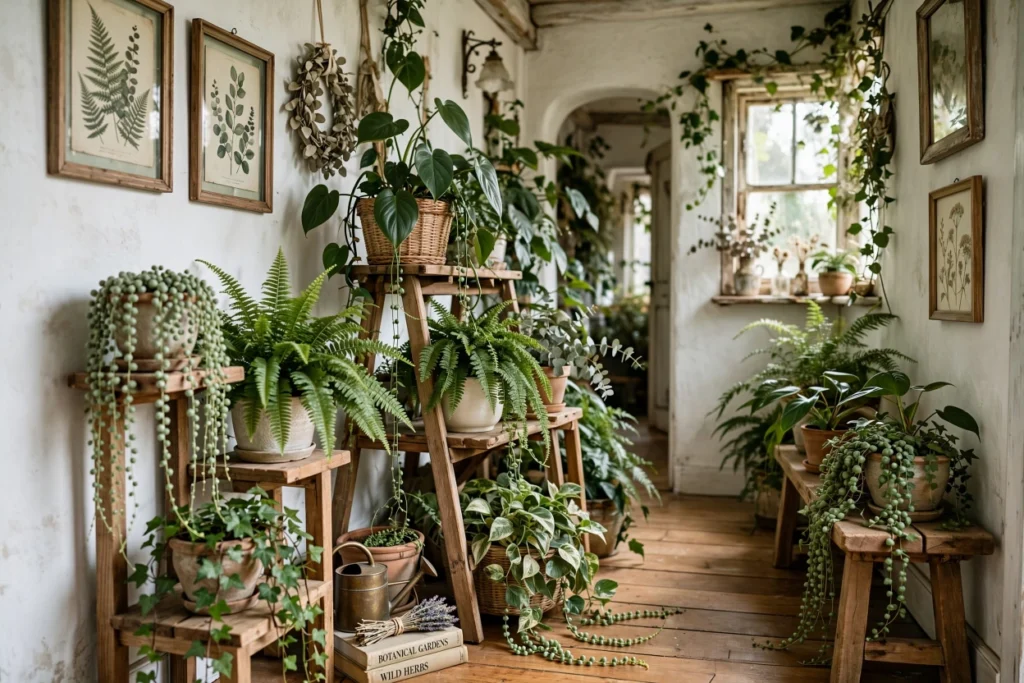
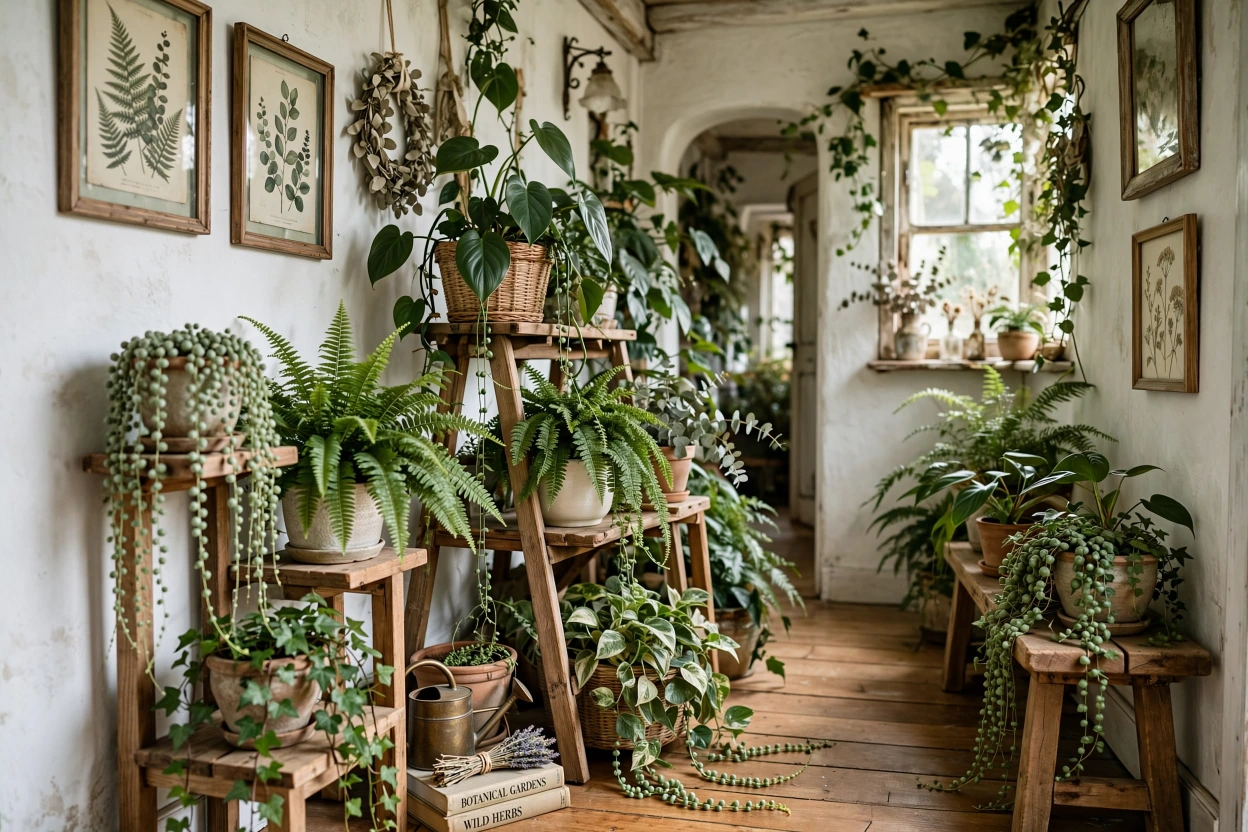
An abundant cascade of potted ferns, trailing ivy, cascading string of pearls, and climbing philodendron arranged on wooden plant stands at dramatically varying heights is the cottagecore hallway botanical design approach that most completely realizes the style’s fundamental aspiration of living in continuous, intimate contact with the plant world — filling the domestic corridor with the specific green abundance, cool humidity, and oxygen-rich atmosphere of a genuine kitchen garden or greenhouse that transforms the simple act of walking through the hallway into a brief, restorative immersion in living botanical abundance. The cottagecore plant hallway is the domestic expression of the Victorian fernery and the Edwardian conservatory translated into a contemporary residential scale — the specific fascination with fern cultivation that swept through Victorian Britain and America, producing an entire horticultural movement called pteridomania, finds its contemporary echo in the cottagecore interior’s devoted accumulation of beautiful, architecturally interesting fern varieties in the most atmospheric areas of the home.
Build the plant cascade from the floor upward using a collection of wooden plant stands at three dramatically different heights — a low stool height, a medium side table height, and a tall plant stand approaching eye level — to create the genuinely three-dimensional botanical installation that a flat, single-level arrangement of floor pots cannot achieve. Choose plants for their specific visual contribution to the overall cascade composition — Boston ferns for their generous, arching fronds that cascade beyond their pot rim in the most dramatically lush way, maidenhair ferns for their delicate, almost translucent leaflets that create a finer texture contrast with the Boston fern’s boldness, trailing English ivy for its classic climbing and cascading character, string of pearls for its otherworldly bead-like trailing stems, and a pothos or heartleaf philodendron for the generous, fast-growing trailing growth that creates the sense of plant abundance increasing and spreading throughout the hallway over time. House plants in a mix of terracotta pots, hand-thrown ceramic vessels, and woven basket pot covers for the varied, collected-over-time aesthetic that cottagecore plant styling achieves at its most beautiful and most convincing.
13. Handmade Rag Rug or Braided Runner
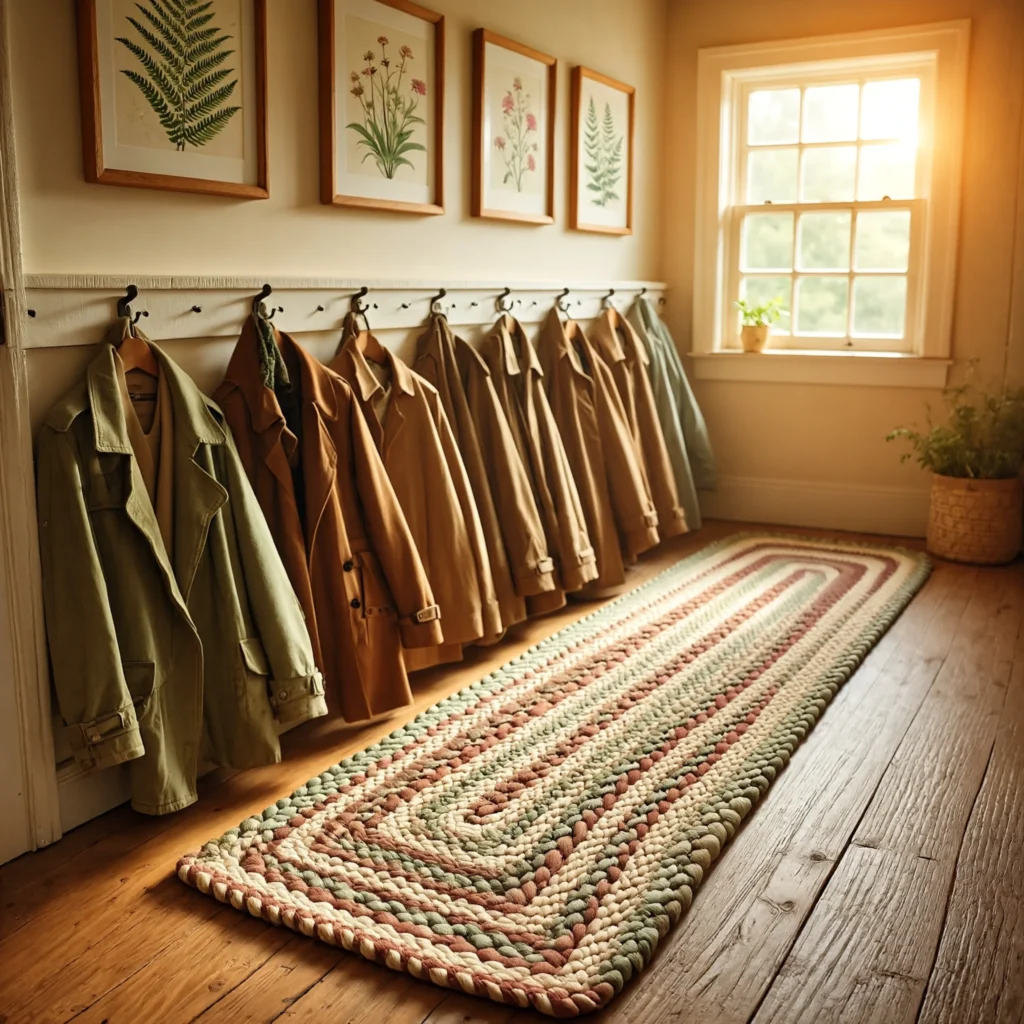
A long handmade braided or woven rag rug running the full length of the cottagecore hallway floor is the textile element that most warmly, most practically, and most craft-authentically completes the corridor’s floor-level design — providing the soft underfoot warmth that any hallway with wooden or stone floors genuinely requires for daily comfort, while introducing the specific aesthetic character of a genuinely handmade domestic textile that carries within its construction the visible evidence of its making and the recycled history of the fabric scraps used to create it. The rag rug tradition — braiding, weaving, or hooking strips of recycled fabric into durable floor textiles — is among the oldest and most universal of all domestic craft practices, present in virtually every pre-industrial culture that produced woven fabric in excess of immediate clothing need, and cottagecore’s celebration of this tradition honors the specific ingenuity, resourcefulness, and craft skill of the rural domestic world it aesthetically inhabits and romantically celebrates.
Make the rug yourself using strips of recycled fabric torn from worn cotton sheets, old linen garments, and salvaged wool blankets in a color palette drawn from the hallway’s existing decorative tones — cream and natural cotton whites, sage and moss greens, dusty rose and lavender pinks, warm biscuit and stone neutrals — braiding the strips into a continuous rope that is then coiled and hand-stitched into an oval or long rectangular form appropriate for the hallway’s dimensions. The braided rag rug’s specific visual character — the regular herringbone texture of the braid, the slight color variations within each strip from its original garment context, and the organic imperfection of hand-stitched coiling — is something that no commercially produced rug can replicate, giving the handmade version a quality of personal craft investment and authentic domestic history that makes it genuinely irreplaceable as a cottagecore floor textile. Alternatively, source a handmade rug from a craft fair, an Etsy artisan, or a specialist rug hooking guild where makers produce genuine handcrafted versions in cottagecore-appropriate botanical and geometric patterns using traditional techniques.
14. Wooden Beadboard Ceiling with Painted Floral Details
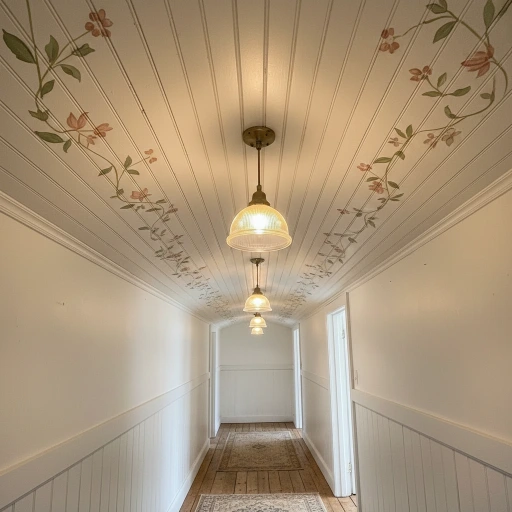
A wooden beadboard ceiling with delicate hand-painted climbing botanical details — roses, sweet peas, and trailing vines winding along the grooves between individual beadboard planks — is the cottagecore hallway design idea that most unexpectedly and most memorably directs the eye upward to discover a surface that most hallway visitors never consciously examine, transforming the ceiling from a neutral, unnoticed overhead plane into a genuine decorative surprise that makes the cottagecore corridor feel more intimate, more personally crafted, and more visually complete than any combination of wall and floor treatments alone can achieve. The beadboard ceiling lowers the apparent height of the space in a way that increases rather than diminishes the hallway’s coziness — a hallway with a beadboard ceiling feels like the interior of a cottage rather than the interior of a contemporary construction, with the specific quality of physical closeness to the room’s structure that characterizes genuinely old, genuinely small-scale domestic architecture.
Install the beadboard using genuine tongue-and-groove pine planks rather than MDF sheet beadboard to achieve the authentic, individual plank character of a real historic ceiling — the slight variation in plank width, the occasional natural knot, and the gentle undulation of a hand-planed surface all contribute to the quality of genuine craft that makes the installation look historically appropriate rather than decoratively applied. Paint the installed beadboard in a warm cream or very pale sage rather than bright white — the slightly warmer tone prevents the low ceiling from feeling sterile or oppressively white while providing the light-reflective brightness that a beadboard ceiling requires to maintain the hallway’s visual luminosity. Apply the hand-painted botanical climbing details using a fine pointed brush and artist’s acrylic paints thinned to a watercolor consistency — painting the climbing rose stems and leaves first in a pale sage green that sits quietly against the cream background, then adding the rose buds and open blooms in blush pink and soft white with a deeper rose center detail that gives each flower the dimensional quality of a simplified botanical illustration at an intimate, close-viewing scale.
15. Vintage Suitcase and Wicker Trunk Stack
A carefully composed corner stack of vintage leather suitcases and wicker trunks in varying sizes, topped with books and small decorative objects, is the cottagecore hallway design idea that most evocatively and most romantically suggests the specific quality of a long-inhabited, story-rich domestic life in which beautiful old objects accumulate naturally over time through use, travel, and inheritance rather than being deliberately purchased for decorative purposes — communicating a quality of personal history and domestic narrative depth that no amount of new purchases, however beautifully chosen, can manufacture or convincingly approximate. The vintage suitcase is the physical embodiment of the cottagecore imagination’s most beloved fantasy — the life lived slowly, beautifully, and in deep connection with the places, people, and objects of the past, each suitcase a container of memory and potential story that has been carried through decades of purposeful, unhurried living.
Source the suitcases from antique markets, estate sales, charity shops, and online vintage marketplaces — prioritizing genuine age and genuine character over pristine condition, since the beauty of a vintage suitcase display depends entirely on the accumulated evidence of actual use: the scuffed leather corners, the faded hotel labels, the brass clasps worn bright from repeated opening, and the specific patina of hide that has been carried through rain and sunshine across decades of travel. Choose a range of sizes that creates a genuinely interesting stacked composition — a large substantial trunk as the base, a medium case in the middle, and a small hat box or overnight case at the top — and vary the materials between leather, canvas, and wicker to create textural variety. Include at least one wicker trunk whose open weave construction introduces a lighter, more cottage-craft texture into the stack alongside the heavier leather cases. Style the top of the stack as a small vignette — a leather-bound journal, a dried flower posy in a small glass bottle, a single candle in a brass holder — for the complete, carefully but casually assembled still-life quality that makes this display most genuinely and most enchantingly cottagecore.
16. Wildflower Arrangement in Vintage Ceramic Jugs
Multiple vintage ceramic jugs and pitchers of varying sizes holding abundant, loosely arranged wildflower bouquets — foxglove stems, cow parsley umbels, climbing sweet peas, garden roses, and meadow grasses gathered in the specific casual abundance of flowers brought directly from garden or field — arranged on a hallway console table with a few fallen petals scattered naturally on the surface is the cottagecore hallway floral design approach that most genuinely and most beautifully captures the style’s relationship with the natural world. This is not the arranged bouquet of florist convention — structurally precise, color-coordinated, and completely free of the natural imperfections of genuine garden harvest — but rather the opposite: flowers chosen for their individual beauty and combined according to what happened to be blooming simultaneously, arranged with the loose, generous hand of someone who values abundance over precision and the natural character of each stem over its controlled placement within a designed composition.
The vintage ceramic vessel is as important as the flowers it holds — the charm of this display depends equally on the character of the jugs and pitchers themselves. Collect over time rather than purchasing at once: a transferware jug from a charity shop, a cream-glazed earthenware pitcher from a farmers market, a hand-painted folk pottery vessel from an antisan fair, a simple stoneware jar from a kitchen salvage sale. The variety of vessel heights, widths, glazes, and decorative treatments creates a display with genuine visual richness and the specific quality of objects that have been loved and collected across years of attentive, pleasure-driven domestic life rather than purchased simultaneously as a coordinated decorative set. Fill each vessel generously rather than sparingly — cottagecore floral arrangements are never sparse or minimalist but rather full to the point of slight overflowing, with stems crossing each other freely, leaves extending beyond the vase rim, and the general quality of abundance that makes a genuinely beautiful garden harvest arrangement look completely and perfectly, joyfully alive.
17. Beehive Skep and Honeycomb Decorative Accents
A vintage straw beehive skep as the centerpiece decorative accent on the hallway console, surrounded by honeycomb-textured beeswax candles, hand-thrown ceramic bee figurines, golden honey jars with handwritten twine labels, and a gallery of botanical bee illustration prints mounted above, is the most thematically specific, most conceptually coherent, and most genuinely charming of all the cottagecore hallway design ideas on this list — creating a complete, unified visual celebration of the bee, the hive, and the honey that is simultaneously one of the most quintessentially rural, most historically rich, and most immediately appealing of all cottage garden themes for domestic interior decoration. The bee has been a symbol of industry, community, sweetness, and the sacred relationship between human domesticity and the natural world in virtually every agricultural culture across history — from ancient Egyptian hieroglyphics to English cottage garden tradition, the bee represents the most positive and most beautiful dimensions of the human relationship with the non-human world.
Source a genuine vintage straw skep — the traditional hand-coiled rye straw beehive that was standard European beekeeping equipment for centuries before the modern wooden hive — from an antique market, a specialist beekeeping equipment supplier who sells decorative versions, or a rural craft practitioner who still makes them using traditional coiling and stitching techniques. The skep’s form is among the most beautiful in the entire vocabulary of traditional craft objects — its simple, perfect dome shape, the visible spiral of its hand-coiled construction, and the warm golden color of aged rye straw create a decorative object of extraordinary material charm that requires no styling support to be genuinely beautiful. Arrange the supporting bee-themed objects around the skep with the generous, slightly casual quality of objects that belong together naturally rather than being deliberately arranged — beeswax candles of varying heights, their honeycomb texture catching the afternoon light, small ceramic bees in mid-flight positions, honey jars with hand-lettered labels, and a scattered handful of dried meadow flowers that might have come from a foraging bee’s working day in the cottage garden just beyond the hallway door.