17 Japandi Christmas Decor Ideas for Calm Holidays
1. Bare Branch Tree with Washi Paper Ornaments
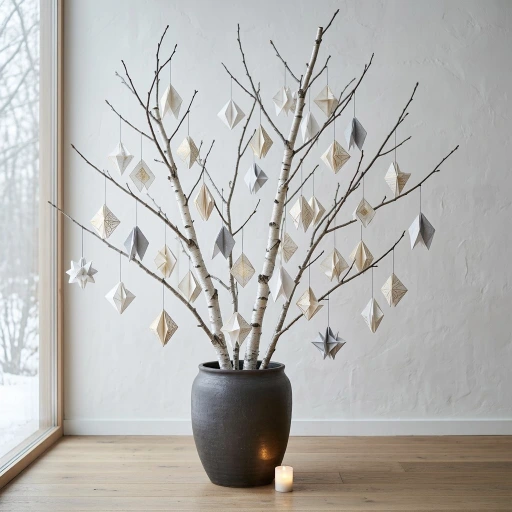
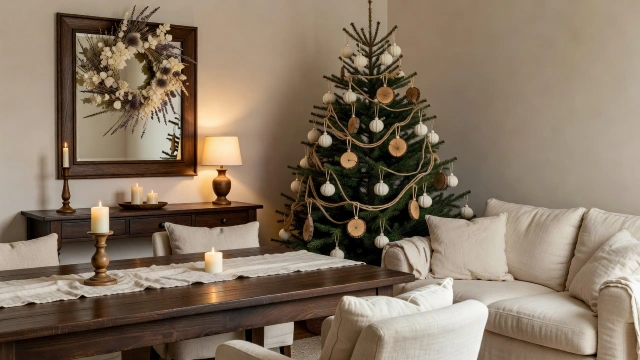
The bare branch tree with washi paper ornaments is the most sculpturally confident and philosophically honest Japandi Christmas focal point possible, celebrating the winter tree in its truest, most architecturally beautiful seasonal form — stripped of foliage and revealed in the pure linear geometry of its bare branching structure — rather than importing an evergreen into the interior and concealing its natural form beneath layers of manufactured decoration. Silver birch branches possess an extraordinary native beauty in their bare winter state — the white bark, the delicate tracery of fine secondary branches, the natural imperfections of each unique branch form — that the Japandi aesthetic honors as more genuinely beautiful and more seasonally truthful than any decorated Christmas tree.
Hand-fold each ornament from genuine Japanese washi paper using simple origami forms — cranes, geometric diamonds, small folded stars, and simple rectangular tags with hand-brushed gold ink patterns — so that every ornament is a small, individual act of making that carries the warmth of human attention and craft in its every fold and crease. The restraint of washi paper ornaments in cream, pale grey, and white against silver birch branches creates a Christmas installation of such complete material harmony — Japanese paper on Japanese birch, winter white on winter white — that the entire composition feels like a found arrangement rather than a designed one, as though the materials simply gravitated toward their most natural and beautiful configuration without conscious intervention. Display the bare branch arrangement in a tall dark ceramic pot weighted with smooth river stones and position it where winter light can cast the extraordinary shadow drawing of the bare branches across the white wall behind throughout the short winter days.
2. Shou Sugi Ban Wooden Advent Numbers
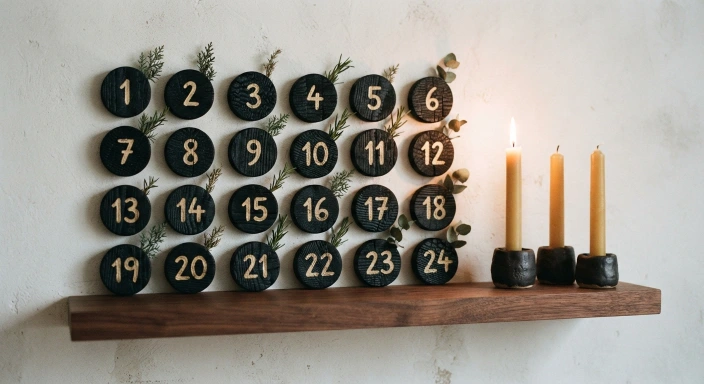
Shou sugi ban wooden Advent number discs are the most materially extraordinary and culturally specific Japandi Christmas calendar object imaginable, bringing the ancient Japanese timber-charring technique into the most beloved Scandinavian Advent counting tradition in a fusion object of such genuine material beauty and cross-cultural depth that it functions simultaneously as a December ritual object, a wall installation of considerable decorative power, and a daily reminder of the extraordinary things that fire, time, and skilled human attention can create from the humblest natural material. Each small cedar disc, charred to a deep, complex black surface with visible grain relief and subtle carbon texture, carries its cream or gold painted number on a background of such quiet, natural drama that the simple act of uncovering each disc as December progresses becomes a genuinely beautiful daily ritual.
Arrange the twenty-four discs in four precise horizontal rows of six on a long floating dark walnut shelf, spacing them with the confident regularity of a Japanese type specimen page — the mathematical clarity of their arrangement creating a beautiful tension with the organic, imperfect surface of each individually charred disc. Tuck tiny dried botanical sprigs of fresh juniper, dried rosemary, or preserved cedar behind alternating discs so that the fragrance of living winter botanicals mingles with the deep, complex charred wood scent of the shou sugi ban surfaces, creating an Advent display that engages the sense of smell as completely as it engages the sense of sight throughout every day of December.
3. Moss and Stone Christmas Centerpiece
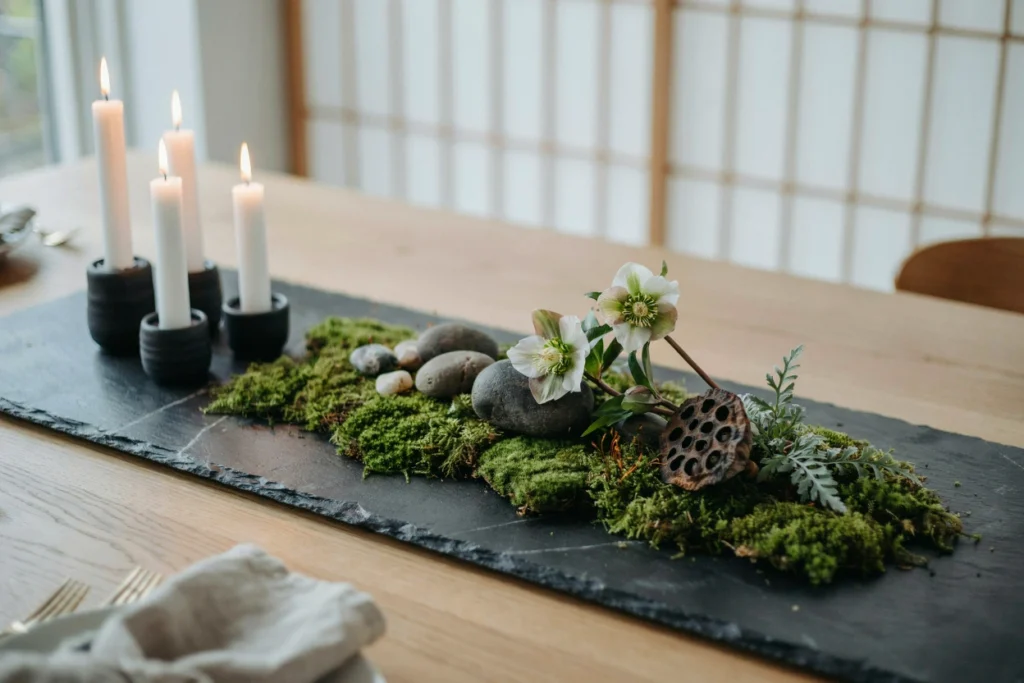
A moss and stone Christmas centerpiece is the most quietly revolutionary Japandi holiday table decoration, replacing the conventional Christmas centerpiece’s abundance of red poinsettias, holly berries, and gold-sprayed pine cones with a living landscape composition of such genuine botanical beauty and contemplative stillness that every guest who sits at the table instinctively slows down, looks carefully, and finds themselves genuinely restored by its presence throughout the meal. The combination of living green moss, smooth grey river stones, and white candles on a dark slate board creates a tabletop meditation garden of extraordinary visual and emotional power — a miniature landscape that references the Japanese dry garden tradition while delivering the warmth and intimate gathering quality that the Scandinavian Christmas table always aspires to create.
Source three genuinely different moss varieties for the composition — the fine, deep green velvet of cushion moss, the feathery complexity of sheet moss, and the silvery, branching delicacy of reindeer moss — arranging them in an organic, asymmetric drift across the slate surface rather than in any geometric pattern, as the naturally irregular distribution of different moss species across a forest floor or rock face is the compositional model this centerpiece aspires to evoke. Position the river stones with the careful deliberateness of a Japanese garden stone arrangement, placing the largest stone slightly off-center as the compositional anchor and graduating smaller stones around it in a naturally convincing distribution that suggests geological process rather than human arrangement, even though every stone has been placed with complete conscious intention.
4. Handmade Beeswax Dipped Taper Candles
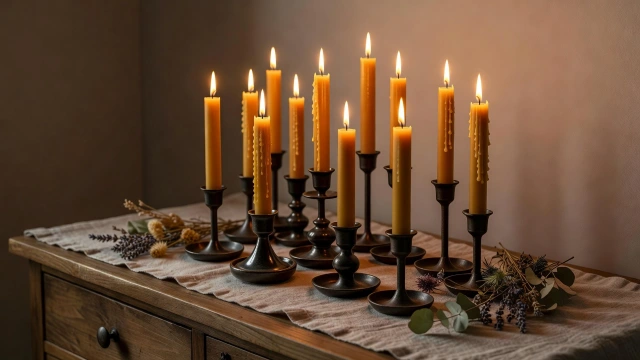
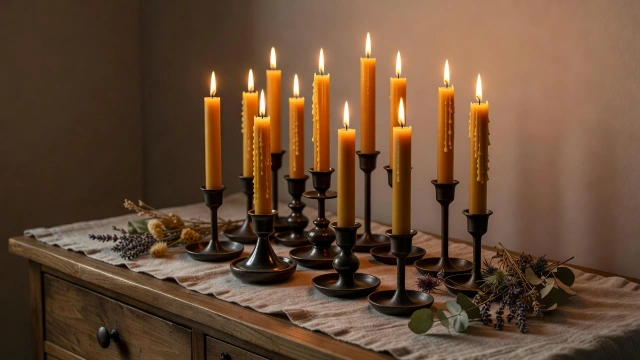
Handmade beeswax dipped taper candles are the most sensory-complete and authentically crafted Japandi Christmas decorating element available, introducing the warm honey amber color of natural beeswax, the complex sweet fragrance of genuine bee-produced wax, and the beautiful slight irregularity of the hand-dipping process into the Christmas interior in a lighting element of such genuine material quality and handcraft integrity that even the unlit candles contribute warmth, beauty, and the quiet pleasure of beautifully made objects to every surface they inhabit. Natural beeswax produces a warmer, deeper amber flame than any other candle material, and its natural fragrance — sweet, slightly floral, warm and complex — is the most beautiful of all winter interior scents without any added fragrance compound whatsoever.
Create your own beeswax tapers using the traditional hand-dipping method — repeatedly dipping a cotton wick into a pot of melted natural beeswax, allowing each layer to cool and harden before the next dip, building the candle gradually through twenty to thirty dipping cycles until the desired diameter is achieved. The slight irregularities of the hand-dipped form — the barely perceptible unevenness of the wax layers, the occasional natural drip frozen on the candle surface, the very slight taper variation between individually made candles — are not imperfections to be corrected but the beautiful evidence of hand-making that gives each candle its unique character and its honest wabi-sabi beauty. Display the completed candles in a collection of dark ceramic and raw iron candlestick holders of dramatically varying heights, grouping them in an asymmetric cluster on a natural linen runner that allows their warm honey color to glow against the neutral textile background.
5. Japanese Furoshiki Christmas Gift Wrapping
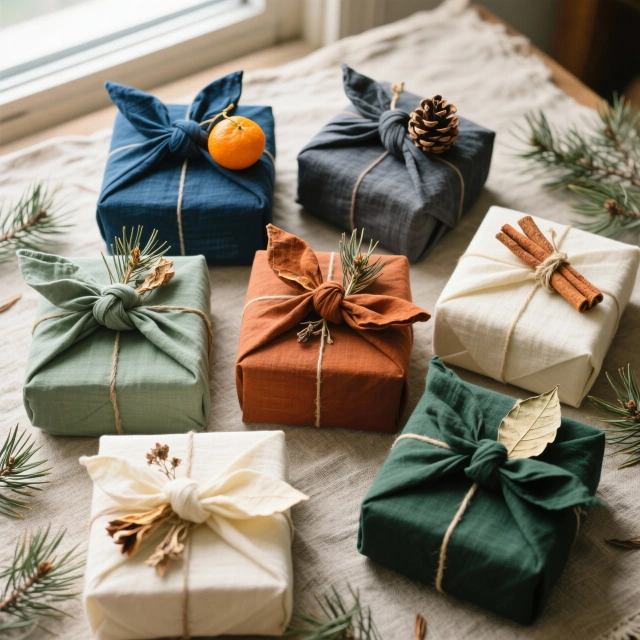
Japanese furoshiki Christmas gift wrapping is the most beautiful, most environmentally conscious, and most genuinely culturally rich Japandi gift presentation practice of the entire holiday season, replacing the disposable one-use paper and plastic ribbon of conventional Christmas wrapping with the Japanese tradition of textile wrapping using reusable fabric squares that transform the very act of wrapping a gift into a small act of craft, care, and cultural connection that makes the fabric wrapping itself a secondary gift as beautiful and considered as the primary present within. Furoshiki — the Japanese practice of wrapping objects in fabric squares using a vocabulary of traditional knots — creates wrapped gifts of extraordinary sculptural beauty whose fabric forms are as varied and individually expressive as the knots used to create them.
Choose furoshiki fabric squares in naturally dyed tones that speak directly to the Japandi winter palette — an indigo blue square for the deep winter sky, a charcoal grey for the bare branch silhouette, a sage green for living juniper and pine, a warm rust for dried botanicals and autumn’s lingering warmth carried into winter, an undyed cream for the first snowfall. Tuck a single natural botanical element into the fabric knot at the top of each wrapped gift — a dried orange slice for its warm color and spiced fragrance, a small pine cone for its geometric perfection, a bundle of three cinnamon sticks for their warm bark fragrance, a single preserved autumn leaf for its paper-thin beauty — creating a gift presentation of such complete material poetry that the recipient experiences the pleasure of discovering and handling the beautiful natural wrapping detail long before they discover the gift it contains.
6. Komorebi Light Installation with String and Paper
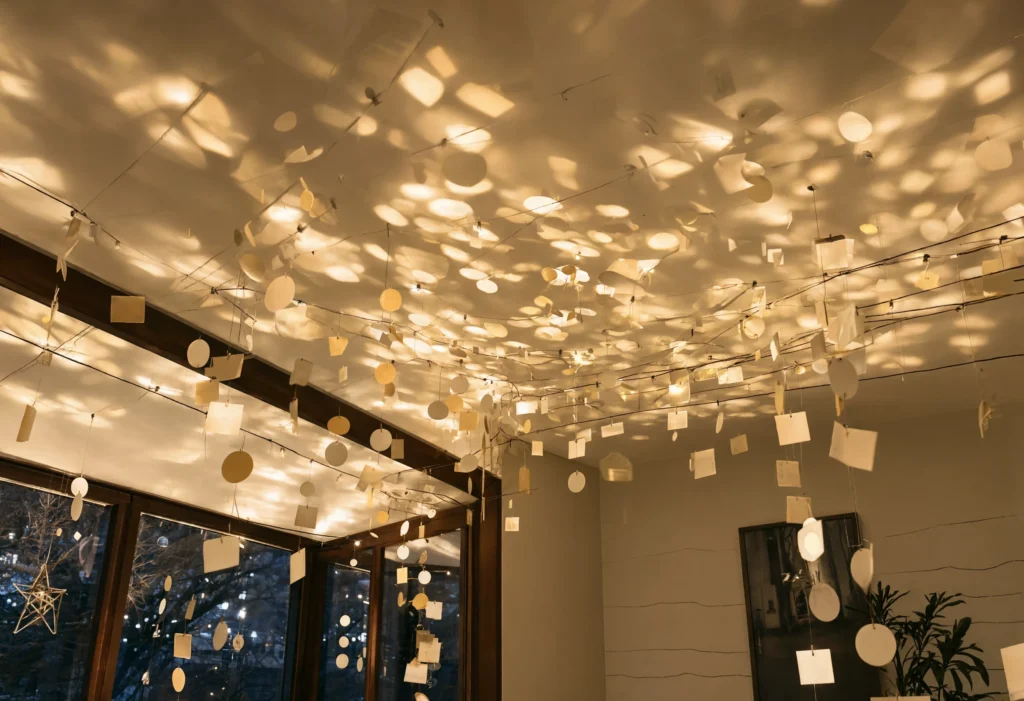
A komorebi light installation with string and translucent paper is the most poetically conceived and most atmospherically transporting Japandi Christmas ceiling decoration imaginable, bringing the untranslatable Japanese concept of komorebi — the interplay of light and shadow filtered through leaves, one of the most beloved and frequently referenced aesthetic experiences in Japanese culture — into the indoor winter room as a ceiling installation that recreates the magical quality of winter light filtering through bare tree branches in a medium of stretched thread and translucent washi paper. The word komorebi has no direct English equivalent because the experience it describes — light not simply present but actively playing, dancing, and filtering through natural obstacles — is considered in Japanese culture a distinct and profoundly beautiful phenomenon deserving its own dedicated linguistic recognition.
Create the installation by stretching thin black threads between opposite walls at varying heights and diagonal angles, creating an irregular geometric network of crossing lines that references the branching structure of a winter canopy as a room-scale drawing in thread. Clip small squares, rectangles, and circles of translucent Japanese washi paper — in white, palest gold, and cream — to the threads at completely irregular intervals using tiny black bulldog clips, positioning the paper elements at different angles to the thread so some hang flat and others twist slightly in air currents, creating gentle movement throughout the installation. Position warm white LED light strips along the room’s perimeter behind the installation, angled upward so that the light passes through the translucent paper elements and casts their warm, filtered glow onto the ceiling above in constantly shifting pools of soft illumination that genuinely recreates the komorebi experience indoors during the darkest month of the year.
7. Ceramic Snow Village on a Driftwood Shelf
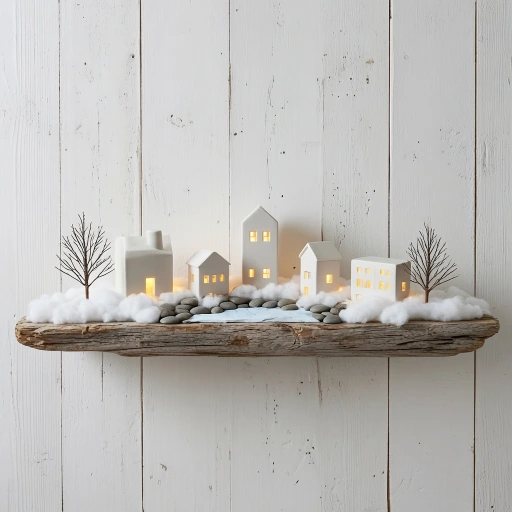
A ceramic snow village composed of simple white matte geometric houses on a driftwood shelf is the most architecturally pure and most genuinely contemporary Japandi Christmas display object, distilling the conventional Christmas village’s sentimental Victorian nostalgia into a composition of complete geometric abstraction that celebrates the pure forms of shelter — the cube, the cylinder, the rectangular prism with a triangular roof — in the most honest and beautiful material available for miniature architecture: white unglazed matte stoneware ceramic. Each small ceramic house is a study in Japandi design principles applied to architectural form — nothing that is not structurally necessary, everything as simple and as beautiful as its material allows, each individual form contributing to the composition of the whole without competing for individual attention.
Commission or purchase the ceramic houses from a studio potter who works in simple matte stoneware, requesting that small square window openings be cut through the clay walls before firing so that a tiny battery-powered LED tea light placed inside each house can glow warmly through the window openings, transforming each geometric ceramic form from a simple sculptural object into a miniature beacon of warm light in the snow village landscape. Arrange the completed houses on the driftwood shelf in an asymmetric village plan with genuine negative space between the buildings — gaps that allow the smooth river stones placed between houses to read as frozen lanes and winter paths — rather than packing the houses together in a space-efficient arrangement that would eliminate the breathing room that makes each individual ceramic form fully visible and fully beautiful in its own right.
8. Natural Pine Cone and Walnut Mantel Display
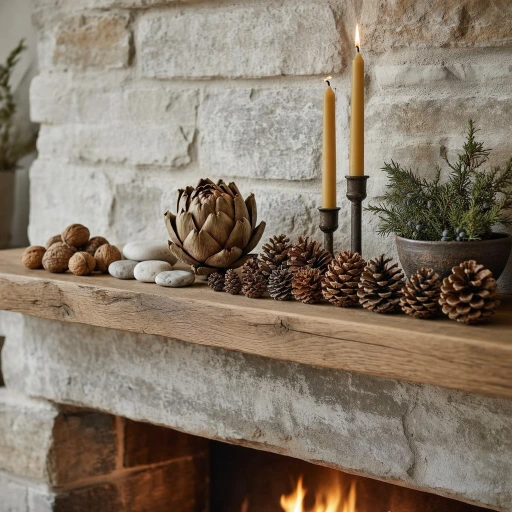
A natural pine cone and walnut mantel display is the most materially honest and most botanically rich Japandi Christmas fireplace decoration, creating a mantel composition of extraordinary natural complexity and quiet visual abundance using only objects gathered from the outdoor winter landscape rather than purchased from a retail store — embodying the Japandi principle that the most beautiful and the most meaningful decorative objects are always those that carry the genuine evidence of their natural origin, their specific place of growth, and the particular season that produced them in their every surface detail and material character. Pine cones gathered from different conifer species within the same afternoon’s woodland walk represent an astonishing diversity of scale, surface texture, and geometric perfection that no manufactured decorative object can rival for sheer natural beauty under close examination.
Arrange the pine cones in a graduated sequence from the largest specimen at one end gradually diminishing to the smallest at the other end of the arrangement, allowing their natural size variation to create a visual rhythm across the mantel surface that is simultaneously ordered and organically varied — the mathematical precision of their graduated arrangement creating a beautiful tension with the completely random, entirely natural variation in the surface texture, color, and exact form of each individual cone. Position a single dramatically large dried artichoke head at the center of the composition as the arrangement’s most unexpected and most geometrically extraordinary element — few natural objects possess the geometric perfection of the dried artichoke’s overlapping bract scales, which form a three-dimensional Fibonacci spiral of absolute mathematical precision that makes the artichoke simultaneously the most complex and the most precisely ordered object in the entire mantel display.
9. Indigo and Cream Textile Christmas Table Runner
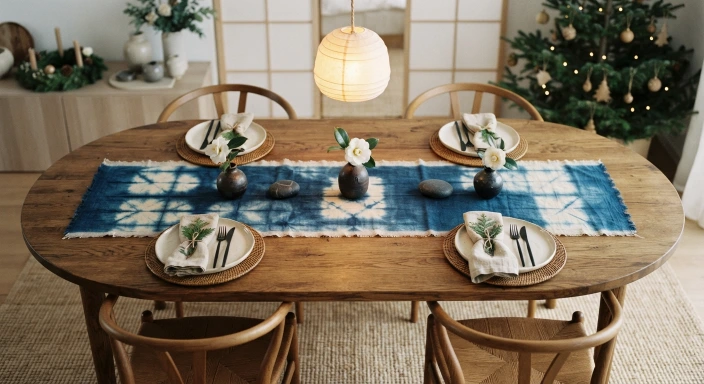
An indigo and cream shibori textile Christmas table runner is the most culturally rich and artistically extraordinary Japandi Christmas table decoration available, bringing the three-hundred-year Japanese tradition of indigo resist dyeing into the Christmas dining room in a textile object of such genuine craft beauty, material depth, and cultural significance that it transforms the dining table from a functional surface into a stage for one of the world’s most beloved and most historically significant textile art forms. Shibori — the Japanese technique of folding, twisting, or binding fabric before dyeing to create resist patterns in which the bound areas remain undyed against the indigo-saturated ground — produces textile patterns of extraordinary variety and natural beauty, each piece unique because each binding creates a slightly different resist pattern in the indigo dye bath, making every shibori runner a genuinely one-of-a-kind handmade object.
Source a genuine hand-dyed shibori runner from a Japanese textile artisan or an indigo-specialist natural dye studio rather than a machine-printed imitation of the shibori pattern, as the genuine hand-dyed piece possesses a depth and variation of color — the indigo shifting from deep navy through medium blue to the palest sky blue at the edges of each resist pattern — that mechanical printing cannot replicate with any fidelity to the original craft process. Allow the runner’s slightly frayed linen edge fringe to remain untrimmed and unfinished, as the honest, living edge of a natural textile is itself a beautiful wabi-sabi detail that communicates genuine material quality and the conscious rejection of over-finished, over-processed textile production in favor of the honest beauty of natural fiber in its most authentic state.
10. Forest Floor Terrarium Christmas Display
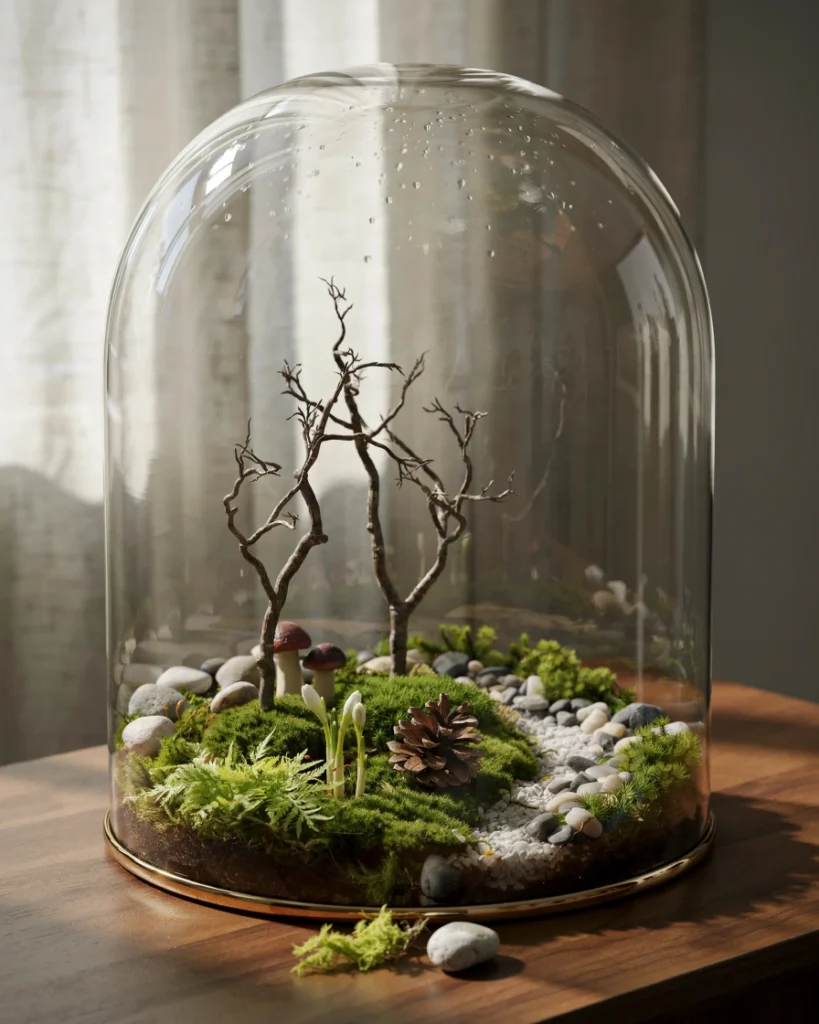
A forest floor terrarium Christmas display is the most biologically alive and most continuously evolving Japandi Christmas decoration on this list, creating a self-sustaining miniature winter woodland ecosystem of extraordinary living beauty within a glass vessel that grows, breathes, and changes throughout the entire Christmas season and well beyond it into the new year, embodying the Japandi philosophy of decorating not with static objects but with living materials that connect the indoor domestic environment to the living natural world outside. The glass terrarium functions simultaneously as a botanical display, a living humidity ecosystem, a contemplative landscape in miniature, and a daily reminder of the extraordinary complexity and beauty of the forest floor ecology that winter simplifies to its most essential elements while concealing none of its fundamental biological richness.
Select a large open glass vessel — a substantial bell jar, a wide-mouthed apothecary jar, or a geometric glass terrarium with an open top — that provides sufficient internal volume for a convincing miniature landscape while allowing the fresh, green, forest scent of the living moss to drift outward into the surrounding room. Layer the terrarium base with horticultural charcoal for drainage, then a thin layer of fine gravel, then a generous depth of terrarium-appropriate potting soil before pressing in the living moss varieties in their natural asymmetric distribution across the entire ground surface. Plant tiny snowdrop or winter aconite bulbs in the moss surface that will emerge and flower during the Christmas season as genuine living botanical events — the appearance of the first white snowdrop flower tip pushing through the dark moss surface is one of the most quietly extraordinary botanical pleasures that a winter terrarium can offer, and its timing is entirely governed by the bulb’s own biological calendar rather than any human decorating intention.
11. Linen and Hemp Macramé Christmas Wall Hanging
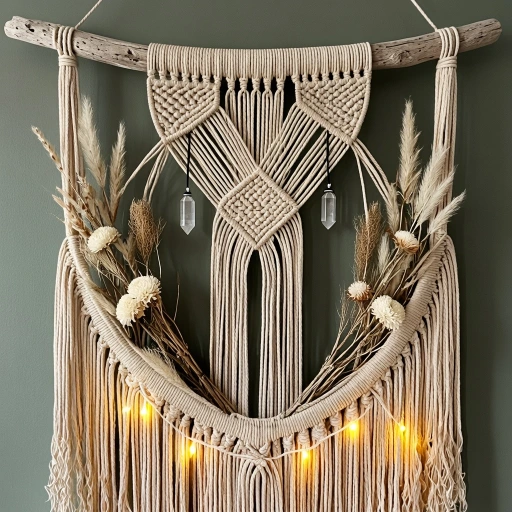
A linen and hemp macramé Christmas wall hanging with botanical inclusions is the most tactilely rich and most individually expressive Japandi Christmas wall decoration available, combining the ancient fiber craft of macramé — practiced in some form in virtually every human culture’s textile tradition — with the natural botanical inclusions of the Japandi winter decorating vocabulary in a large-scale wall artwork that transforms the entire surface it inhabits with the warmth of handmade fiber, the organic beauty of dried winter botanicals, and the quiet light of small warm bulbs woven into its fringe. The undyed natural linen and hemp cord of the macramé structure exists in a state of such complete material harmony with the dried pampas grass, preserved botanicals, and raw crystal points woven throughout it that the entire piece reads as a single, organically unified natural object rather than a craft project assembled from separate purchased components.
Design the macramé around a large central diamond knotted form with deliberately maintained open negative space sections within the diamond’s interior — the open spaces within the knotted structure are as compositionally important as the knotted cord itself, creating windows of air and wall-surface visibility that give the hanging its sense of lightness, breathing room, and the particular Japandi quality of generous empty space as an active, beautiful compositional element rather than a void awaiting filling. Weave small warm battery LED lights into the lower fringe section of the hanging, positioning the light sources within the hanging’s fiber structure so that the light glows outward through the cord as warm amber warmth rather than shining nakedly from visible bulb points, creating the most intimate and most integrated textile lighting effect achievable in a macramé format.
12. White Amaryllis Single Stem Vignettes
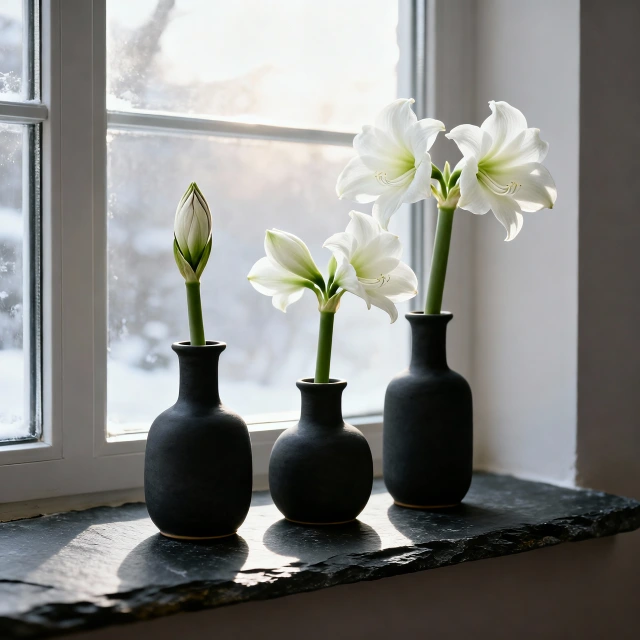
White amaryllis single stem vignettes are the most classically beautiful and most seasonally powerful Japandi Christmas botanical display, celebrating the single flower stem as a complete and sufficient decorative statement in the tradition of Japanese ikebana flower arrangement philosophy — which has always held that one perfect flower in one perfect vessel, placed with complete attention and intention, creates more genuine beauty than a hundred flowers arranged without discrimination. The white amaryllis is the most architecturally magnificent winter-blooming flower available in temperate climates — its thick, hollow stem of dark architectural green, its tight closed bud as geometric and as perfect as a carved wooden form, and its fully opened four-trumpet flower head of extraordinary white velvet beauty make it one of the few flowers that is as beautiful in each stage of its development as it is in its moment of peak bloom.
Display three individual amaryllis stems in three identical dark matte ceramic bud vases of varying heights, deliberately choosing stems at three different stages of development — tight closed bud, half-open, and fully open — so the complete vignette of three vases tells the entire developmental story of the flower’s blooming process simultaneously, creating a display that changes meaningfully day by day as the closed bud opens and the fully open flower begins its gradual, beautiful decline toward the equally beautiful final stage of the open, turning, spent flower head. The darkness of the matte ceramic vessel against the white of the amaryllis flower creates a visual contrast of such complete simplicity and elegance that no additional decorative element of any kind is needed or appropriate — the dark vessel and the white flower are sufficient, complete, and perfect in their two-element composition.
13. Minimalist Christmas Village with Rice Paper Lanterns
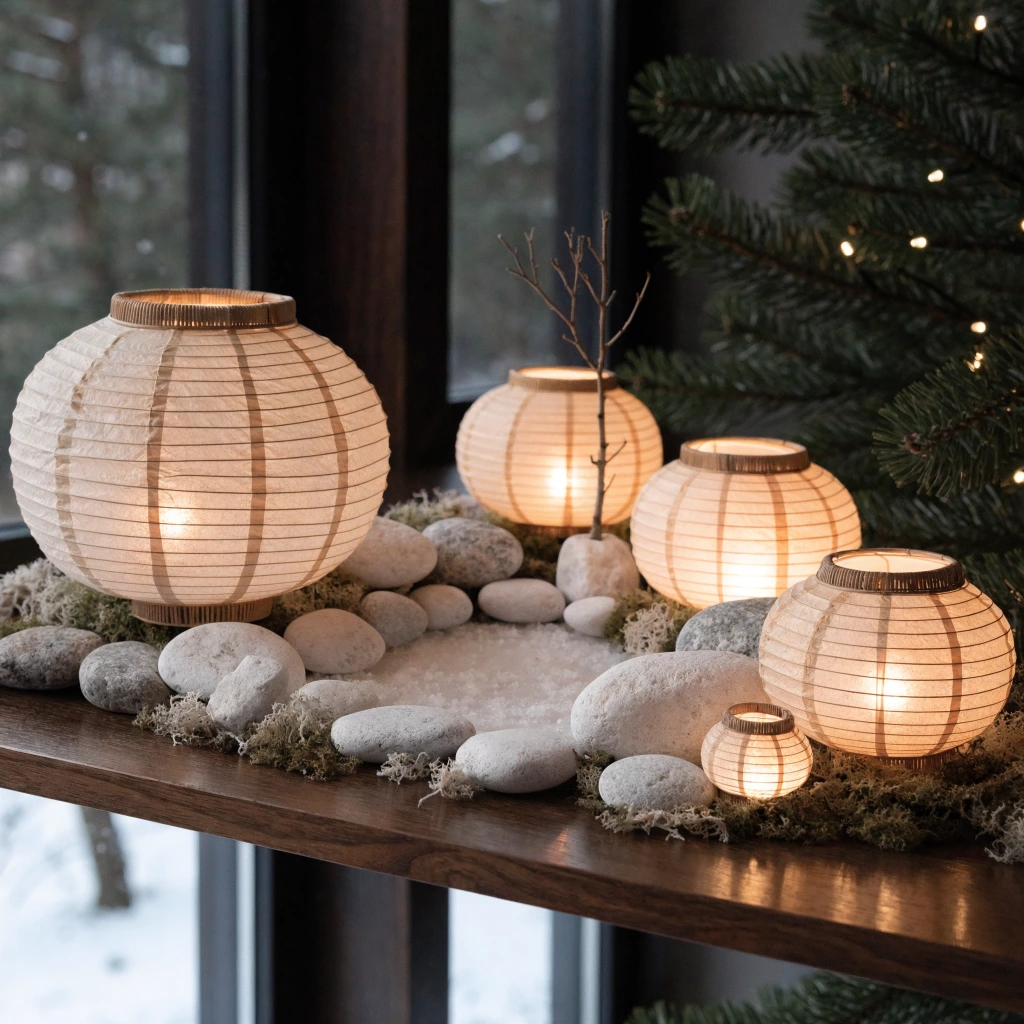
A minimalist Christmas village created from Japanese round rice paper lanterns is the most inventive and most atmospherically magical Japandi Christmas shelf display idea of the season, reinterpreting the beloved Western tradition of the ceramic Christmas village through the lens of Japanese paper lantern craft in a fusion display that achieves all of the original village tradition’s warmth, glow, and sense of intimate winter community within a material vocabulary of such complete Japandi purity — natural rice paper, warm LED light, smooth river stone, living moss — that it functions as a genuine design object rather than a sentimental seasonal decoration. The round rice paper lanterns, each glowing warmly with the soft amber light of its internal LED source, suggest illuminated windows in snow-covered houses with an abstract, poetic economy of means that is far more visually interesting and far more emotionally resonant than literal ceramic house figurines.
Vary the lantern sizes dramatically — one large lantern as the village’s central community building, two medium lanterns as substantial houses on either side, and two small lanterns as more modest dwellings at the composition’s outer edges — creating a genuine sense of architectural hierarchy and urban variety within the village plan that makes the composition feel like a real inhabited place rather than an arbitrary collection of spherical forms. Press tiny sections of living moss flat against the shelf surface between and around the lantern bases to suggest snow-covered ground of a different biological character than actual snow, introducing a living, gently fragrant green element that prevents the village display from becoming too abstract or too visually cold in its monochromatic white and amber palette.
14. Hand-Thrown Ceramic Christmas Tree
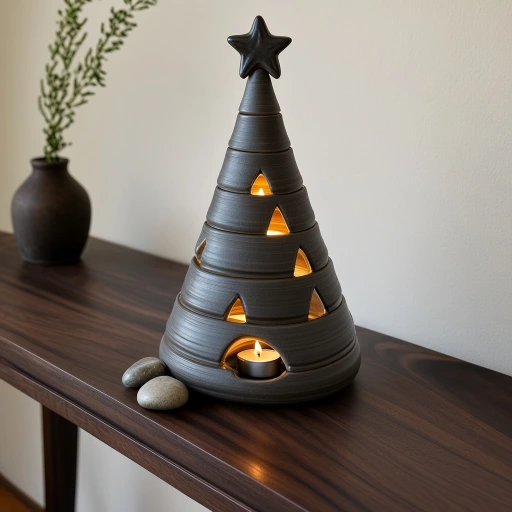
A hand-thrown ceramic Christmas tree is the most permanently beautiful and most philosophically complete single Japandi Christmas decorating object available — a functional sculpture that replaces the conventional Christmas tree with a single handmade ceramic object of such genuine craft beauty, material honesty, and warm glowing presence that it serves as a complete Christmas focal point in itself without requiring any additional decoration, any further ornamentation, or any supplementary decorating elements beyond the smooth river stones placed at its ceramic base and the warm tea light candle burning within its hollow interior. The hand-thrown ceramic Christmas tree embodies every Japandi value simultaneously — the honest beauty of the material, the visible evidence of the maker’s hand in the clay surface, the functional elegance of a form that is simultaneously sculpture and light source, and the profound satisfaction of choosing one beautifully made, permanently valuable object over many disposable seasonal decorations.
Commission the ceramic tree from a studio potter who works in dark stoneware clay, requesting that the throwing rings be left visible on the exterior surface rather than smoothed away — the horizontal throwing marks that record the upward movement of the potter’s hands through the wet clay are among the most beautiful and most technically honest surface details in all of ceramic craft, and their presence on the Christmas tree form transforms the object from a mere decorative reproduction of a tree shape into a genuine record of a specific making process performed by specific human hands at a specific moment in time. Small triangular cut-out windows pierced through the clay wall before firing allow the warm candlelight from the tea light burning within to glow outward through the dark ceramic as points of warm amber light that suggest ornaments, suggest windows, and suggest the most essential quality of the Christmas tree — its capacity to be a source of warm, gathered light in the darkness of the winter season.
15. Scandinavian Straw Star Mobile
Scandinavian straw star mobiles are the most traditionally rooted and most genuinely handcrafted Japandi Christmas ceiling decoration available, connecting the contemporary Japandi design philosophy directly to the ancient Nordic folk craft tradition of creating geometric star forms from dried rye straw as seasonal decorations that celebrate both the agricultural abundance of the summer harvest now stored safely for winter and the return of light promised by the winter solstice’s turning point in the darkest season. The julstjärna — Swedish Christmas star — woven from dried rye straw using the same folding, weaving, and binding techniques practiced in Scandinavian farmhouses for centuries, possesses a material beauty of extraordinary warmth and authenticity that no manufactured decoration of any kind can replicate, because the beauty of genuine dried rye straw is inseparable from its agricultural origin, its seasonal harvest context, and the specific quality of golden amber light that it captures and reflects in its dried, preserved surface.
Assemble seven straw stars of three different sizes — two large, three medium, two small — using dried rye straw soaked briefly in warm water to achieve the flexibility needed for weaving without breaking the individual straw stalks, then allowed to dry completely in their woven form over twenty-four hours before hanging. Vary the star forms between the classic eight-pointed Swedish Advent star, the sixteen-pointed more complex star pattern, and the simpler four-pointed cross form, so the mobile presents genuine formal variety across its seven elements rather than simply repeating the same star pattern at different scales. The golden amber color of the dried straw against the white ceiling and winter light of a December room creates one of the most genuinely beautiful and most culturally authentic Japandi Christmas visual compositions available — Nordic craft material in Japanese compositional principle, warm agricultural gold against winter white and grey, ancient folk knowledge expressed through contemporary minimalist display.
16. Dark Ceramic Vessel Winter Branch Arrangement
A dark ceramic vessel holding a winter branch arrangement in ikebana style is the most culturally authentic and most compositionally disciplined Japandi Christmas decorating idea on this entire list, applying the three-element triangular compositional philosophy of Japanese ikebana flower arrangement to winter botanical materials that are uniquely available in the Christmas season — bare oak branches with their beautiful lichen-covered bark, dried cotton stems with their extraordinary white boll forms, fresh pine branches carrying the season’s most evocative fragrance. The dark ceramic vessel is not merely a container for the branches but an active compositional participant in the complete arrangement — its size, weight, color, and material character must be chosen in deliberate relationship to the specific branches it will hold, creating a vessel-and-branch dialogue of the kind that ikebana masters spend decades learning to hear and respond to with genuine sensitivity.
Choose the three branch materials with the discriminating attention that ikebana demands — the tall primary shin element must reach dramatically upward and establish the arrangement’s primary directional energy, the medium secondary soe element must mediate between the vertical aspiration of the shin and the horizontal groundedness of the arrangement’s base, and the low tertiary tai element must feel genuinely close to the viewer, intimate and human in its scale and accessible quality. Allow the arrangement’s negative space — the open air between and around the three branches — to be as consciously composed as the branches themselves, adjusting each element until the empty space between them feels as natural, as balanced, and as beautiful as the botanical materials that define its boundaries. The complete arrangement in its dark ceramic vessel on the slate board with its single river stone companion is a sufficient and complete Christmas decoration for an entire room — which is precisely the radical, liberating, and genuinely beautiful claim that the Japandi Christmas philosophy makes about the nature of decorating excellence.
17. Washi Tape Christmas Window Art
Washi tape Christmas window art is the most accessible, most reversible, and most surprisingly beautiful Japandi Christmas decorating idea for window surfaces — creating geometric snowflake and branch patterns of considerable graphic beauty and seasonal poetry from the most modest and most universally available craft material imaginable, using only strips of Japanese washi tape applied directly to the interior window glass in patterns that allow the outdoor winter light to filter through the untaped glass around the design, creating a stained-glass-without-color effect of extraordinary winter beauty that costs almost nothing, requires no special skill beyond patience and geometric attention, and removes completely without leaving any mark on the glass when January arrives. Washi tape’s beautiful translucent quality — unlike opaque masking tape, genuine Japanese washi tape has a slight translucency that allows the light through the glass to glow warmly through the tape itself — makes it the ideal medium for window art that works with light rather than blocking it.
Design the snowflake pattern on paper first at the exact scale you intend to apply it to the window, measuring the available glass area and calculating the six arms of the snowflake’s symmetrical radiation from the central point with geometric precision before beginning the tape application. Begin the window application at the center point of the snowflake, applying the six primary arms first as long straight tape lines radiating outward at sixty-degree intervals, then adding the secondary branches on each arm in the classical geometric snowflake pattern before finishing with the finest tertiary detail lines at the outer extremities of each arm. The completed washi tape snowflake seen from inside the room against the pale grey winter light coming through the surrounding clear glass is one of the most quietly beautiful and most genuinely surprising Japandi Christmas visual experiences available — a graphic artwork made from the simplest materials, powered entirely by natural winter light, and beautiful in the most completely unpretentious and honest possible way.