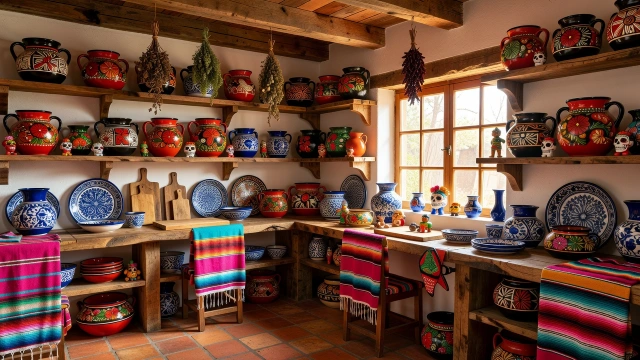
17 Restored Italian Country House Ideas with Timeless Charm
1. Exposed Stone Wall Interior with Lime Plaster Panels
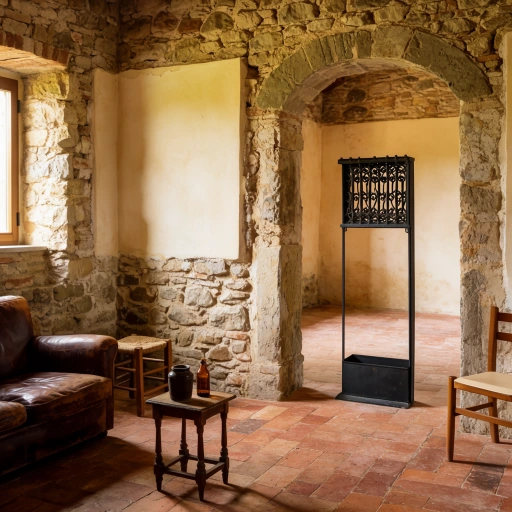
The exposed stone wall interior with lime plaster panels is the foundational decorative gesture of the authentically restored Italian country house, celebrating the original building material in its most honest, unadorned form while introducing the warmth and luminosity of traditional Italian lime plaster to create a wall surface of extraordinary textural dialogue between rough and smooth, ancient and finished, geological and human. Original fieldstone walls in the warm golden, grey, and rust tones of regional Italian limestone or tufa reveal themselves as the most beautiful wall covering imaginable when partially exposed — each stone placed by a mason centuries ago, each mortar joint worn to a gentle softness by generations of habitation and the slow chemistry of lime.
Work with a traditional lime plaster artisan rather than standard cement render when finishing the sections of wall between exposed stone zones, as lime plaster breathes with the ancient stone structure in a way that modern cement cannot, preventing moisture trapping that causes long-term structural damage to historic masonry. The warm cream tone of freshly applied lime plaster deepens and softens beautifully over months and years as the carbonation process continues, developing a quality of aged luminosity that painted gypsum board walls can never approach regardless of paint color or finish. Leave the most characterful sections of original stonework fully exposed — particularly around arched doorways, window surrounds, and fireplace openings — where the stone’s structural role in the building’s history is most architecturally legible and most visually magnificent.
2. Terracotta Cotto Floor with Antique Encaustic Border Tiles
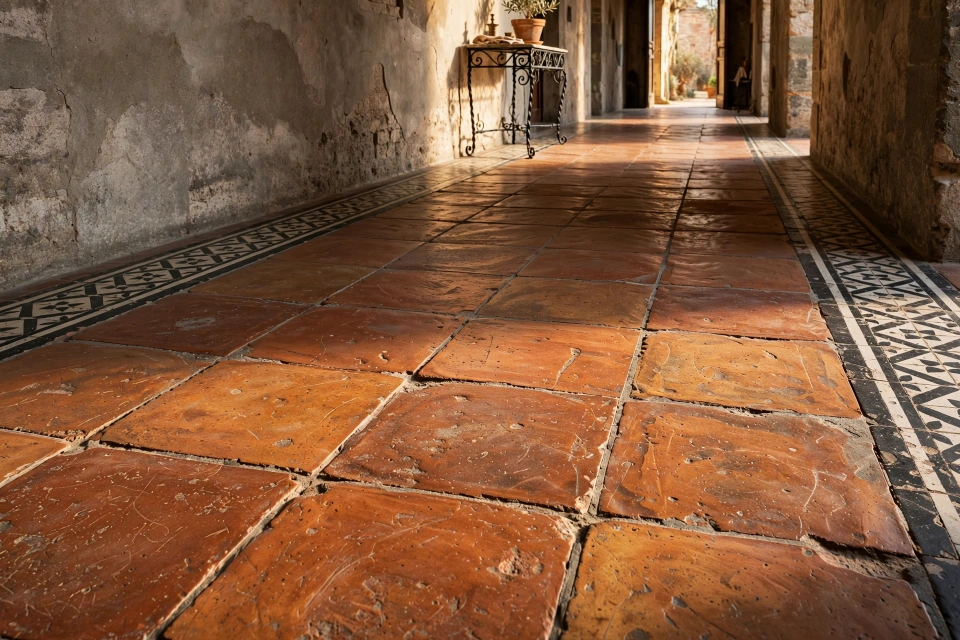
Handmade terracotta cotto flooring is the single most authentically Italian country house material available to the restorer, a fired clay tile made in the hills of Tuscany, Umbria, and Puglia using essentially unchanged techniques since the Renaissance period whose warm amber-red tones, natural surface variation, and deeply satisfying weight underfoot create a sense of permanent, rooted habitation that no contemporary flooring material can remotely replicate. Each handmade cotto tile carries the slight irregularity of its human making — variations in color from the kiln’s uneven heat, subtle differences in thickness, the occasional thumbprint pressed into the clay before firing — that collectively create a floor surface of living, breathing warmth rather than the deadening uniformity of machine-made tile.
Source genuine handmade cotto tiles from traditional Tuscan or Umbrian tile workshops that have maintained artisanal production methods across multiple generations of the same family, as the quality of hand-thrown cotto is immediately distinguishable from machine-pressed imitations in the richness of color variation and the gentle undulation of the tile surface that catches and plays with raking light in ways flat machine tiles never achieve. Introduce an antique encaustic cement tile border along wall edges and doorway thresholds for the most historically authentic Italian country house floor treatment — original encaustic tiles salvaged from demolished buildings carry decades of beautiful wear and the specific color quality of nineteenth-century mineral pigments that contemporary reproductions cannot fully replicate regardless of production care and material quality.
3. Vaulted Brick Ceiling with Iron Chandeliers
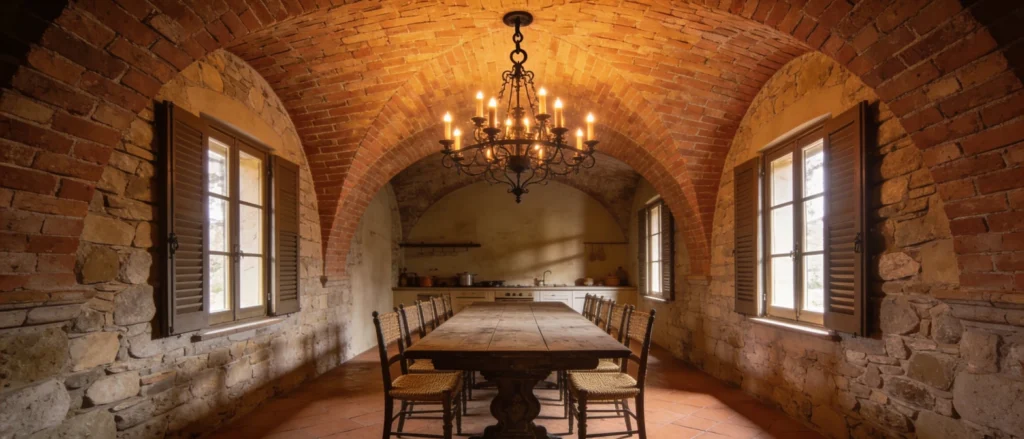
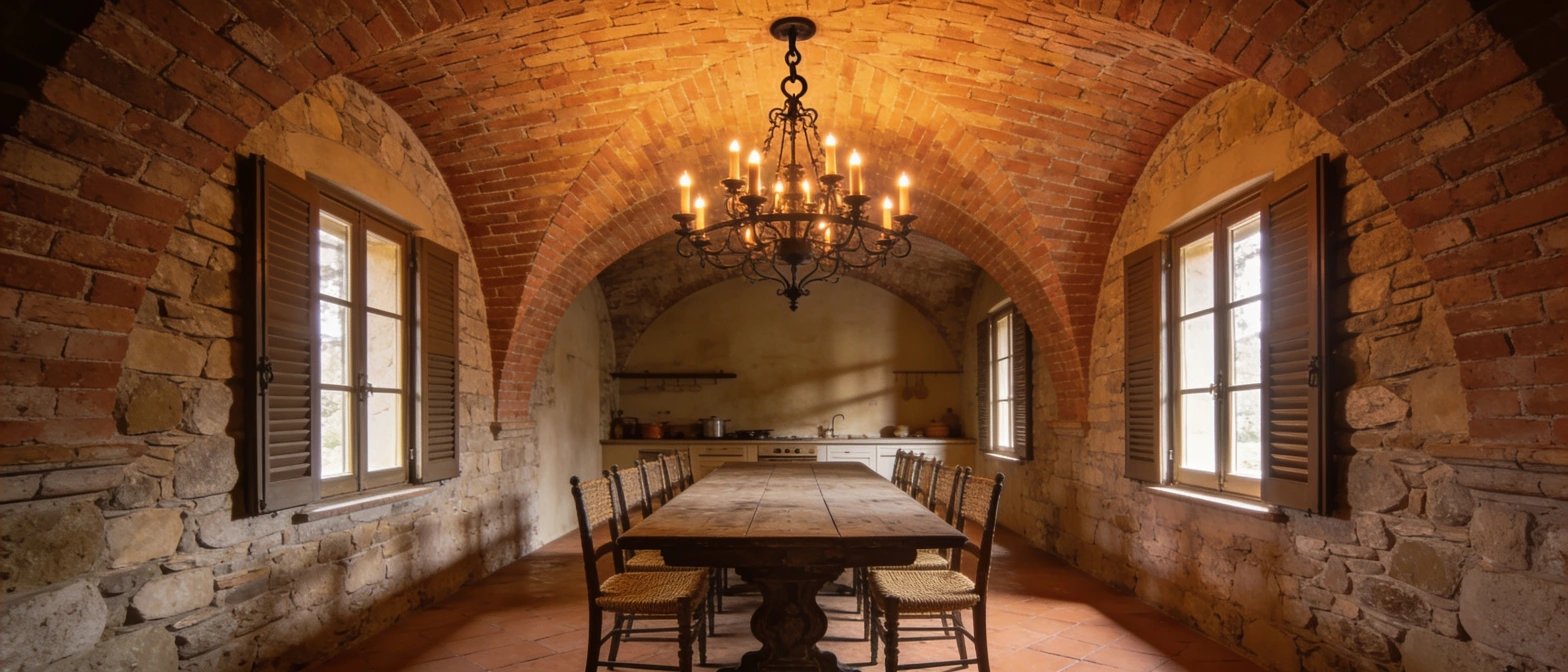
The vaulted brick ceiling is the most dramatically beautiful and most distinctly Italian architectural element in the restored country house, a structural system of such inherent geometric elegance and material warmth that every room it covers is immediately elevated to a spatial experience of quiet grandeur that flat ceilings — regardless of how beautifully decorated — simply cannot approach. The barrel vault, the cross vault, and the Catalan tile vault appear throughout Italian rural architecture from medieval farm buildings to Renaissance villas, expressing in their curved geometry both the structural intelligence of pre-industrial building masonry and an intuitive beauty of form that makes every vault feel simultaneously ancient and absolutely contemporary in its aesthetic authority.
Restore original brick vaulting with matching handmade brick sourced from specialist demolition salvage yards or traditional brick manufacturers who maintain period-appropriate production methods, avoiding the jarring visual interruption of modern machine brick patches within an original handmade structure. The curved surface of a brick vault creates extraordinary acoustic qualities in a room — voices and music resonate with a warm, chapel-like quality entirely different from flat-ceilinged rooms — making vaulted spaces the most naturally beautiful rooms for the extended family dinners and convivial gatherings that Italian country house living celebrates as its highest daily ritual. Hang a substantial wrought iron chandelier from the vault’s crown using a long drop chain that positions the fixture at the most flattering height above the dining table, its amber candlelight reflecting warmly in the curved brick surface overhead.
4. Original Wooden Beam Ceiling with Antique Chestnut Timbers
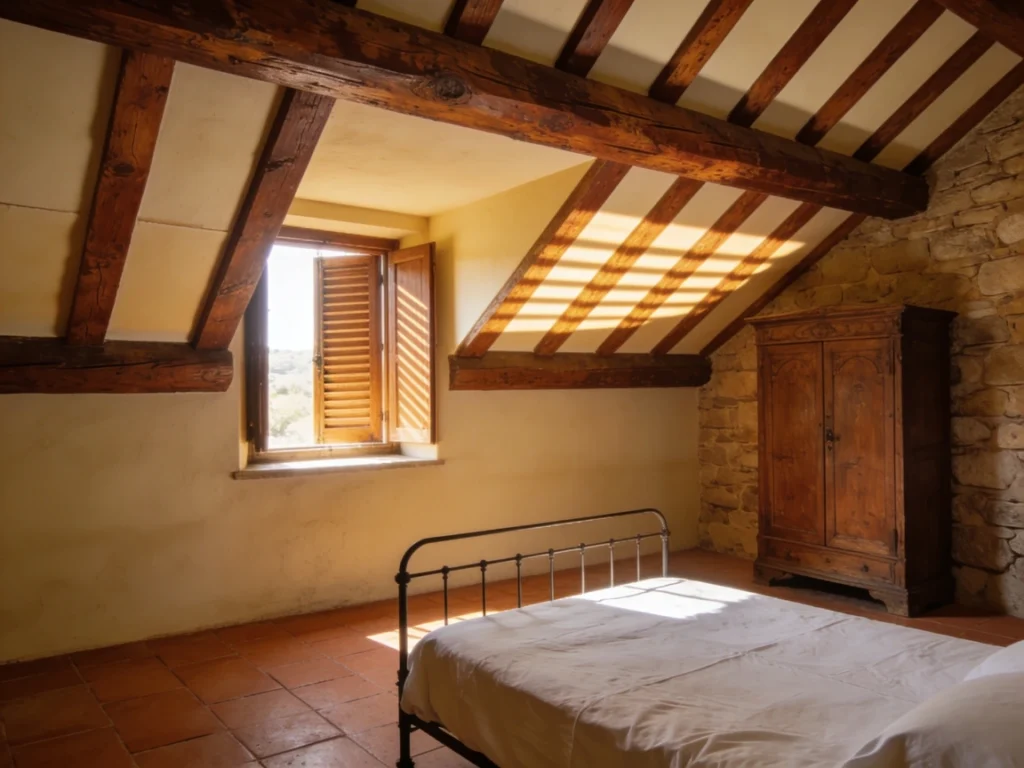
Original wooden beam ceilings in antique chestnut or oak are the most universally beloved architectural feature of the restored Italian country house — the first thing every visitor looks upward to see, the detail most consistently cited by Italian rural property buyers as the irreplaceable quality that made them fall in love with a particular house above all other candidate properties they considered. The centuries-old chestnut beams of a Tuscan farmhouse or Umbrian stone house carry an irreplaceable quality of presence and age — the deep warm brown of genuinely old timber darkened by generations of cooking smoke, the beautiful checking and splitting patterns of ancient wood that has expanded and contracted through four or five hundred summer cycles, the slight sag at mid-span that reveals the long, slow creep of timber under structural load over centuries of faithful service.
Never replace original ceiling beams with new timber regardless of how structurally sound they appear to be, as the age and patina of genuine antique chestnut is irreplaceable and the building’s historical character diminishes irreparably with every original timber element removed. Where beams require structural reinforcement, consult with a specialist in historic timber structures who can advise on traditional repair techniques using compatible materials and methods that strengthen without replacing. Restore the plaster panels between beams using traditional lime plaster in a warm ivory tone that picks up the golden undertone of aged chestnut, and leave the beam surfaces completely untreated rather than applying any oil, wax, or varnish that alters their natural aged appearance and the beautiful matte quality of centuries-old timber surface.
5. Arched Stone Doorways and Window Reveals
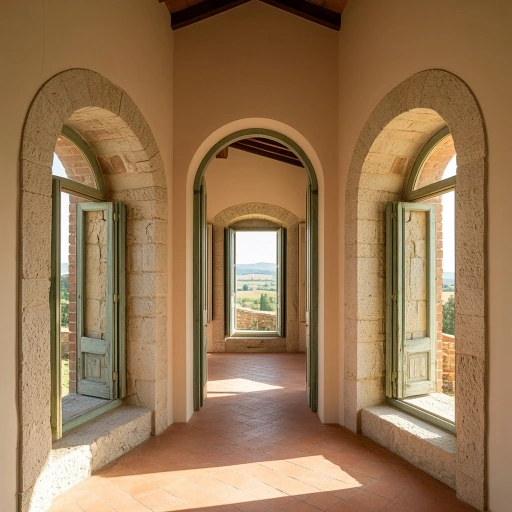
Arched stone doorways and deep window reveals are the most eloquent architectural witnesses to the age and constructional integrity of a genuine Italian country house, communicating the building’s historical depth and material seriousness through structural elements that cannot be faked, reproduced at affordable cost, or appreciated at their full value in a photographic image — they must be experienced in person, walked through, and touched to be fully understood as the extraordinary architectural gifts they represent. The arch is the fundamental structural device of Italian masonry construction from ancient Roman aqueducts to Renaissance palace doorways to humble farmhouse openings, expressing in its curved geometry both the structural logic of compressive masonry and an aesthetic refinement that makes every arched opening more beautiful than any rectangular alternative regardless of context or scale.
Restore original stone arches by carefully removing any cement or gypsum render that may have been applied to them in previous insensitive modernization works, revealing the original stone voussoirs and their traditional lime mortar joints that tell the complete structural story of how the arch was built. Deep window reveals — sometimes sixty to eighty centimeters of solid stone wall thickness in medieval and Renaissance rural construction — create the most beautiful deep-set window conditions imaginable for interior decoration, providing stone window seats, display ledges for terracotta vessels and candles, and a quality of framed daylight entering the room that shallow contemporary window construction can never replicate. Paint original interior wooden shutters in the traditional faded green, blue-grey, or ochre tones of Italian regional painting traditions rather than replacing them with modern hardware.
6. Rustic Italian Kitchen with Pietra Serena Stone Countertops
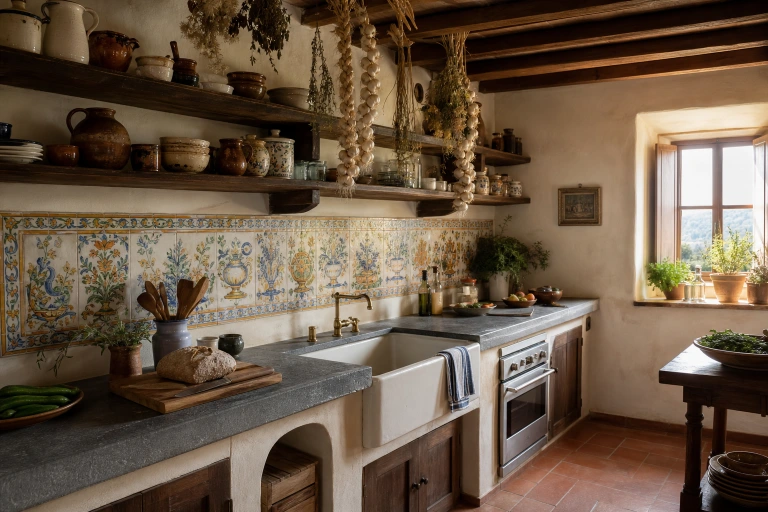
The rustic Italian farmhouse kitchen with pietra serena stone countertops is the most soul-satisfying room in the entire restored Italian country house, a working space that has been shaped by generations of daily cooking practice into a form of such accumulated functional wisdom and material beauty that it requires almost no decorative intervention beyond honest restoration and the faithful reinstatement of traditional materials. Pietra serena — the blue-grey limestone quarried in the hills around Florence since the Etruscan period and used by Brunelleschi and Michelangelo in the greatest architectural works of the Renaissance — brings to the farmhouse kitchen counter a quality of serious, intellectually rigorous material beauty that is simultaneously humble in its matte surface and magnificent in its geological depth.
Open chestnut wood shelving rather than upper cabinets with doors is the most authentically Italian kitchen storage solution, displaying the everyday working collection of hand-thrown ceramic bowls, terracotta baking dishes, brass colanders, and glass preserving jars as the honest, beautiful evidence of a kitchen that is genuinely used rather than architecturally staged for photographic appearances. Install a large ceramic farmhouse sink with a single lever brass tap as the kitchen’s functional centerpiece, and introduce hand-painted Deruta ceramic tiles as a backsplash panel behind the cooking area — the bold cobalt blue, deep orange, and emerald green geometric patterns of traditional Deruta majolica provide the single concentrated burst of Italian decorative color that the restrained material palette of lime plaster, stone, and aged wood requires to achieve warmth and vitality.
7. Pergola-Covered Outdoor Dining Terrace
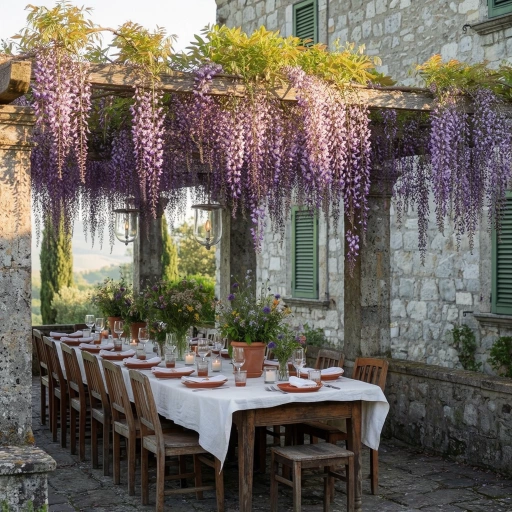
The pergola-covered outdoor dining terrace is the crowning glory of the restored Italian country house and the spatial expression of the culture’s deepest domestic value — the long, leisurely, multi-generational table around which food, wine, conversation, and genuine human connection are celebrated as the highest forms of daily living available to us. A stone-paved terrace extending from the main house facade, shaded by a mature wisteria-draped or grapevine-covered wooden pergola of generous proportions, and furnished with a long antique wooden table capable of seating twelve or more guests creates a permanent outdoor room of extraordinary atmospheric beauty that functions as the true heart of Italian country house social life from late spring through early autumn. The play of dappled light through wisteria or vine leaves across a white linen tablecloth is one of the most beautiful visual experiences Italian country living offers.
Use original stone paving — either reclaimed Tuscany sandstone, Umbrian limestone, or Pugliese basalt depending on regional context — rather than new concrete or ceramic tile to ensure the terrace reads as a natural extension of the ancient building it adjoins rather than a contemporary addition. Allow the pergola structure to develop its covering vine over several years without impatience, as the genuine maturity of an established wisteria, grapevine, or climbing rose transforms a newly constructed wooden structure into something that appears to have been part of the property for generations. Train the vine coverage deliberately to leave a lighter central zone above the table itself so diners receive dappled filtered light rather than complete shade, preserving the visual connection to the sky above that makes Italian outdoor dining so fundamentally different from eating inside.
8. Frescoed Accent Wall Revival
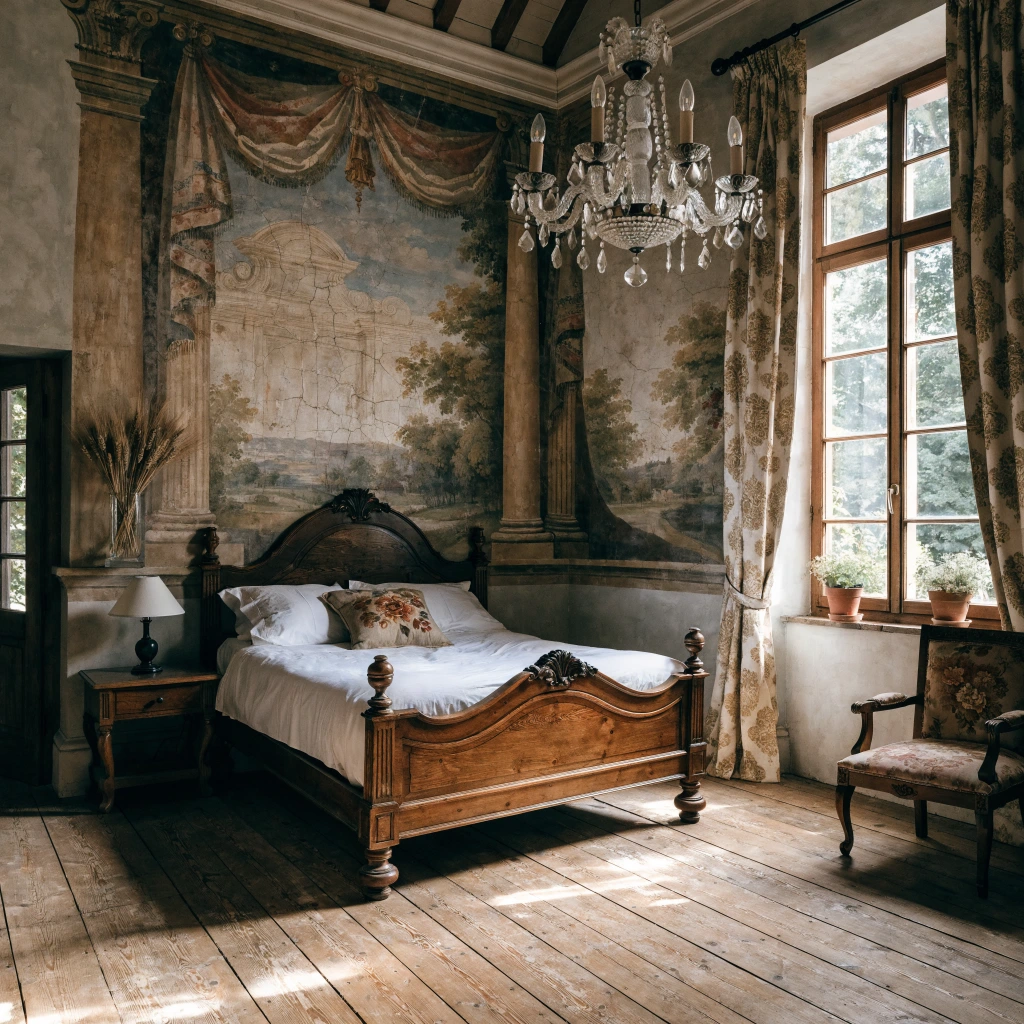
A frescoed accent wall revival is the most historically extraordinary and emotionally powerful decorating gesture available in a genuinely antique Italian country house, transforming a room from a beautifully restored interior into a living connection with a specific historical moment when a specific artist stood in this specific room and painted these specific images on walls that have witnessed everything that has happened in this house in the centuries since. Original fresco fragments — even partial, damaged, faded survivals — possess an aura and a historical presence that no reproduction, no contemporary wall painting, and no purely material decorating gesture can approach in its power to make a room feel genuinely inhabited by the accumulated weight of Italian history and human habitation.
Commission a specialist conservation fresco restorer — a conservatore d’affreschi — to assess, stabilize, and carefully clean any fresco fragments discovered beneath later paint layers during restoration works, as the removal of overpaint from original fresco requires extraordinary technical skill, deep material knowledge, and absolute patience that the general building restorer or house painter does not possess. Where original frescoes have been entirely lost but historical evidence of their existence remains in the form of plaster preparation layers or archival documentation, commission a contemporary fresco artist working in the traditional buon fresco technique to create a new wall painting in historical style that respects the room’s specific regional and period context. The surrounding lime plaster walls should be left in their most honest, minimally finished state to allow the fresco to speak with the uninterrupted authority its historical significance commands.
9. Original Cantina Wine Cellar Restoration
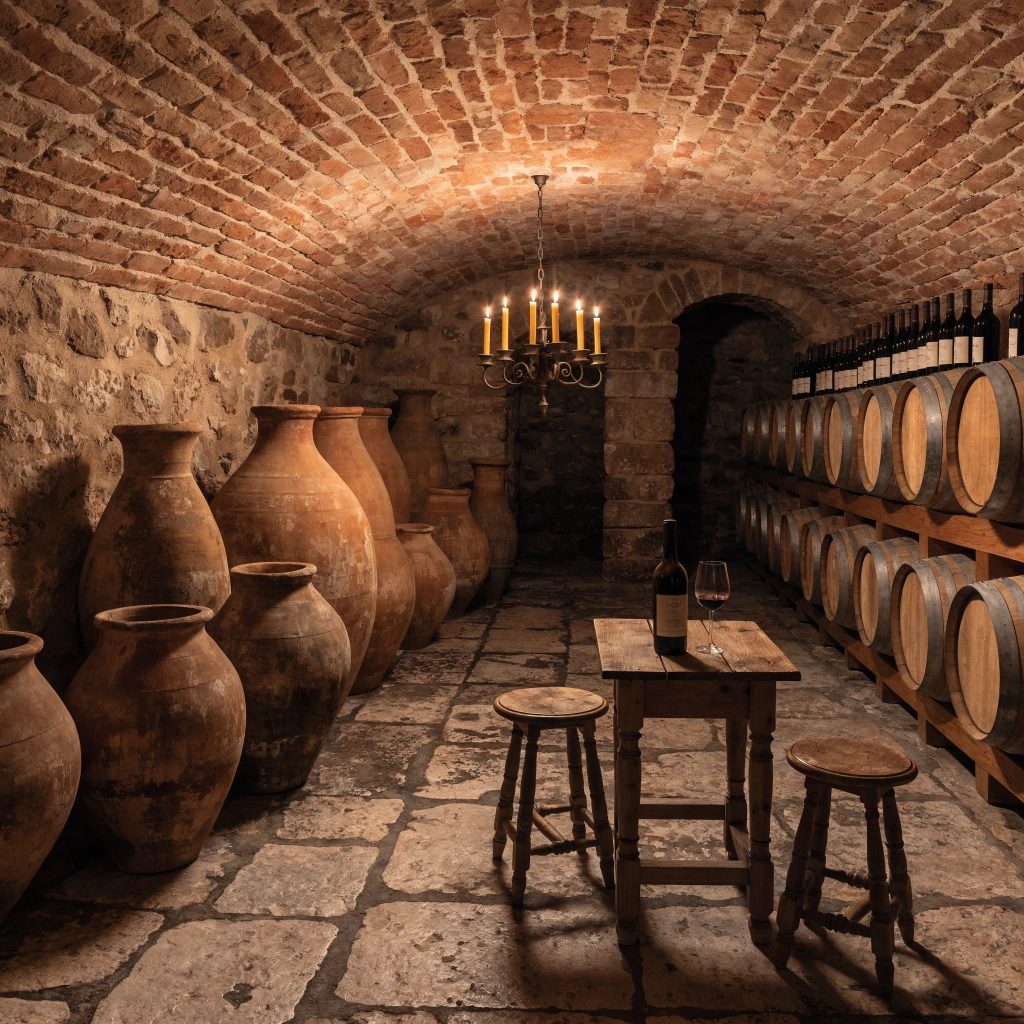
The original cantina wine cellar restoration is the most profoundly Italian of all country house project ideas, honoring the culture’s deepest relationship between land, agriculture, and the transformative alchemy of wine production that has defined Italian rural civilization since before the Roman Republic made viticulture the organizing principle of its agricultural economy. Every authentic Italian country house of any age contains a cantina — a ground-floor or semi-subterranean room with thick stone walls, earthen or stone floors, and the naturally stable cool temperature that barrel aging and bottle storage require — and restoring this space to its original purpose creates both a genuinely functional wine storage facility and the most atmospheric room in the entire house for impromptu late evening gatherings around a simple wooden table and a collection of local bottles.
Resist the temptation to modernize the cantina with climate control systems, recessed LED lighting, or contemporary wine rack furniture, as the natural temperature stability of a properly constructed thick-walled stone cantina is perfectly adequate for wine storage without mechanical assistance and the authentic atmosphere of the raw space is infinitely more beautiful and historically appropriate than any contemporary intervention. Restore the vaulted brick or stone ceiling by removing inappropriate cement render and repointing original masonry with traditional lime mortar, clean and seal the original stone floor with natural linseed oil rather than synthetic sealers, and furnish the space with simple wooden barrel racks, original terracotta amphorae, and wrought iron candleholders that honor the cantina’s centuries of agricultural service with the respect and material honesty it deserves.
10. Lime-Washed Bedroom Walls with Antique Iron Bed
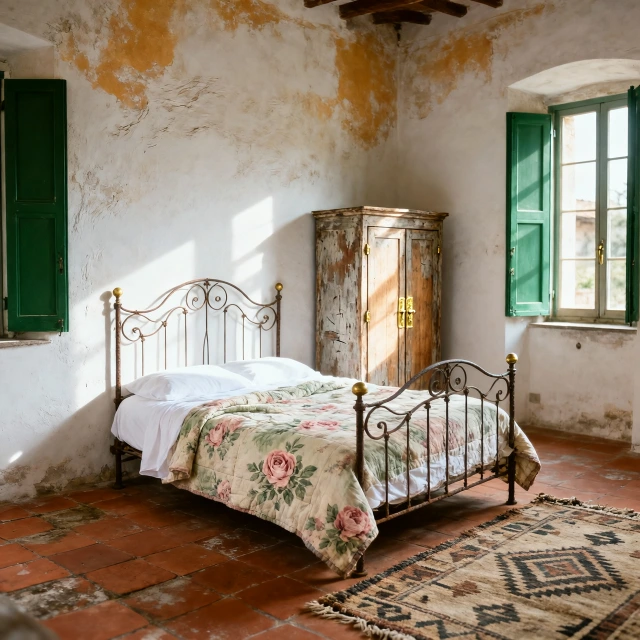
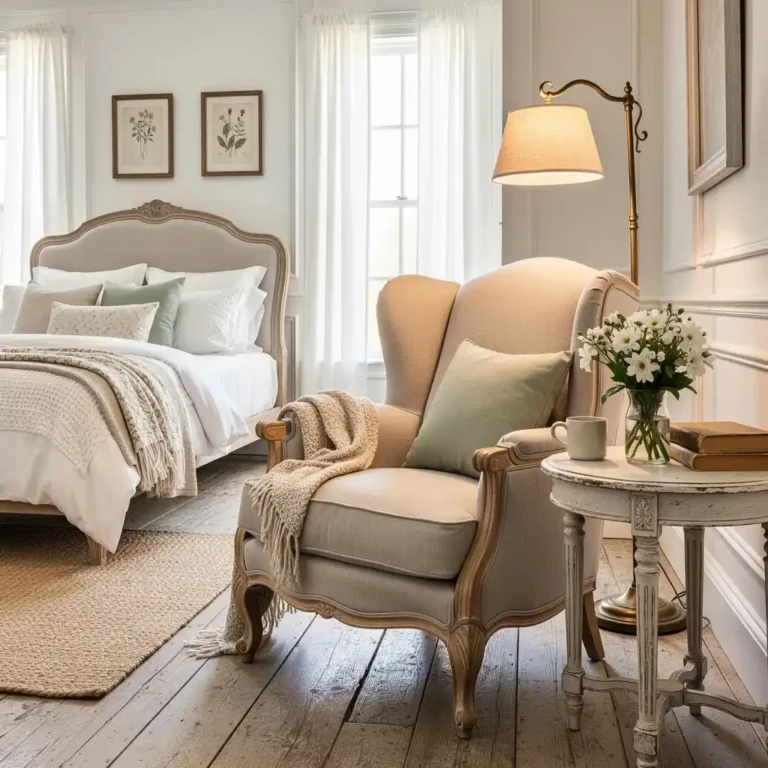
Lime-washed bedroom walls paired with an antique wrought iron bed create the most quietly beautiful and most genuinely Italian bedroom experience available in the restored country house, achieving through extreme simplicity and material honesty an atmosphere of deep, restoring calm that the most elaborately decorated contemporary bedroom simply cannot produce because it has not been shaped by the slow accumulation of generations of habitation, use, and the beautiful chemistry of aged lime. The lime-washed wall surface — built up in multiple thin layers of pigmented lime wash applied by brush with visible directional strokes — creates a depth and luminosity of color entirely unlike paint, absorbing and reflecting light with a subtlety and warmth that varies throughout the day as the angle and intensity of sunlight changes, making the bedroom walls a constantly evolving study in the quality of Italian light.
Apply lime wash in the warm aged white with subtle ochre, raw sienna, or pink undertones of traditional Tuscan and Umbrian interior wall treatments rather than the cooler, bluer whites of northern European lime wash traditions, as the warm undertone harmonizes with terracotta floors, chestnut beams, and the golden afternoon light that characterizes the Italian countryside landscape visible through the bedroom windows. An antique wrought iron bed in simple elegant curves — sourced from Italian antique dealers, rural brocantes, or specialist dealers in nineteenth and early twentieth century Italian furniture — contributes the room’s single piece of decorative ironwork with a restraint and linear beauty perfectly calibrated to the honest simplicity of the lime-washed walls. Dress the bed with white linen of generous weight and a single faded antique quilt as the only textile layers needed to complete a bedroom of irreducible, timeless Italian country perfection.
11. Italian Country Garden with Cypress Allée and Lavender Borders
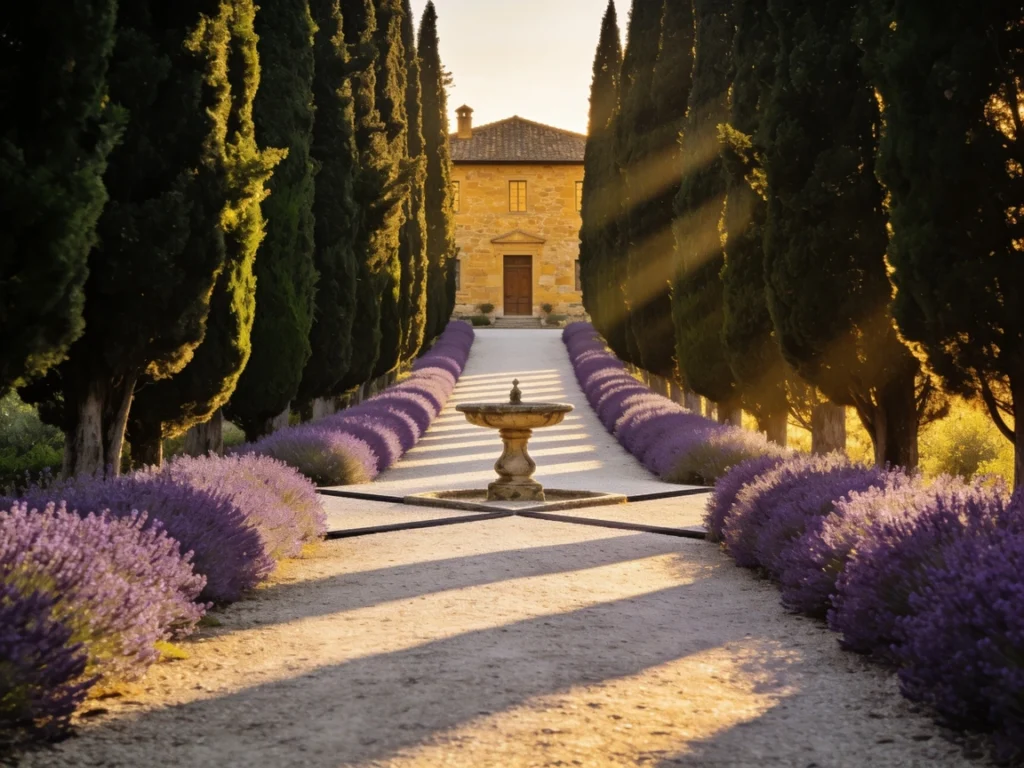
The Italian country garden with cypress allée and lavender borders is the most classically beautiful and most immediately recognizable exterior landscape feature of the Tuscan and Umbrian countryside, a garden composition of such ancient lineage and perfect formal logic that it appears in Italian landscape paintings from the fourteenth century to the present day without any diminishment of its power to create a sense of arrival, of ceremony, and of the deep human pleasure of moving through a deliberately shaped natural environment toward a beautiful destination. The dark vertical exclamation marks of Italian cypress trees flanking a pale gravel path in regular spacing are perhaps the single most iconic image in the entire visual vocabulary of Italian countryside landscape design.
Plant Italian cypress trees in pairs at six to eight meter spacing along the allée for the correct formal proportion and visual rhythm, accepting that the full drama of the mature allée will require fifteen to twenty years to develop its complete character — the patience required by genuine Italian garden making is one of its most important philosophical qualities, connecting the gardener to a timescale that exceeds individual human lifespans and implies a commitment to place and continuity of inhabitation that is deeply embedded in Italian rural culture. Establish lavender borders using Lavandula angustifolia in long, generous sweeps rather than narrow strips, allowing the plants to billow and soften the geometric precision of the cypress allée with their aromatic informality. An antique stone fountain or wellhead positioned at the allée’s terminus or at a crossing axis provides the focal point that the formal garden tradition requires at the end of every designed vista.
12. Handmade Deruta Ceramic Collection Display
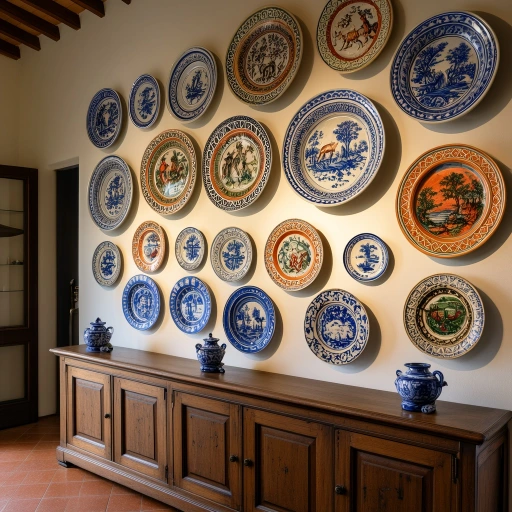
A handmade Deruta ceramic collection display is the most authentically Italian decorative gesture available to the country house restorer, covering an entire dining room or kitchen wall with the bold, joyful, intellectually sophisticated painted ceramics of the Umbrian town of Deruta — a center of fine majolica production since the thirteenth century whose distinctive cobalt blue and white, polychrome floral, and lustred geometric patterns have decorated the walls of Italian country houses, palaces, and convents for seven hundred uninterrupted years of extraordinary artistic production. The Deruta ceramic tradition is not a folk craft but a sophisticated applied art with a documented history of design evolution, technical innovation, and individual workshop signatures that makes genuine Deruta pieces as collectible and historically significant as any painting or sculpture.
Build a Deruta collection gradually and with genuine curatorial intention rather than purchasing a matched set of contemporary reproductions simultaneously, as the beauty of a great Italian ceramic wall comes from the combination of different periods, different workshops, different decorative programs, and different scales of plate that collectively tell the story of a collector’s growing knowledge and deepening engagement with the tradition over time. Mix genuinely antique pieces acquired from Italian antique dealers with high-quality contemporary production pieces from the best of the current Deruta workshops that maintain traditional hand-painting methods and authentic glaze chemistry, as the combination of old and new within a single wall display creates a living dialogue between the tradition’s history and its present vitality. Arrange pieces in a salon-hang style with organic spacing on the wall above a long wooden sideboard dressed with a single large Deruta floor vase and a simple arrangement of seasonal garden flowers.
13. Trullo-Inspired Conical Stone Roof Restoration

The trullo-inspired conical stone roof restoration is the most architecturally extraordinary and most culturally specific Italian country house idea on this list, celebrating the genuinely unique building typology of Puglia’s Valle d’Itria — the conical dry-stone corbelled roof structures known as trulli that represent one of the most remarkable indigenous architectural inventions in the entire history of Mediterranean vernacular building. The trullo roof is constructed without mortar using a dry-stone corbelling technique of extraordinary structural ingenuity, each limestone course slightly offset inward from the one below until the conical form closes at the apex with a single capstone, the entire structure held in compression by its own geometry in a feat of pre-scientific structural engineering that has withstood centuries of Pugliese weather without failure.
Restore original trullo roofs using a traditional dry-stone mason — a muratore a secco — who has inherited the specific knowledge of local limestone selection, coursing patterns, and capstone fitting that has been transmitted within Pugliese building families across generations without systematic documentation, as this knowledge exists only in the hands and eyes of practitioners and cannot be reconstructed from written sources or engineering principles alone. The interior of a restored trullo is one of the most extraordinary domestic spaces imaginable — the conical ceiling soaring overhead, the thick walls maintaining a naturally cool temperature through the hottest Pugliese summer months, the single arched window admitting a shaft of intensely bright southern Italian light across whitewashed plaster walls of absolute simplicity. Furnish a restored trullo interior with the most spare, quiet, materially honest objects that Japandi or Wabi-Sabi minimalism could prescribe — the architecture itself provides everything the space needs to be profoundly beautiful.
14. Original Olive Press Room Conversion
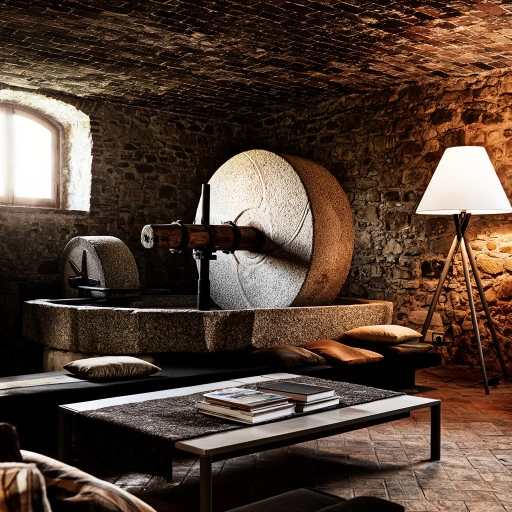
The original olive press room conversion is the most dramatically theatrical and most historically resonant adaptive reuse project available within the restored Italian country house or masseria, transforming a working agricultural space of tremendous historical significance — the frantoio or olive mill room where the essential product of the Mediterranean agricultural economy was processed for millennia — into a living room of extraordinary spatial character and material power that no architecturally designed interior can replicate because its beauty derives entirely from the authentic industrial grandeur of genuinely antique agricultural machinery preserved in its original spatial context. The massive stone mill wheels, granite pressing basins, and timber beam presses of an original frantoio are objects of such sculptural power and historical presence that they require no supplementary decoration — they are the decoration, and every other element in the room must defer to their overwhelming authority.
Preserve all original olive press machinery in situ without any attempt to move, modify, or sanitize the pieces for decorative purposes — the patina of centuries of olive oil absorption in the stone surfaces, the dark staining of the timber beam presses, and the accumulated evidence of thousands of harvest seasons in every surface of the frantoio are irreplaceable historical documents that must be protected rather than cleaned away. Introduce contemporary seating of deliberately understated, low-profile design that acknowledges the spatial dominance of the machinery without competing with it for visual attention, and use dramatically directional artificial lighting to sculpt the three-dimensional form of the mill wheels and pressing stones with the same careful attention a museum curator would apply to the display of genuinely priceless sculptural artifacts — which is precisely what they are.
15. Italian Country House Loggia with Climbing Roses
The Italian country house loggia with climbing roses is the most romantically beautiful exterior architectural space in the Italian rural building tradition — an intermediate zone between interior domestic life and the landscape beyond that has no precise equivalent in northern European architecture and that explains more eloquently than any other single spatial element why the Italian country house represents such a universally compelling domestic ideal for people from every climate and cultural background around the world. The loggia — a vaulted or beamed arcade of stone arches opening one full side of a room to the garden — creates a protected outdoor living space of extraordinary versatility, functioning as a shaded summer dining room, a rain-sheltered autumn garden room, a fragrant spring sitting room beneath cascading rose bloom, and a sun-trap winter terrace on calm bright January days when the Italian countryside offers its most crystalline, impossibly beautiful light.
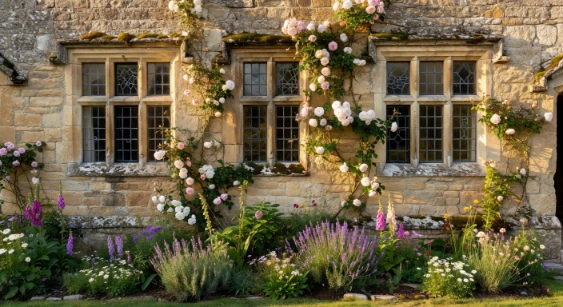
Plant climbing roses at the base of each loggia column using the most fragrant heritage varieties available — Rosa ‘New Dawn’, Rosa ‘Albertine’, or the deeply fragrant Rosa ‘Madame Alfred Carrière’ in cream white — and train the canes along the stone arches using soft natural twine and discrete vine eyes fixed into the mortar joints with minimal visual intrusion. Allow the climbing roses to develop their natural sprawling habit over several years without over-pruning, letting them billow and overflow the architectural geometry of the stone arches with a studied romantic informality that is as distinctly Italian in its garden aesthetic as the formal cypress allée is in its landscape design. Furnish the loggia floor with the most minimal, most weathered, most authentically Italian pieces available — a simple stone or wooden bench, a terracotta pot of lemon trees, a worn rush-seat chair — and trust the architecture and the roses to provide everything else the space needs.
16. Antique Italian Furniture and Cassone Collection
An antique Italian furniture and cassone collection brings the accumulated decorative history of Italian craftsmanship across five centuries directly into the restored country house, furnishing its rooms with objects of genuine historical significance, extraordinary material quality, and the specific beauty of things made by skilled hands for specific purposes within the Italian cultural context that produced the building they now inhabit. The cassone — the elaborately painted or carved wooden marriage chest that was among the most important and prestigious pieces of furniture in every Italian household from the medieval period through the eighteenth century — is the single most culturally significant and visually dramatic furniture piece available to the Italian country house restorer, bringing with it the entire social history of Italian family life, dowry traditions, and the extraordinary applied arts tradition of painted furniture decoration.
Source antique Italian furniture from specialist dealers in Italian antiques, Florentine auction houses, rural Tuscan brocantes, and the estate sales of old Italian families rather than from international dealers who charge substantial premiums for pieces that can be found more affordably and more authentically within Italy itself. Resist the temptation to over-restore antique Italian pieces — stripping, sanding, and refinishing antique walnut furniture to a clean contemporary standard destroys precisely the aged patina and accumulated evidence of use that makes antique furniture beautiful and historically significant rather than merely old. A cassone with its original painted decoration partially worn away by centuries of use is infinitely more beautiful and historically valuable than the same piece with its decoration freshly repainted to appear as new, because the wear itself is the most honest and irreplaceable record of the object’s extraordinary longevity.
17. Masseria-Style Courtyard with Central Fountain
The masseria-style courtyard with central fountain is the most complete and most ancient expression of the Italian country house ideal — an entirely enclosed outdoor room that turns the building’s interior face toward a private landscape of complete sensory beauty while presenting a defensive blank wall to the world beyond, embodying in its spatial organization the fundamental Italian distinction between the public face of things and the private richness of family life conducted away from external observation. The masseria — the fortified agricultural estate of Puglia and southern Italy, built around an internal courtyard that served as the organizational center of a self-sufficient agricultural community — offers the most complete and most spatially dramatic version of this courtyard ideal, its whitewashed stone arcaded buildings enclosing a private world of fountain sound, citrus fragrance, and dappled southern light of extraordinary beauty and complete serenity.
Restore the central fountain using an original stone basin if one survives in place or source a period-appropriate antique stone fountain from a Pugliese salvage dealer who specializes in historic building materials — the specific regional character of a Pugliese limestone fountain carved in the local style is an irreplaceable detail that generic reproduction fountains in terracotta or resin cannot provide regardless of their physical similarity. Plant large terracotta urns at each corner of the courtyard with mature lemon and bitter orange trees trained into the traditional standard form with a clear trunk and rounded canopy, their fragrant blossom filling the enclosed courtyard in spring with one of the most intensely beautiful natural fragrances available to any outdoor space in the temperate world. Train bougainvillea up the arcade columns and allow it to cascade freely from upper balconies and roof parapets, its deep magenta bracts providing the one note of vivid, unrestrained southern Italian color that the whitewashed courtyard requires to complete its sensory and visual perfection.