14 Luxury Spanish Mediterranean Homes with Timeless Elegance
1. Grand Arched Entry with Hand-Carved Wooden Doors
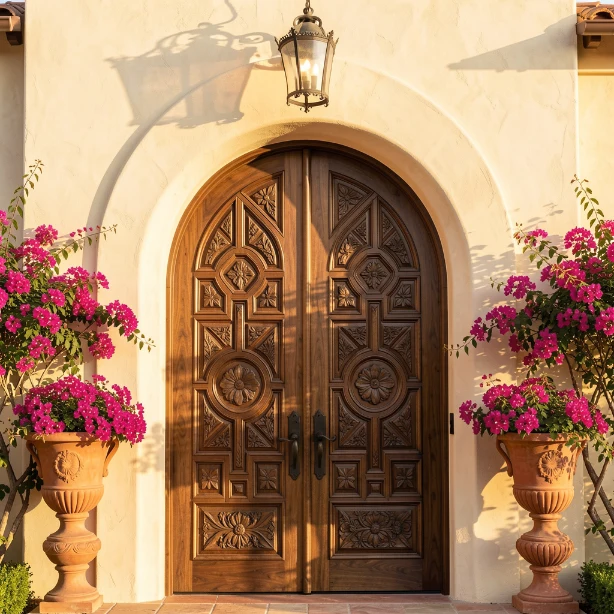
A grand arched entry featuring hand-carved wooden doors is the single most architecturally commanding and immediately breathtaking feature of a luxury Spanish Mediterranean home that announces its design heritage, its commitment to genuine craftsmanship, and its understanding of the Mediterranean tradition’s most fundamental principle — that the threshold between the outside world and the domestic sanctuary deserves the most beautiful, most laboriously crafted, and most permanently impressive architectural treatment available to the skilled artisan’s hands, tools, and generations-accumulated expertise.
Commission these extraordinary doors from master woodworkers specializing in Spanish colonial and Mediterranean revival joinery — craftsmen who work in solid walnut, mahogany, or reclaimed antique oak and apply traditional hand-carving techniques passed down through generations of Spanish and Moorish artisan traditions. The carved motifs should reference authentic historical sources — geometric star patterns from Moorish tilework, organic floral scrollwork from Andalusian architectural ornament, and interlaced strap patterns from Spanish colonial decorative traditions — for a result that communicates genuine historical literacy and uncompromising quality. Pair with wrought iron strap hinges and a period-appropriate door knocker in aged bronze for complete authenticity.
2. Terracotta Barrel Tile Roof
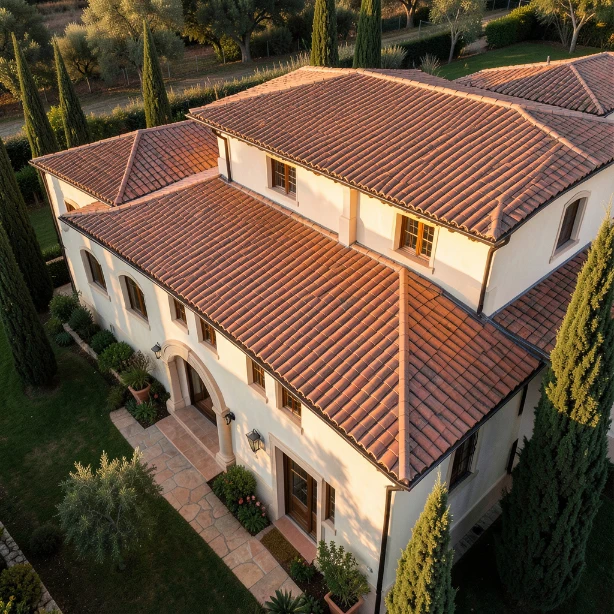
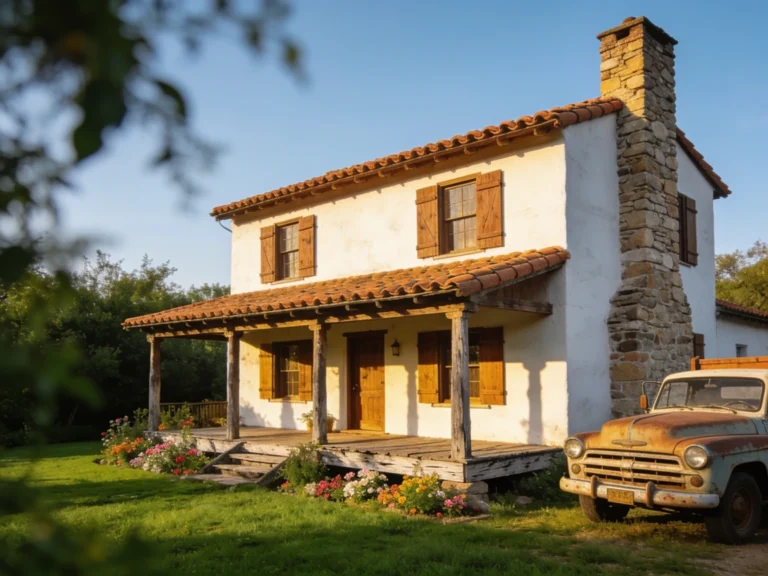
A terracotta barrel tile roof is the single most visually definitive and historically authentic exterior feature of a luxury Spanish Mediterranean home — the characteristic curved clay tiles, fired to their warm reddish-orange color through centuries-unchanged kiln processes, creating the undulating, rhythmically beautiful roofline that immediately identifies the Mediterranean architectural tradition from any distance or viewing angle and makes even a modest home appear connected to the most beautiful, sun-drenched residential architecture of southern Spain, Morocco, and the broader Mediterranean basin.
Premium handmade terracotta barrel tiles from Spanish manufacturers like Tejas Verea or American producers like Eagle Roofing Products who manufacture authentic-profile clay tiles using genuine traditional processes provide the most historically accurate and visually beautiful roof covering for luxury Spanish Mediterranean homes. The natural color variation between individual fired tiles — ranging from warm salmon to deep rust to almost ochre yellow within a single roof plane — creates a gorgeous tonal richness that machine-made uniform tiles completely lack. Proper installation requires skilled roofing craftsmen experienced specifically with clay barrel tile to ensure appropriate underlayment, flashing, and ridge cap detailing that preserves both beauty and weather performance.
3. Courtyard with Central Fountain
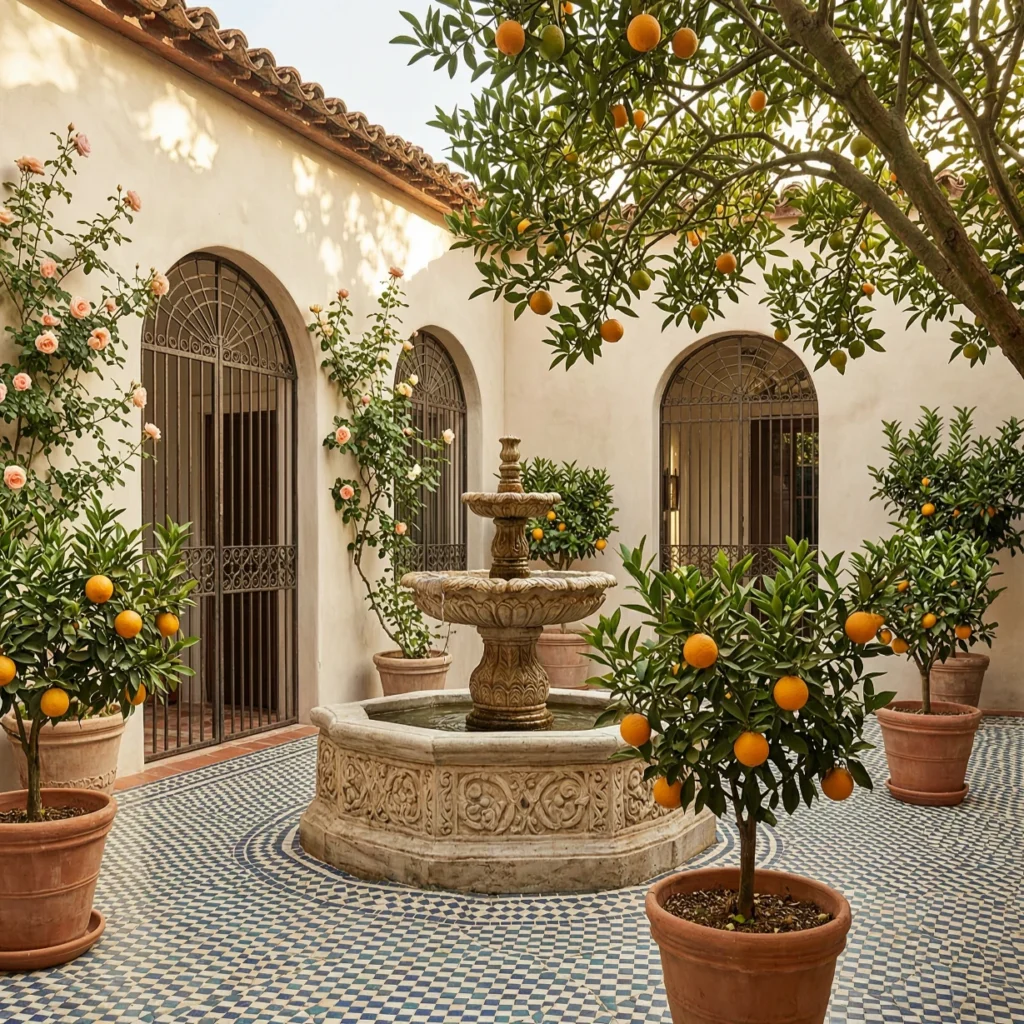
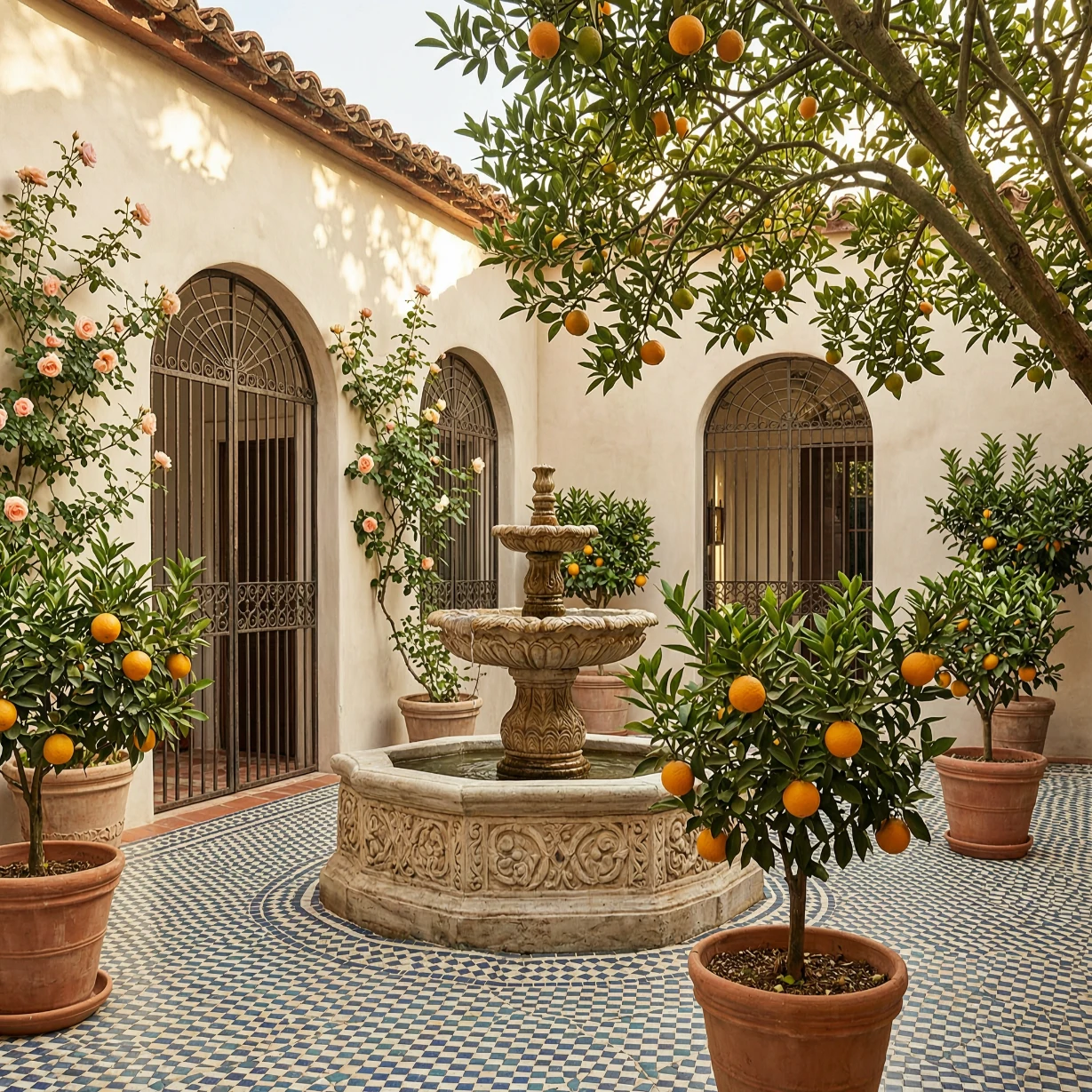
A private interior courtyard with a hand-carved stone fountain at its center is the most quintessentially Spanish Mediterranean and genuinely magical residential feature that transforms the home’s architectural heart into a secluded, sensory-rich outdoor living sanctuary — water sound, fragrant citrus and roses, dappled light filtering through mature trees, and the intimate enclosure of surrounding stucco walls creating a domestic paradise that has been the defining spatial aspiration of Mediterranean residential architecture since the ancient Roman atrium and the Moorish riad traditions first established the courtyard as the most desirable and humanly nourishing organizational principle for residential design.
Design the courtyard around a central hand-carved limestone or marble fountain — ideally sourced from artisan stone carvers in Granada, Seville, or from American craftsmen working in the Andalusian tradition — with water flowing from upper tier to lower basin in a continuous, acoustically soothing cycle that fills the courtyard with the most ancient and universally appreciated sound of human-scaled domestic architecture. Pave the surrounding courtyard floor with authentic Moorish geometric tile patterns in terracotta, cobalt, and cream — sourced from Spanish tile manufacturers like Ceramica Lantejo or quality American tile producers — and plant orange, lemon, and olive trees in large terracotta pots for complete sensory authenticity.
4. Wrought Iron Windows and Balcony Railings
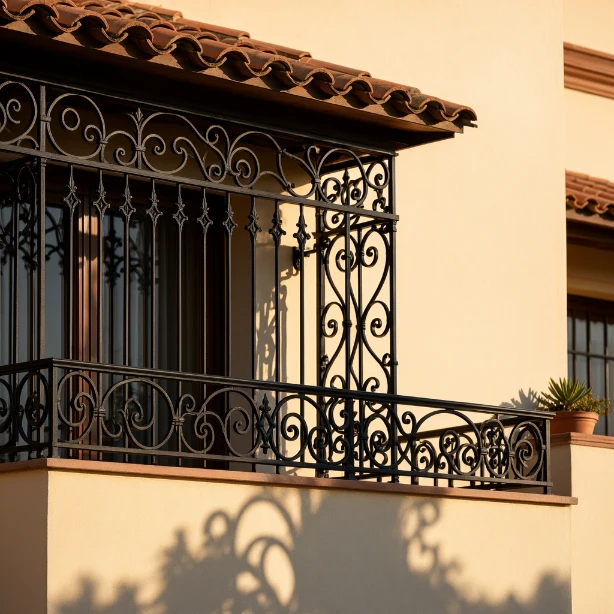
Exquisitely detailed wrought iron window grilles, balcony railings, and gate installations are the most delicately beautiful and historically authentic architectural metalwork feature of luxury Spanish Mediterranean homes — the hand-forged iron scrollwork, geometric lattices, and decorative finials casting the most extraordinarily beautiful shadow patterns across cream stucco walls throughout the changing light of every Mediterranean-inspired California, Florida, or Arizona day, creating a living architectural display that is simultaneously permanently installed and continuously, photographically beautiful in its shadow-casting, light-responsive, time-varying decorative performance.
Commission authentic wrought iron work from blacksmiths trained in traditional Spanish colonial and Mediterranean revival metalworking techniques — craftsmen who forge genuine wrought iron rather than working with cast iron or fabricated mild steel, producing work with the slight surface irregularity, warmly dark patina, and genuine material density that distinguishes hand-forged work from mass-produced alternatives at every level of close visual inspection. Traditional motifs should include continuous scroll patterns, helical twisted sections, fleur-de-lis and acanthus leaf finials, and the interlaced geometric star patterns that reference the Moorish mathematical traditions that most powerfully influenced Spanish decorative arts throughout the medieval period and its extraordinary architectural legacy.
5. Hand-Painted Talavera Tile Installations
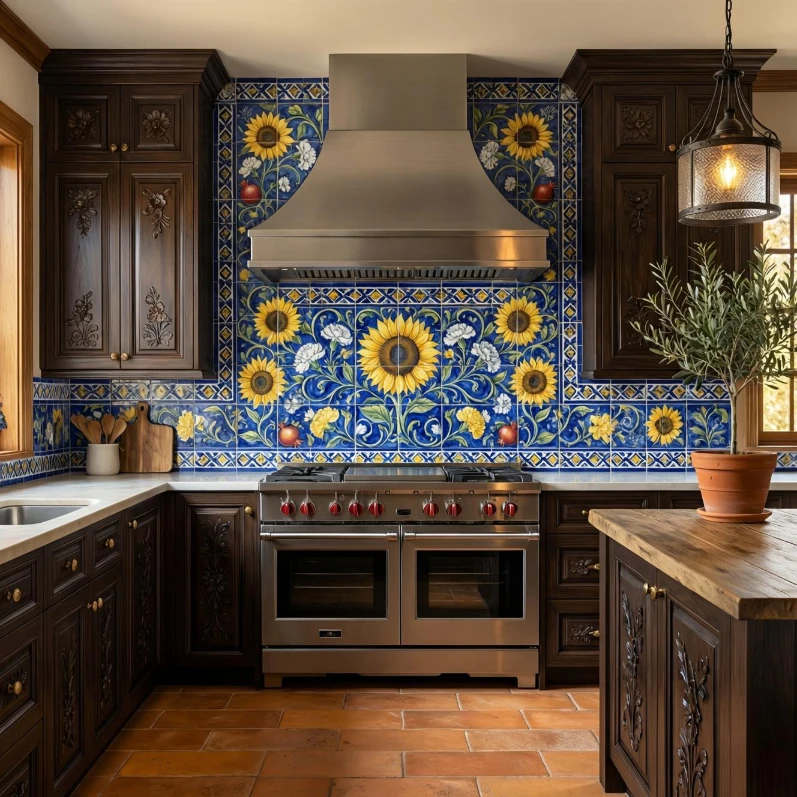
Hand-painted Talavera tile installations — the brilliantly colored, tin-glazed earthenware produced through techniques introduced to Spain by Moorish craftsmen and perfected by Mexican artisans in the colonial city of Puebla — are the most vibrantly beautiful and culturally authentic decorative feature of luxury Spanish Mediterranean interiors that introduces genuine artisanal color, pattern complexity, and the irreplaceable warmth of hand-painted ceramics to kitchen backsplashes, bathroom walls, stair risers, pool surrounds, and garden fountain basins throughout the beautifully appointed home.
Source authentic hand-painted Talavera tiles from reputable Mexican artisan producers in Puebla — where the tradition remains most vigorously practiced and most authentically expressed — or from quality American importers like Casa Moro and Tierra y Fuego who work directly with skilled Talavera painters and ensure genuine hand-painting quality control for every tile in the order. Each authentic Talavera tile should display the characteristic slight surface irregularity, the warm hand-brushed quality of individual painted strokes, and the specific lead-free tin glaze chemistry that produces Talavera’s characteristic warm, slightly matte white ground and deeply saturated cobalt, yellow, green, and orange color palette that no machine-printed tile can honestly replicate.
6. Exposed Wooden Beam Ceilings
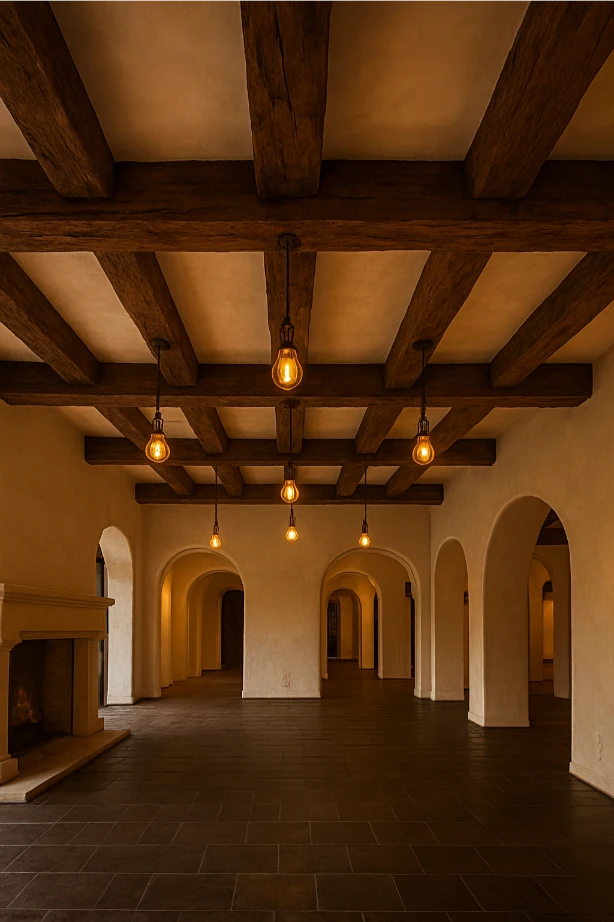
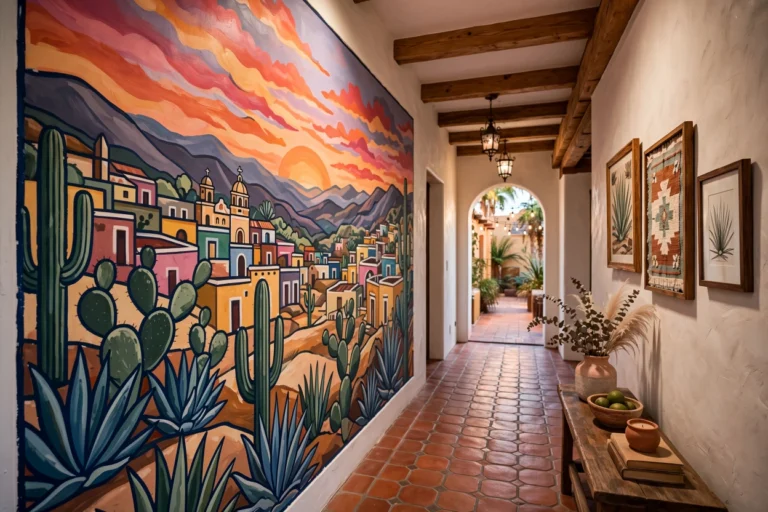
Exposed hand-hewn wooden beam ceilings are the most structurally beautiful and atmospherically warm architectural interior feature of luxury Spanish Mediterranean homes — the massive reclaimed oak, pine, or fir beams crossing the full ceiling width in rhythmic intervals creating an overhead architectural landscape of genuine material richness, honest structural expression, and the deep, specific warmth that only centuries-aged, sun-dried, hand-worked wood possesses and communicates through its presence in a beautifully designed room.
Source hand-hewn beams from quality reclaimed timber suppliers like Reclaimed Designworks, Pioneer Millworks, or regional architectural salvage dealers who carry genuine antique structural timbers reclaimed from demolished 19th-century barns, industrial buildings, and colonial-era structures — pieces with accumulated grain depth, authentic adze marks, surface patina, and the specific material character that new timber simply cannot possess regardless of how skillfully it is artificially distressed or surface-treated to simulate age. Install with appropriate structural engineering consultation to ensure proper load distribution and to determine whether original structural function or purely decorative installation is the most appropriate approach for each specific ceiling application.
7. Limestone or Travertine Flooring Throughout
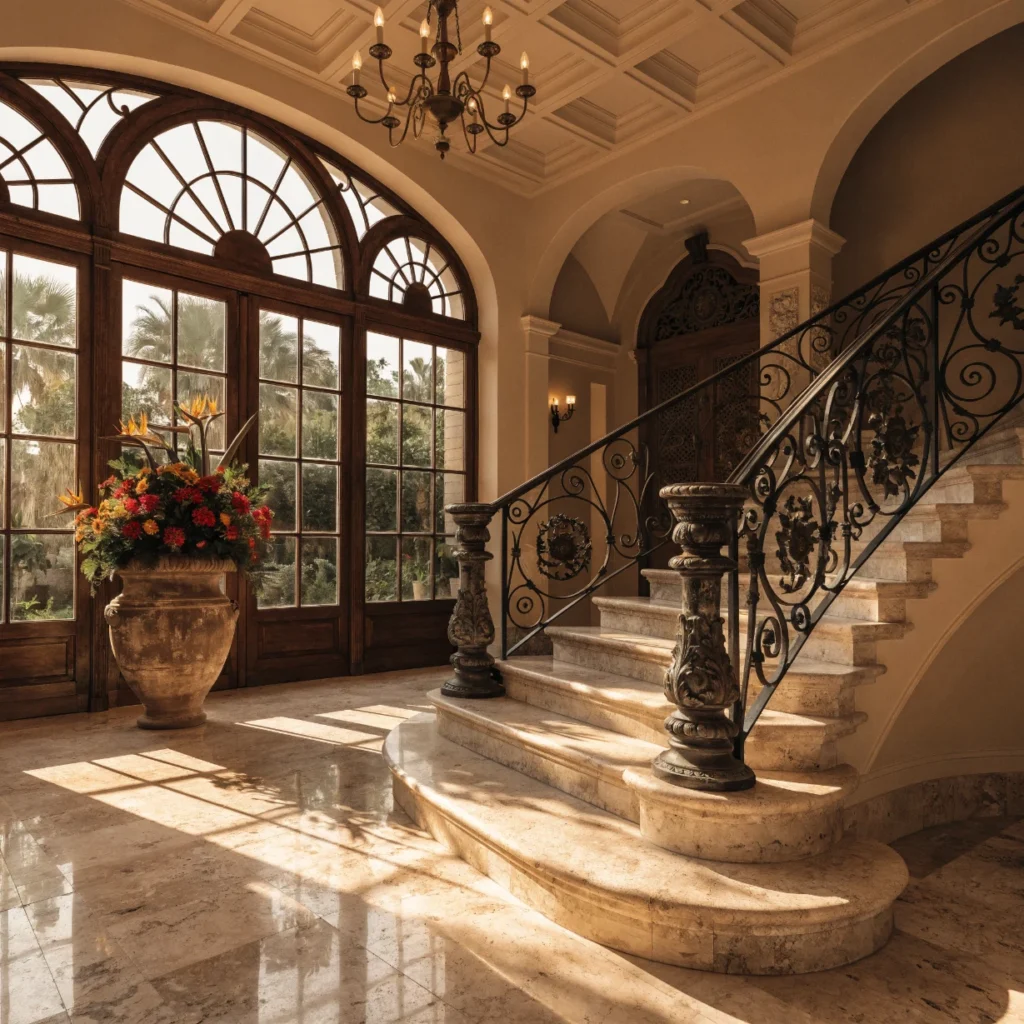
Honed limestone or travertine flooring installed throughout the primary living spaces of a luxury Spanish Mediterranean home is the most materially authentic and genuinely beautiful flooring choice that connects the interior’s design vocabulary directly to the specific geological materials — the sedimentary limestone formations of the Mediterranean basin, the travertine quarries of central Italy and Turkey — that have provided the most enduringly beautiful and widely used building materials in the architectural history of the Mediterranean world’s most celebrated residential and civic design traditions.
Select large-format honed travertine or limestone tiles in warm ivory, honey, and walnut tones from quality natural stone suppliers like MSI, Arizona Tile, or Bedrosians — choosing honed rather than polished finishes for a matte, stone-quarry authentic surface quality that provides both slip resistance and the specific aesthetic warmth of unpolished natural stone rather than the reflective, mirror-like quality of a polished finish that feels less historically appropriate and less atmospherically warm in a Spanish Mediterranean interior context. Fill travertine voids with grout matched to the stone’s natural color for the most seamless, continuous-looking stone floor surface.
8. Arched Interior Doorways and Pass-Throughs
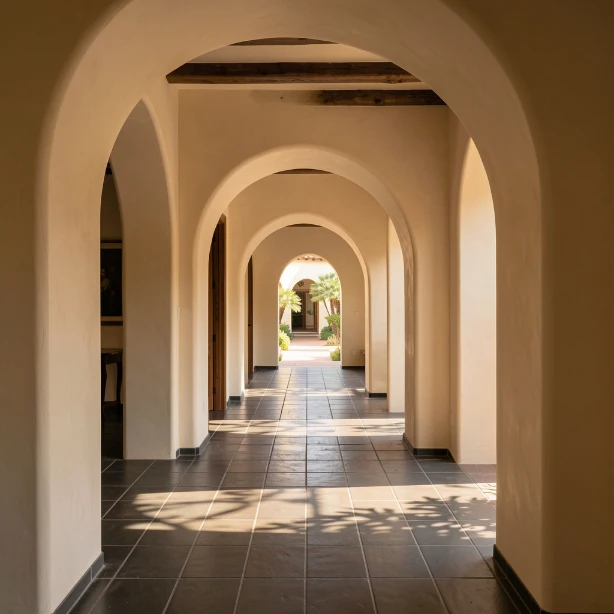
A sequence of rounded or slightly pointed Moorish arches used consistently throughout the interior doorways, pass-throughs, niches, and room transitions of a luxury Spanish Mediterranean home is the single most spatially distinctive and genuinely extraordinary architectural feature that communicates the design tradition’s deepest historical roots — in the horseshoe arches of the Alhambra palace, the pointed arches of Andalusian mosque-cathedrals, and the rounded arches of Roman and Byzantine structures that collectively formed the architectural vocabulary that Spanish colonial builders carried across the Atlantic to the Americas and that the early 20th-century Mediterranean revival movement rediscovered and celebrated.
Design the arch profiles consistently throughout the home — using the same radius, the same reveal depth, and the same plaster treatment at every interior arch for the most architecturally coherent and professionally resolved result. The most authentic Spanish Mediterranean arch profile is a three-centered elliptical arch rather than a simple semicircular arch — the subtle flattening of the curve at the crown giving the arch a slightly more sophisticated, specifically Spanish character than the more generic Roman semicircle. Plaster the arch soffits and faces in smooth troweled finish with subtle color variation between the arch face and the wall surface for a refined architectural definition.
9. Outdoor Loggia with Columns and Climbing Vines
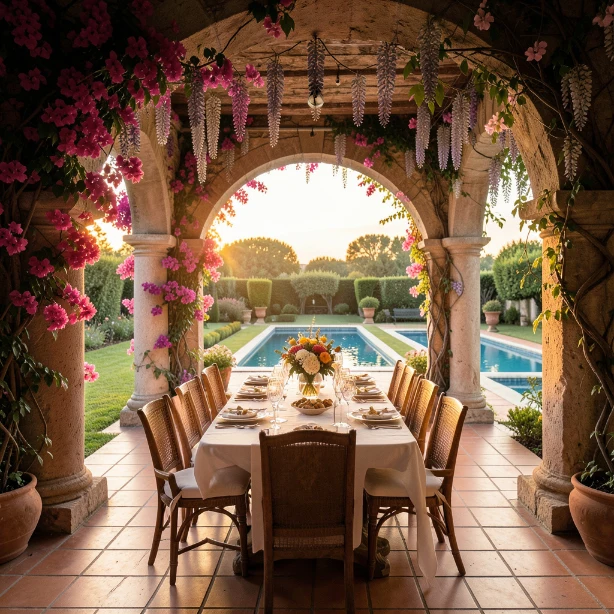
An outdoor loggia — a covered, colonnaded outdoor living space that functions as an architectural transition between the fully interior rooms and the fully exterior garden — is the most magnificently livable and genuinely Mediterranean outdoor space feature of a luxury Spanish Mediterranean home that provides shaded, architecturally framed outdoor living throughout the warm Mediterranean-climate months while framing views of the garden, pool, and landscape in a series of column-bounded, arch-topped visual compositions that make every outdoor moment feel like living inside the most beautiful painting imaginable.
Design the loggia with paired stone or cast stone columns supporting proper structural arches — not decorative arches merely attached to a flat beam, but genuine load-bearing arch masonry that expresses the structural logic of traditional Mediterranean construction honestly and beautifully. Plant bougainvillea, wisteria, jasmine, and climbing roses at each column base and train them upward over the arch faces and along the loggia’s perimeter beam for the most romantically overgrown, fragrant, and visually spectacular long-term result — understanding that the most magnificent Spanish Mediterranean loggias require five to ten years of vine growth maturity to achieve their most breathtakingly beautiful, flowers-cascading-everywhere appearance.
10. Moorish Geometric Tile Stair Risers
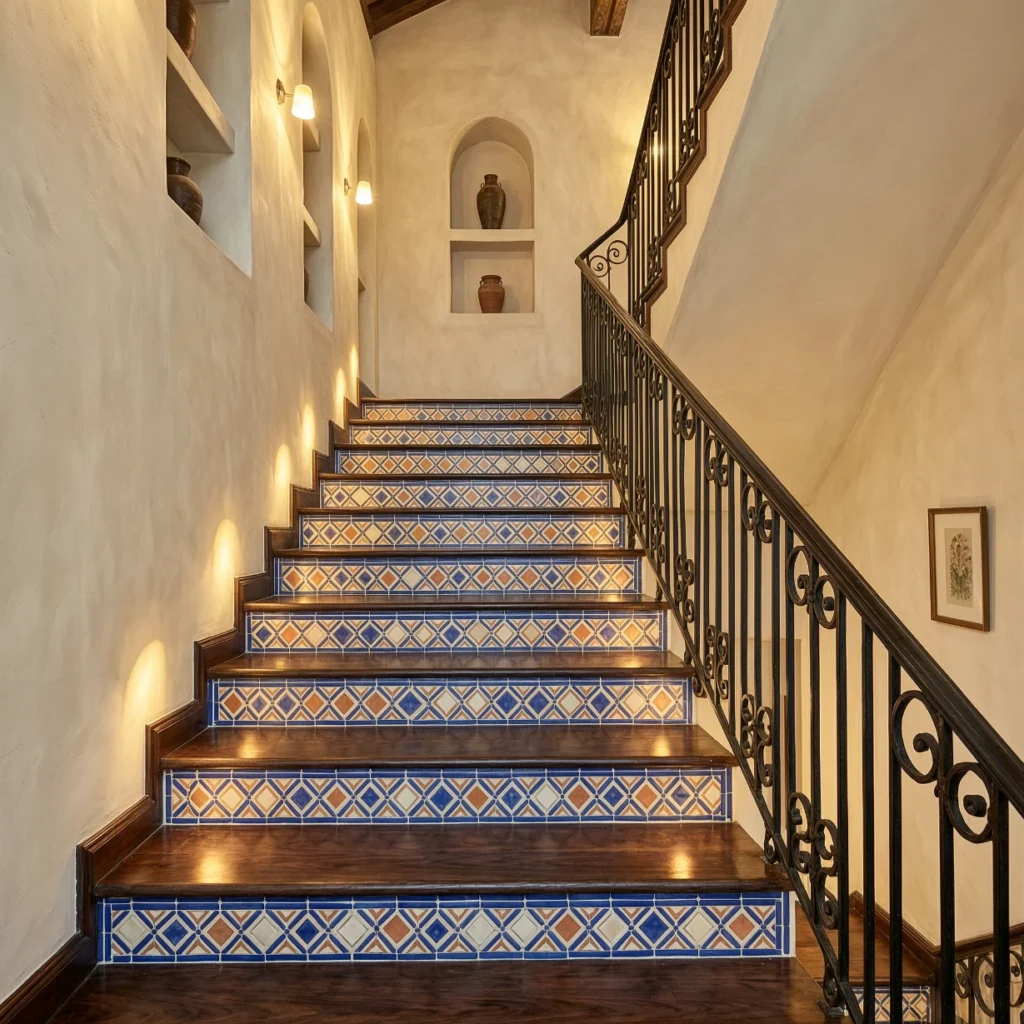
Moorish geometric tile stair risers — each individual riser covered in hand-painted ceramic tile featuring the intricate, mathematically precise geometric patterns derived from Islamic decorative arts — are the most visually stunning and culturally sophisticated decorative detail in a luxury Spanish Mediterranean home’s interior, transforming the functional necessity of a staircase into a magnificent, ascending gallery of ceramic artistry that draws the eye upward through a composition of brilliant color, complex pattern, and genuine artisanal skill at every step of the ascent.
Each riser should display a different but compositionally related geometric pattern — a progression through the family of Islamic star patterns, or an alternating sequence of complementary geometric designs — for a staircase that rewards careful visual attention with continuous discovery of new pattern relationships and color harmonies at each successive step. Source hand-painted tile from authentic Moroccan or Spanish artisan producers, or from quality American tile artists working in the traditional Zellige and Azulejo tile painting traditions with genuine hand-painting skill and period-appropriate pattern research. Install with white grout lines for the crispest, most visually defined pattern presentation that allows each tile’s geometric design to read clearly and beautifully.
11. Formal Spanish Colonial Garden Design
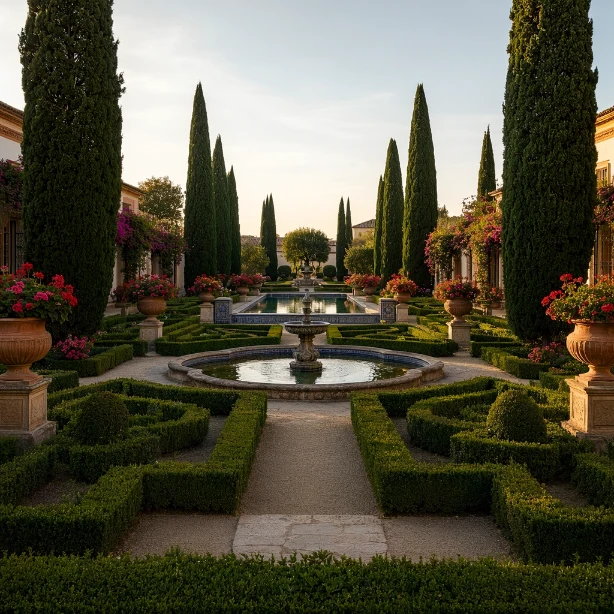
A formally designed Spanish colonial garden — symmetrically organized around a central axis extending from the main house facade, with geometric parterre beds of clipped boxwood, a central stone fountain, terracotta urns at key compositional points, and cypress trees providing tall vertical accents against the sky — is the most architecturally coherent and historically authentic landscape feature of a luxury Spanish Mediterranean estate that extends the home’s interior design vocabulary outward into the grounds as a continuous expression of the same aesthetic principles governing every detail of the architecture itself.
Consult a landscape architect specializing in Spanish colonial and Mediterranean revival garden design who understands the specific plant palette — Mediterranean cypress, olive trees, Italian cypress, boxwood, lavender, rosemary, geraniums, bougainvillea, and orange jasmine — the geometric layout traditions, the water feature placement principles, and the paving material vocabulary — terracotta, limestone, and Moorish tile — that collectively constitute an authentic Spanish colonial garden aesthetic rather than a generic formal garden decorated with Spanish-themed accessories. The garden’s most critical design element is its relationship to the house — it must feel like a designed outdoor room extending from the architecture.
12. Hand-Plastered Stucco Walls with Warm Patina
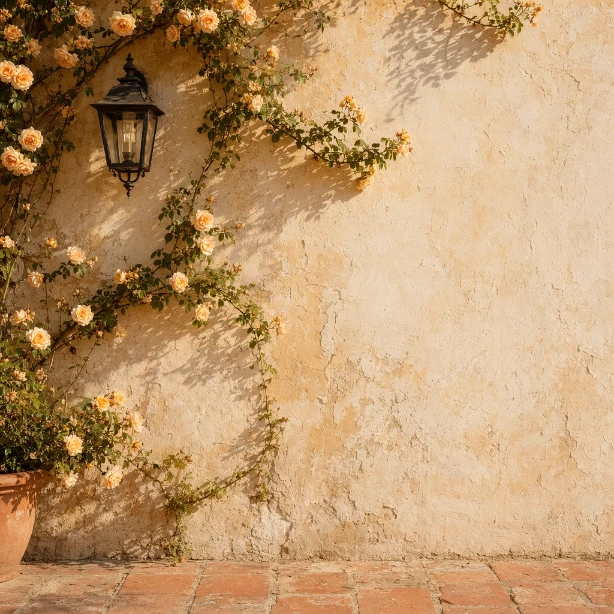
Hand-plastered stucco walls with genuine color variation, subtle surface texture from skilled trowel work, and the warm, honey-toned patina that develops through years of weathering are the most architecturally authentic and visually beautiful exterior wall treatment for a luxury Spanish Mediterranean home — the slightly irregular, organically textured, warmly toned stucco surface representing the accumulated evidence of genuine handcraft, natural material aging, and the specific aesthetic character that machine-applied synthetic stucco systems simply cannot replicate regardless of their practical performance advantages or their economic efficiency relative to traditional hand-application methods.
Specify genuine three-coat Portland cement stucco applied by skilled plasterers trained in traditional hand-application techniques — scratch coat, brown coat, and finish coat — using integrally colored finish coat mixtures that include warm ochre, terracotta, and cream pigment combinations for the most authentically Mediterranean color result. Request a hand-textured finish coat applied with a wood float for the slightly open, organically varied surface texture that gives genuine Spanish Mediterranean stucco its characteristic visual warmth. Age the finished stucco surface with a limewash treatment in a slightly warmer, more golden tone than the base stucco for an immediate, convincing patina effect.
13. Cantera Stone Architectural Details
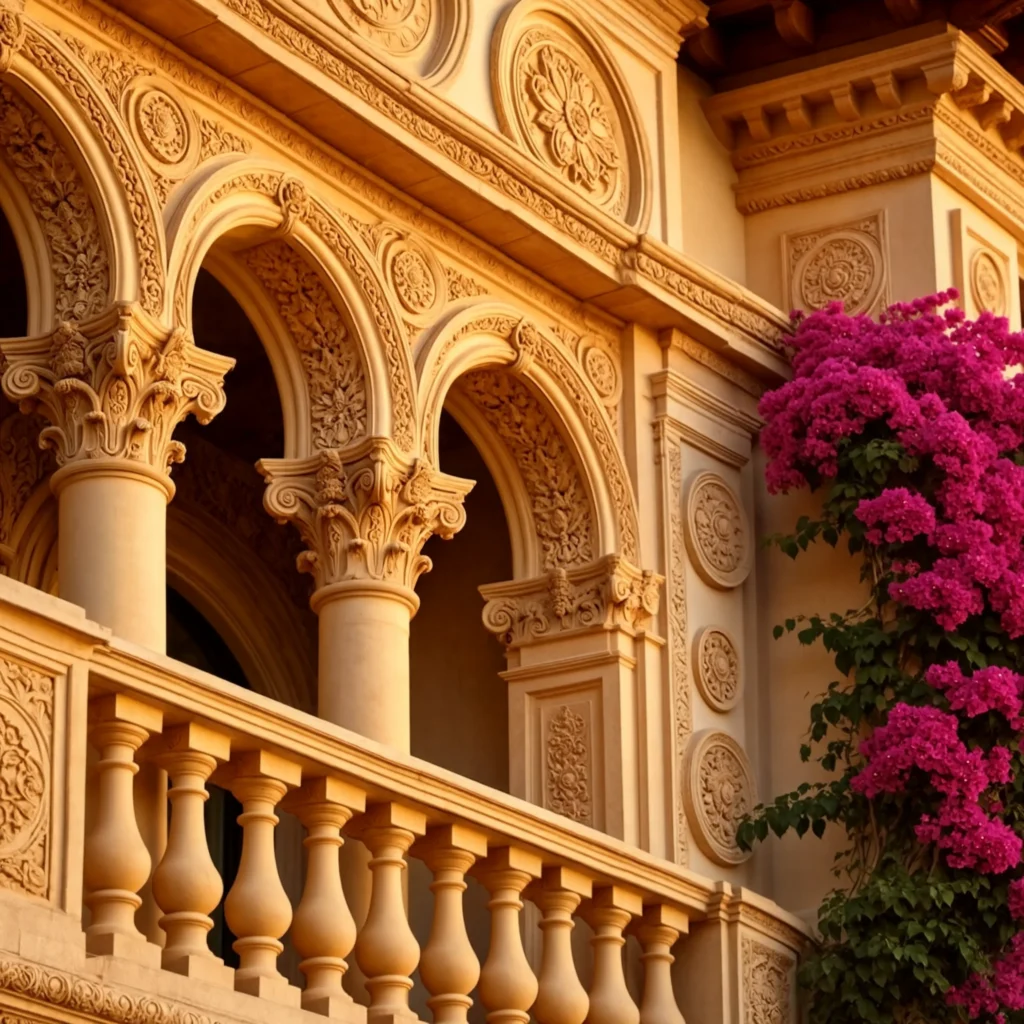
Hand-carved cantera stone architectural details — window and door surrounds, column capitals, decorative medallions, balustrade balusters, fountain basins, and ornamental facade elements — are the most luxuriously beautiful and historically authentic decorative stonework feature of the finest luxury Spanish Mediterranean homes, the warm honey-colored volcanic stone carved by skilled Mexican and Central American stonecutters into the floral, foliate, geometric, and figural ornamental vocabulary of Spanish colonial architecture in a tradition of exceptional craft quality that has been practiced continuously and with undiminished skill for five centuries.
Source cantera stone architectural elements from specialized importers who work directly with master stone carvers in Guanajuato and Zacatecas, Mexico — where the largest and most skilled concentrations of traditional cantera stone carvers continue practicing their extraordinary craft for discriminating architectural clients worldwide who appreciate genuine quality and authentic materials. Each carved element should be specified in pink or grey cantera for exterior applications where the stone’s natural weather resistance is essential, and in the softer, more easily carved pale yellow or cream varieties for sheltered interior niches, fireplace surrounds, and decorative wall installations where weather exposure is not a performance concern.
14. Swimming Pool with Moorish Tile Surround
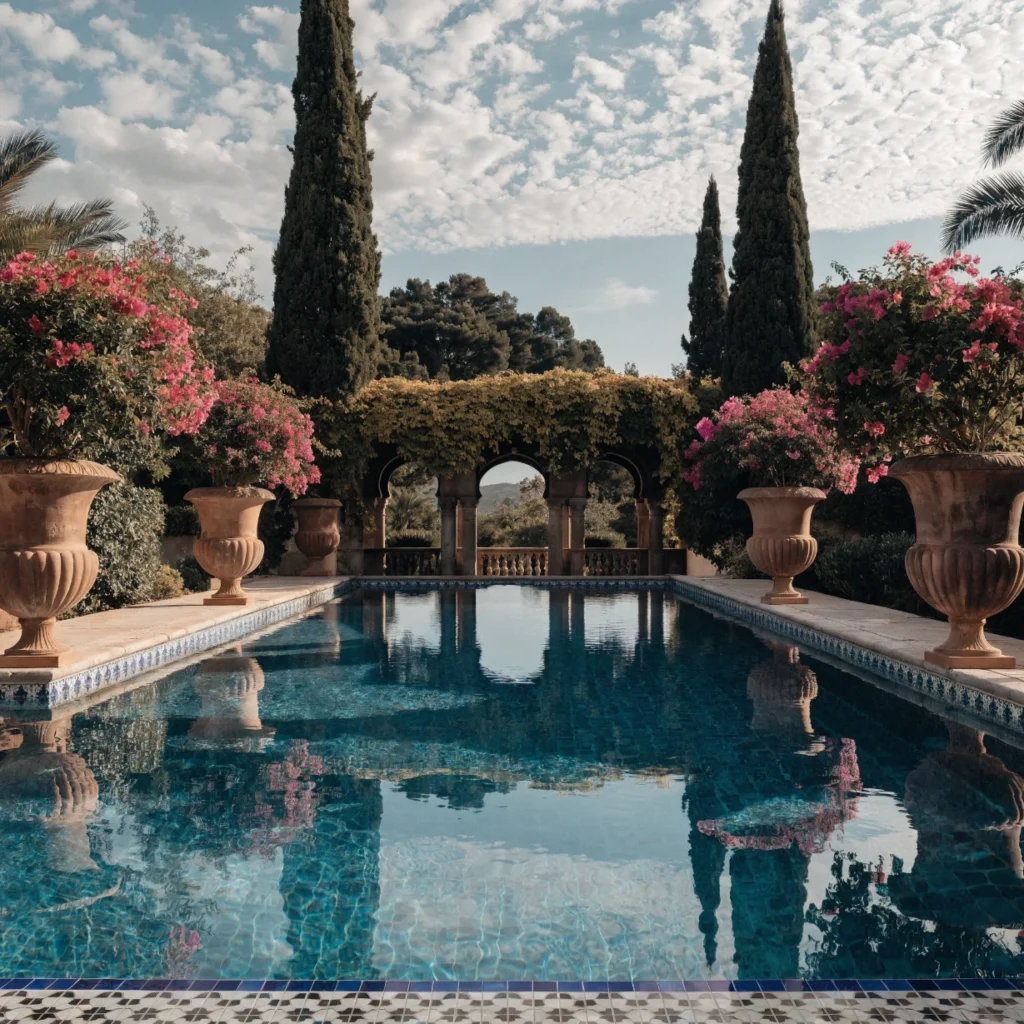
A swimming pool with a Moorish geometric tile surround — the pool coping, waterline band, shallow bench, and surrounding deck all featuring hand-painted ceramic tile in the cobalt, turquoise, gold, and white palette of authentic Islamic geometric decoration — is the most visually spectacular and genuinely extraordinary outdoor luxury feature of a Spanish Mediterranean estate that reflects the design tradition’s most ancient and most consistently beautiful relationship with water as both a practical resource and a profoundly significant aesthetic and spiritual element deserving the most beautiful, most carefully crafted, and most permanently impressive architectural celebration achievable.
Design the pool’s tile program with a specialist in Moorish and Spanish colonial ceramic arts who can develop a coherent geometric tile composition that reads beautifully at both close range and from the loggia or garden vantage points across the pool’s full length — beginning with an eight-pointed star pattern at the pool’s shallow entry steps, continuing with a border band of geometric interlace at the waterline, and culminating in a larger geometric medallion installed on the pool floor at the deep end that glows with refracted light through the turquoise water surface in an effect of genuine, breathtaking, genuinely magnificent beauty throughout every sunlit hour of every perfect Mediterranean-climate day.