18 English Country House Exterior Ideas You’ll Love
1. Climbing Rose Covered Stone Facade
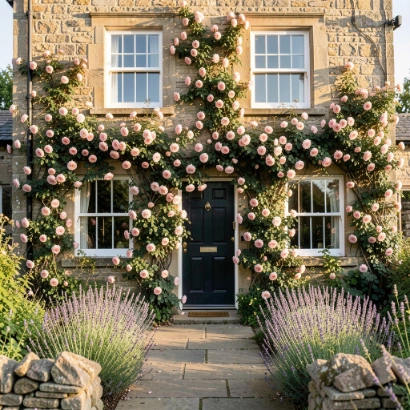
A stone house facade covered in climbing roses in full summer bloom is the single most romantically beautiful and most universally beloved English country house exterior image, representing the highest expression of the English national genius for combining architecture and horticulture into a unified composition of extraordinary natural beauty that improves with every passing season of continued growth. Choose vigorous climbing rose varieties with proven architectural covering ability — Rosa mulliganii, Kiftsgate, Albertine, or the magnificent pink-blush New Dawn — training the initial framework of main stems horizontally along wires fixed to the stone at six-inch intervals to encourage the maximum lateral spread and the most generous flowering coverage across the full width and height of the house facade. The climbing rose’s annual cycle of bare winter structure, fresh spring foliage emergence, early summer bud formation, and the full magnificent mid-summer flowering creates a facade of continuously changing beauty across all twelve months of the year.
Underplant the climbing rose’s base with a cottage garden planting of lavender, catmint, hardy geraniums, and alliums that knit together the junction between stone wall and garden path with a generous, slightly informal planting arrangement of complementary blues, purples, and silvers that makes the rose’s pink blooms appear even more brilliantly beautiful by chromatic contrast. Maintain a clearly defined flagstone or brick path of sufficient width to allow comfortable passage through the rose-covered entrance without ducking under low-hanging flower clusters, and train all rose stems firmly to their wire supports after flowering to prevent the facade from becoming impenetrably dense and difficult to maintain. This climbing rose facade earns the deepest, most passionate, and most consistently devoted Pinterest engagement of any English country house exterior idea because it represents the most completely beautiful and most genuinely English vision of a house made magnificent by the collaborative achievement of architecture, horticulture, and the benevolent passage of time working together in perfect, unhurried harmony.
2. Wisteria-Draped Entrance Porch
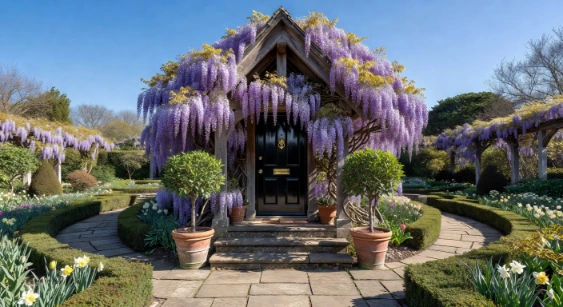
A wisteria-draped entrance porch in full lilac bloom is one of the most spectacular and most photographically unforgettable English country house exterior features, transforming the everyday functional element of a front entrance canopy into a breathtaking natural architectural spectacle of cascading purple flower racemes, intoxicating fragrance, and the magnificent visual drama of a plant that has spent decades building the structural framework required to produce its annual, fleeting, utterly transcendent display. Train wisteria sinensis or wisteria floribunda along the porch timbers and up onto the house wall above, establishing the main structural stems along the porch beams and allowing lateral flowering spurs to develop along the length of each horizontal wire, pruning twice annually in summer and winter to build the dense, heavily flowered spur system that produces the most generous and visually spectacular display of hanging flower clusters. Wisteria’s bare-stemmed winter silhouette has its own sculptural beauty and clearly communicates the promise of the spectacular spring display to come.
Paint the front door in a deep, glossy color — black, navy, or racing green — that creates a dramatic visual focal point of saturated color beneath the pale purple wisteria canopy, and fit it with polished brass door furniture of substantial quality including a lion’s head knocker, a letterbox, and a pair of matching coat hooks inside the porch. Flank the front steps with a pair of clipped bay or box topiary standards in lead or terracotta containers that provide year-round formal structure and vertical emphasis at the entrance composition’s ground level. This wisteria porch earns magnificent Pinterest engagement because the image of cascading purple wisteria framing a glossy painted front door beneath a blue spring sky represents one of the most powerful and most universally desired English country house exterior visions — a moment of natural theatrical beauty so complete and so brief that it makes the entire house appear, for those extraordinary few weeks of peak bloom, to be the most beautiful building in the world.
3. Georgian Sash Windows with Painted Shutters
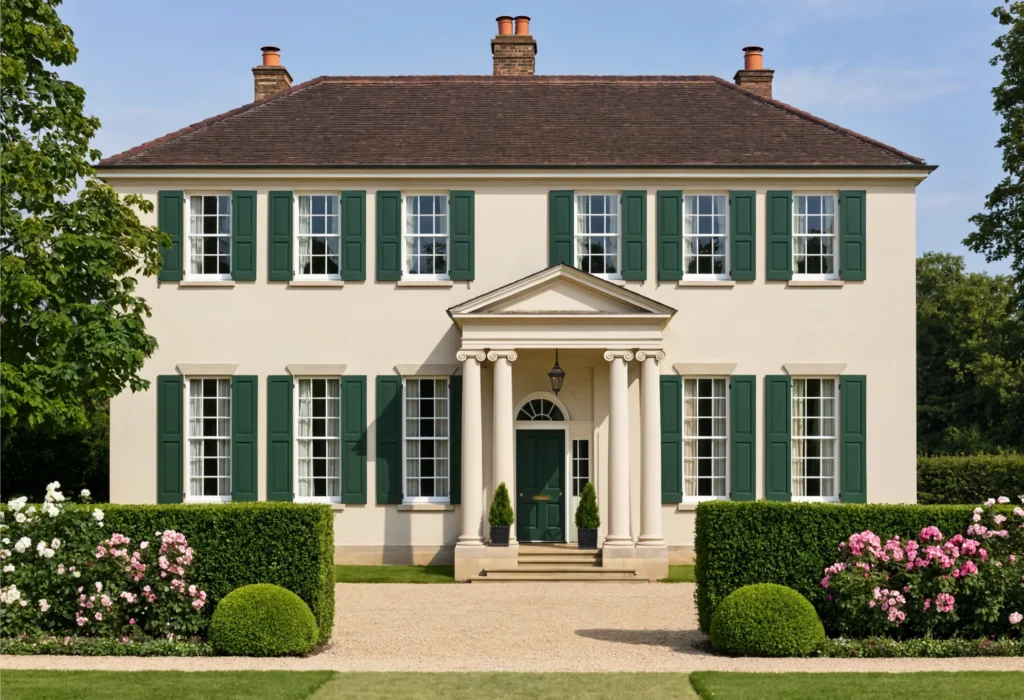
Georgian sash windows with painted exterior shutters represent the most architecturally perfect and historically correct window treatment for the classic English country house exterior, expressing the eighteenth century’s supreme confidence in the mathematical relationship between window opening and wall surface, between light and solidity, and between the individual window’s vertical proportion and the facade’s overall horizontal composition of extraordinary classical clarity and permanent visual authority. Specify six-over-six or eight-over-eight sash windows with slender glazing bars of correctly Georgian profile — no thicker than 19mm face width — painted in the purest brilliant white for maximum contrast against the rendered or stone facade, as the crispness and precision of the painted glazing bar is the element that most clearly communicates the window’s period authenticity and the facade’s overall quality of architectural finish and material care. The sash window’s vertical rectangle proportion, its counterbalanced weight mechanism, and the characteristic way it opens with the upper sash dropping behind the lower creates a window type of remarkable elegance and sophisticated functionality that no other window form has ever surpassed or seriously challenged in its particular combination of visual beauty and practical domestic excellence.
Install exterior painted timber shutters in dark bottle green, slate blue, or deep charcoal on either side of each window, ensuring they are genuinely functional — hinged to fold back flat against the wall and capable of being closed fully across the window opening — rather than purely decorative elements attached to the wall as fixed architectural dressing with no working capacity. The operating shutter communicates the house’s quality and genuine architectural integrity with a subtle but unmistakable signal of authentic Georgian domestic design. This Georgian sash window and shutter exterior earns outstanding Pinterest engagement because the image of a perfectly proportioned, symmetrically windowed Georgian facade with dark painted shutters on a cream rendered wall represents one of the most complete and most enduringly beautiful visions of English country house exterior architecture — a building that looks as though it was designed with full classical knowledge and built to last not decades but centuries.
4. Dry Stone Wall Garden Boundary
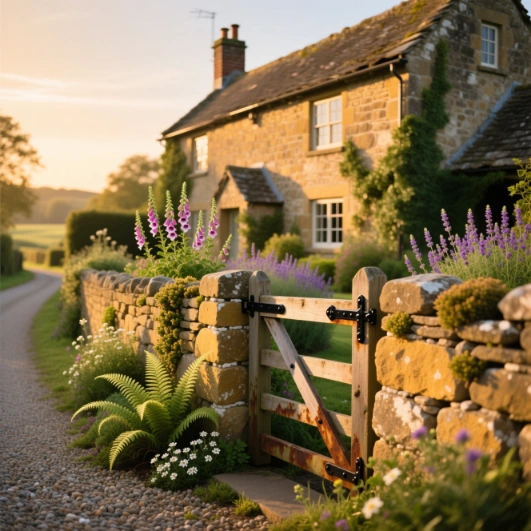
A traditional dry stone wall forming the garden boundary of an English country house is one of the most materially authentic and landscape-historically significant exterior features available to any rural property, connecting the house and its grounds to a dry stone walling tradition that has shaped the physical character of the English countryside for more than four thousand years of agricultural land management and the patient, skilled assembly of local stone without mortar. Source locally quarried stone of the same geological type used for the house construction wherever possible — limestone in the Cotswolds, millstone grit in the Yorkshire Dales, granite in Cornwall and Devon — as the material continuity between house wall and garden boundary wall creates a powerful sense of the property’s deep rootedness in its specific local landscape and geological character. Engage a skilled dry stone waller with traditional training and current Dry Stone Walling Association certification to construct or restore walls to the correct regional specification of batter angle, through-stone placement, and coping stone arrangement that distinguishes genuinely traditional dry stone construction from its less structurally sound imitations.
Allow self-seeded plants to colonize the wall’s mortar-free joints over several seasons — stonecrop sedums, wild thyme, navelwort, maidenhair spleenwort, and the small native ferns that find perfect conditions in the cool, slightly damp shelter of the deep stone joints — creating a linear garden of extraordinary botanical delicacy and naturalness that makes the wall appear to have grown from the landscape rather than having been built upon it. Hang a traditional five-bar gate with black-painted iron furniture at the principal garden entrance, choosing a gate of correctly proportioned horizontal rail spacing and the slight upward sweep of traditional agricultural gate design. This dry stone wall boundary earns devoted Pinterest engagement because it is the most geologically honest and landscape-historically authentic of all English country house exterior boundary treatments — a wall that carries within its carefully selected and patiently stacked stones the accumulated craft knowledge, landscape observation, and patient physical skill of an extraordinarily long and unbroken rural building tradition.
5. Gravel Driveway with Pleached Lime Allee
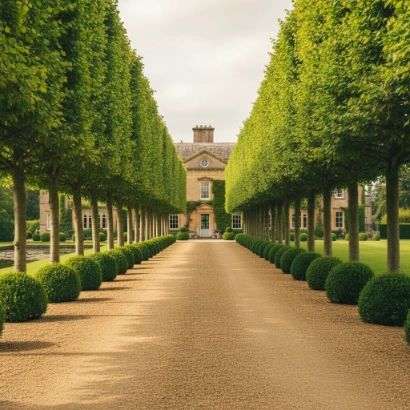
A gravel driveway flanked by a formally pleached lime tree allee is the most architecturally grandest and historically prestigious approach treatment available to the English country house exterior, creating a formal avenue of trained living architecture that frames the first view of the house with a corridor of extraordinary green geometry and controlled natural beauty. Plant a pleached lime allee using Tilia platyphyllos or Tilia europaea at regular spacings of three to four meters, training the main stems upward on clear posts to the desired height before beginning the horizontal training of lateral branches along parallel wires to form the continuous elevated green canopy that characterizes the fully mature pleached avenue. The pleached lime’s flat, two-dimensional canopy plane — dense with large heart-shaped leaves in summer and reduced to an intricate tracery of trained horizontal branches in winter — creates a living green wall of remarkable architectural precision that combines the warmth and natural beauty of living plant material with the formal structural clarity of a built architectural screen.
Surface the driveway in a locally sourced pale golden or warm buff gravel of suitable particle size — typically 10mm to 20mm angular crushed stone rather than round pea shingle that migrates underfoot — rolled to a firm, well-drained surface that provides a comfortable walking and driving surface while contributing a warm, reflective material texture and color to the driveway’s overall visual composition. Edge the gravel on both sides with a mown grass verge or a clipped box hedge of sufficient width to visually ground the pleached lime stems and provide a clear material transition between the formal driveway surface and the parkland or garden planting beyond. This pleached lime allee driveway earns magnificent Pinterest engagement because it creates the most architecturally impressive, most photographically dramatic, and most historically distinguished approach sequence available to any English country house exterior — a formal avenue that announces the house’s presence with quiet, confident, and completely convincing architectural authority.
6. Traditional Thatched Roof with Decorative Ridge
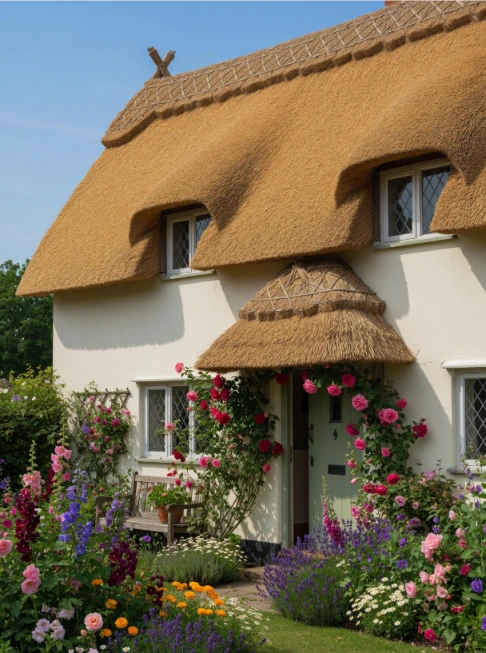
A traditional thatched roof with a decoratively worked ridge is the most romantically iconic and most immediately recognizable English country house exterior feature, representing a roofing tradition of extraordinary age, remarkable material beauty, and deeply characteristic regional variation that has given the English countryside its most beloved and most photographed domestic architectural image for more than a thousand years of continuous thatched construction. Specify long-straw, combed wheat reed, or Norfolk water reed thatching material according to the regional tradition of the house’s specific county location, engaging a Master Thatcher with accreditation from the National Society of Master Thatchers who understands the local thatching conventions of ridge style, eaves cut, and surface dressing pattern that distinguish genuine regional thatching practice from the generic approach of a less regionally knowledgeable contractor. The thatched roof’s characteristic deep, overhanging eaves — typically projecting 450mm to 600mm beyond the wall face — create the most beautifully dramatic shadows across the house facade and provide remarkable weather protection to the walls below that makes the deep overhang simultaneously an aesthetic and a practical feature of considerable importance and domestic value.
Specify a decoratively worked ridge of the most elaborate regional pattern appropriate to the house’s county — a cross-hatched or herringbone-patterned block ridge in the East Anglian tradition, a flush-cut ridge with a scalloped or pointed surface pattern in the West Country style, or a rolled and twisted rope-pattern ridge in the Hampshire manner — engaging the thatcher in a collaborative design discussion about the ridge’s decorative ambition and the specific patterns available within the regional tradition. Place a traditional decorative ridge animal — a pheasant, a fox, an owl, or a pair of crossed wheat sheaves — at the ridge apex or gable ends as the most characterful and regionally authentic finishing detail of the thatched roof’s decorative program. This thatched roof exterior earns the most passionate and universally enthusiastic Pinterest engagement of any English country house feature because the image of a beautifully thatched cottage surrounded by a cottage garden in full summer bloom represents the single most powerful, most universally desired, and most enduringly beautiful vision of the English countryside domestic ideal.
7. Painted Front Door with Period Brass Hardware
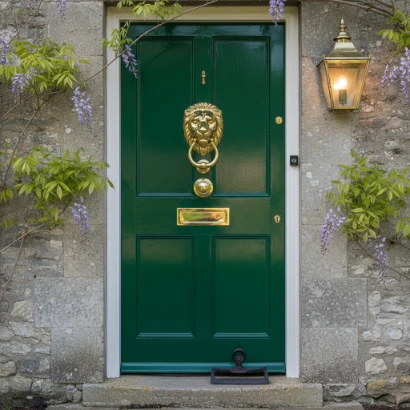
A glossy painted front door with period brass hardware is the most immediately impactful and most personally expressive single exterior design decision available to the English country house, creating a focused composition of saturated color, reflective metalwork, and architectural detail at the house’s most important and most frequently observed exterior point that communicates the household’s taste, confidence, and relationship with the English decorating tradition with remarkable clarity and considerable decorative power. Choose a paint color of genuine boldness and chromatic depth — deep racing green, glossy black, midnight navy, rich burgundy, or warm ox blood — applied in a high-gloss oil or hard enamel formulation that provides a paint surface of mirror-like reflectivity and the most saturated, most visually impactful color expression possible on a painted timber door surface. The glossy paint’s ability to reflect the surrounding garden, sky, and architectural detail in its surface creates a door that changes continuously through the day as the light shifts and the garden moves around it, making it a living focal point of endlessly interesting surface complexity rather than a flat area of static applied color.
Fit the front door with the most beautiful and most period-authentic brass hardware available — a substantial lion’s head door knocker with a ring striker, a hinged brass letterbox with engraved border detail, a polished brass door knob with a matching keyhole escutcheon, and a pair of brass coat hooks inside the entrance lobby — choosing pieces from specialist period hardware suppliers whose castings have the weight, surface detail, and correct period proportion of genuine antique originals rather than the thin, lightweight pressed brass of inferior reproduction fittings. Set a traditional cast iron boot scraper into the stone step at the door’s base as the most authentically English countryside finishing detail of the front entrance composition. This painted door and brass hardware exterior earns exceptional Pinterest engagement because it is simultaneously the most easily achieved and most dramatically transformative exterior improvement available to any English country house, delivering an immediate, powerful, and completely authentic decorative impact through the combination of a bold paint color choice and genuinely beautiful period metalwork.
8. Formal Box Parterre Front Garden
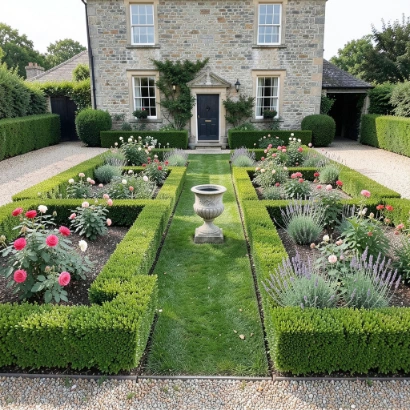
A formal clipped box parterre in the front garden of an English country house is the most historically prestigious and most architecturally complementary landscape treatment for a property of classical proportions and formal architectural character, creating an outdoor room of extraordinary geometric precision and botanical beauty that extends the house’s sense of controlled, ordered, deeply considered design outward from the building itself into the surrounding landscape with complete formal authority. Design the parterre using Buxus sempervirens clipped to a height of 300mm to 450mm in geometric compartment shapes — squares, rectangles, L-shapes, and the characteristic French parterre de broderie scrollwork patterns that English formal garden design adapted from continental European precedents during the seventeenth century — laid out with total bilateral symmetry on both sides of the garden’s central axis running perpendicular from the house front door to the garden boundary. Clip the box to a precisely flat top and perfectly vertical sides using a stretched string line and spirit level guide, maintaining the geometric sharpness of the compartment edges that gives the parterre its characteristic quality of controlled, artificial precision in deliberate and beautiful contrast to the naturalistic English countryside landscape beyond the garden boundary.
Fill the parterre compartments with materials that provide year-round visual interest and seasonal color change — pale golden gravel as the base, with centrally positioned rose standards or lavender plants in summer, bulb interplanting of alliums and tulips for spring, and the evergreen box structure itself providing the parterre’s complete winter framework and structure. Place a centrally positioned carved stone sundial, a lead cistern planted with herbs, or an antique stone urn as the parterre’s axial focal point, selecting an object of sufficient sculptural presence and material quality to hold the composition’s center with quiet, confident authority. This formal box parterre exterior earns outstanding Pinterest engagement because it represents the most architecturally serious and historically distinguished front garden treatment available to the English country house — a landscape design of genuine formal ambition that enhances the house’s classical proportions and communicates the household’s knowledge of and commitment to the English formal garden tradition with unmistakable clarity and considerable visual splendor.
9. Stone Mullioned Windows with Leaded Lights
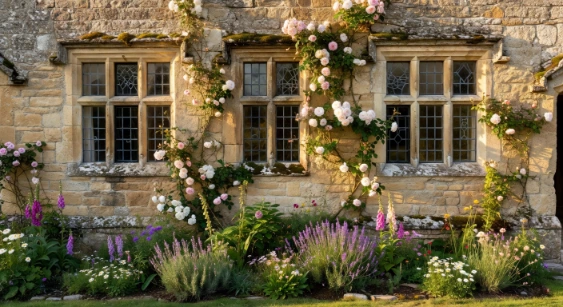
Original stone mullioned windows with small-pane leaded glass are the most architecturally authentic and historically significant window type available to the English country house exterior, representing a window form of extraordinary beauty and domestic intimacy that has characterized the English country house from the medieval period through the Jacobean era and beyond, giving thousands of English houses their most recognizable and most beloved exterior detail of warm stone geometry and glittering glass surface. The stone mullion’s characteristic slender vertical proportions, its slightly chamfered or hollow-molded profile, and the beautiful texture of hand-cut or sawn stone create window divisions of a refinement and material warmth that no metal or timber alternative can replicate in the specific context of a stone-built country house exterior of medieval or Tudor character. The leaded glass within each light — whether diamond quarries, rectangular panes, or heraldic colored glass panels — catches and refracts the changing daylight in the most beautiful and complex way, making the window surface appear almost to shimmer with accumulated light rather than simply admitting it passively as a transparent barrier between interior and exterior.
Maintain and restore existing stone mullions using lime mortar of the correct hydraulic strength and color to match the original bedding mortar, and replace damaged or missing leaded lights with hand-made glass from specialist suppliers whose products replicate the slight surface irregularities, small air bubbles, and natural color variations of genuinely old glass that give the window its characteristic quality of warm, living, imperfect translucency. Plant climbing roses or a mature wisteria around the window surround at sufficient distance to avoid damaging the stone with woody stem growth while allowing the flowering stems to frame the window in seasonal bloom. This stone mullioned window exterior earns profound Pinterest engagement because it represents the most genuinely historical and most materially irreplaceable of all English country house exterior architectural details — a window whose beauty is inseparable from the age, material, and craft of its original construction and impossible to replicate in any modern alternative however carefully designed or skillfully executed.
10. Brick and Flint Chequerboard Facade
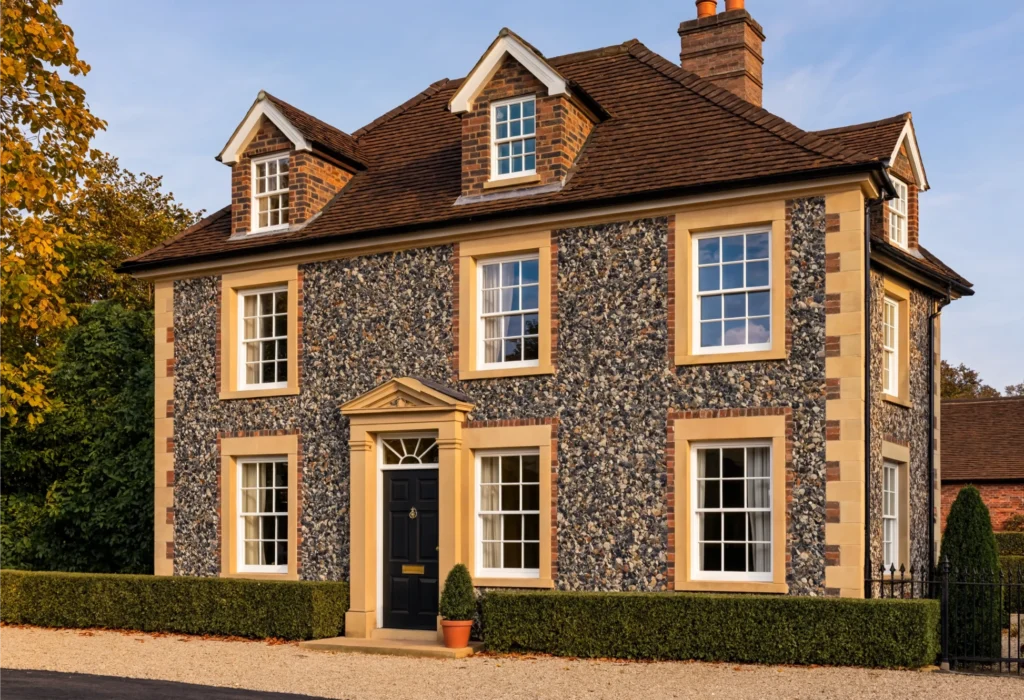
A brick and knapped flint chequerboard facade is the most visually distinctive and regionally specific English country house exterior material treatment, representing a building tradition of extraordinary geometric ambition and skilled material workmanship that is concentrated almost entirely in the chalk downland counties of East Anglia, Sussex, and Hampshire where both materials are locally abundant and the combination has been used since the medieval period to create facades of remarkable decorative impact and considerable construction difficulty. The chequerboard pattern requires the precise cutting and laying of both materials to identical square dimensions — typically 300mm by 300mm — in alternating courses that maintain perfect geometric alignment horizontally, vertically, and diagonally across the full extent of the facade, demonstrating a level of constructional precision and material control that makes any well-executed flint and brick chequerboard facade an immediately impressive statement of serious building craftsmanship and regional material knowledge. Knapped flint — the flint nodule split to reveal a flat, jet-black vitreous face — creates squares of extraordinary color depth and reflective surface that contrast dramatically with the warm red or orange tones of the adjacent brick squares in a facade composition of maximum tonal and textural contrast.
Specify stone quoins — large, precisely cut blocks of dressed limestone or clunch chalk — at the building’s corner returns as the most authentic and structurally appropriate termination of the chequerboard pattern, giving the facade edges a visual and material emphasis that clarifies the building’s three-dimensional form and provides an architectural frame for the complex patterned surface between. Introduce stone surrounds to all window and door openings as a further frame element that organizes the chequerboard pattern around each aperture with formal architectural clarity and prevents the pattern from appearing to dissolve into visual chaos at the crucial transition between wall surface and window opening. This brick and flint chequerboard exterior earns exceptional Pinterest engagement because it is the most visually dramatic and most materially distinctive of all English country house exterior treatments — a facade that makes an immediate and completely unforgettable impression through the bold, confident, and beautifully executed combination of two local materials in a pattern of extraordinary geometric precision and deeply regional material character.
11. Dovecote Garden Feature
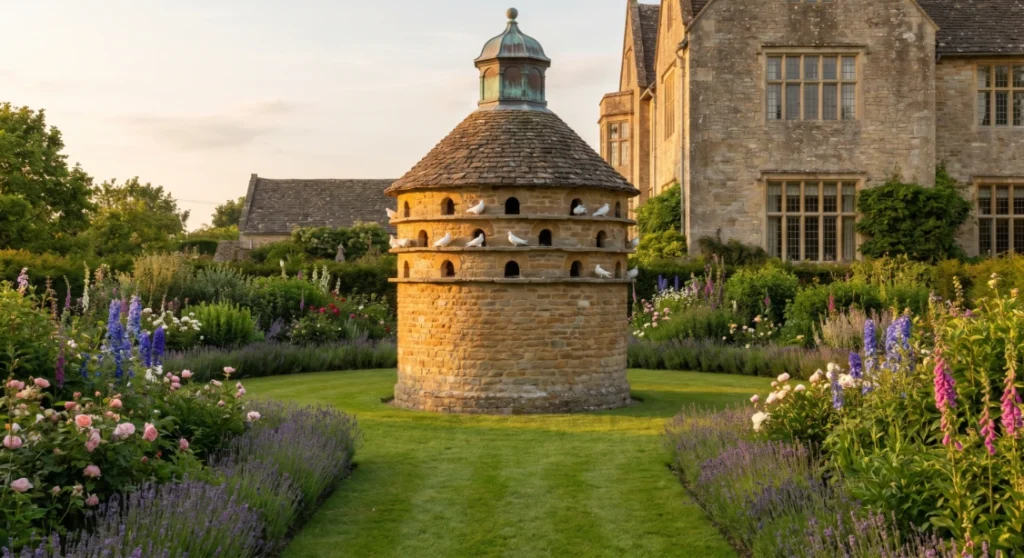
A restored historic dovecote as a focal point of the English country house garden is one of the most architecturally distinguished and historically evocative garden features available to any property with the grounds and architectural heritage to accommodate this remarkable and increasingly rare survivor of the English medieval and post-medieval agricultural estate. The dovecote’s characteristic circular, octagonal, or square plan with its steeply pitched stone, tile, or thatch roof and its rows of nesting box apertures arranged around the upper exterior represents one of the most complete and most architecturally satisfying building types in the entire English rural vernacular tradition — a building designed entirely around the behavioral requirements of its dove inhabitants and achieving in that total functional dedication a simplicity and purity of architectural form of extraordinary beauty and permanent visual interest. Restore existing dovecotes using traditional lime mortar, locally sourced replacement stone of matching geological type, and oak shingles or plain clay tiles appropriate to the regional building tradition, preserving every element of original fabric including carved nesting box details, wooden potence and rotating ladder systems inside, and original stone perching ledges on the exterior.
Position the dovecote as a free-standing garden focal point on a circular mown grass platform at the intersection of garden paths or at the end of an axial view from the house, surrounded by an informal planting of lavender, catmint, and cottage garden perennials at its base that softens the transition between the architectural dovecote and the garden landscape. Stock the restored dovecote with fantail or white domestic doves whose presence — their cooing, their constant comings and goings, and the white flash of their wings against the sky — transforms the garden into a living, animated landscape of extraordinary atmospheric beauty. This dovecote garden feature earns devoted Pinterest engagement because it represents the most architecturally historically significant and most atmospherically beautiful of all English country house garden structures — a building whose combination of ancient agricultural purpose, vernacular architectural beauty, and the living presence of its dove inhabitants creates a garden feature of completely unique and permanently unforgettable character and charm.
12. Walled Kitchen Garden with Espaliered Fruit
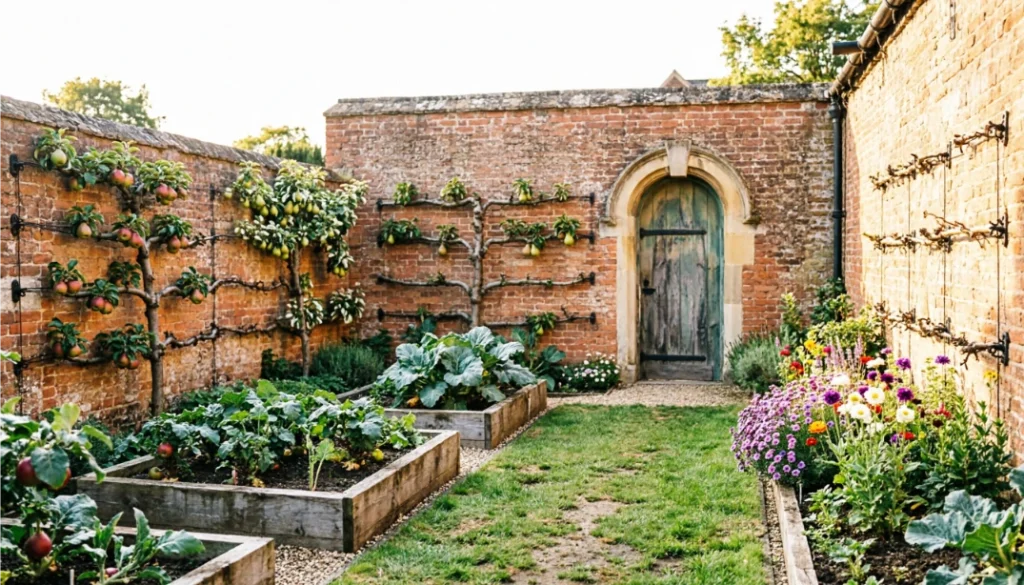
A walled kitchen garden with espaliered fruit trees trained against the brick walls is the most functionally complete and historically prestigious productive garden feature available to the English country house exterior grounds, preserving a kitchen garden tradition of extraordinary horticultural sophistication and domestic self-sufficiency that reached its peak of ambitious development in the great English country house walled gardens of the eighteenth and nineteenth centuries and continues to represent the highest aspiration of the English productive garden tradition. The walled kitchen garden’s enclosing brick walls — typically built to a height of three to four meters in the warm red or orange brick of the local regional tradition — serve simultaneously as windbreaks, frost protection barriers, solar heat stores, and the most important and most beautiful structural element of the entire kitchen garden composition, their mellow, lichen-spotted surfaces providing the most sympathetic and productive backdrop for the trained fruit trees that are the walled garden’s most decoratively spectacular horticultural feature. Train apple, pear, cherry, and fig trees against the south-facing and west-facing walls in formal espalier, fan, or palmette patterns using strong galvanized wires stretched horizontally at 400mm intervals along vine eyes set into the mortar joints, building over several years the precise, flat, two-dimensional tree form that maximizes the wall’s radiated heat absorption and produces the finest quality ripened fruit of any kitchen garden growing method.
Design the kitchen garden’s internal layout with the formal geometric confidence of the traditional potager — four quadrant beds arranged around a central path intersection with a focal point of a stone sundial, a lead cistern fountain, or a clipped standard gooseberry — using timber, brick, or iron edging to define each raised growing bed with crisp material precision. Establish a cutting flower border along at least one wall to supply the house with fresh seasonal flowers throughout the growing season, choosing long-stemmed annuals and perennials that cut well and last generously in water. This walled kitchen garden exterior earns magnificent Pinterest engagement because it represents the most productive, most historically distinguished, and most comprehensively beautiful of all English country house exterior landscape features — a garden that is simultaneously an architectural composition of considerable formal beauty, a working productive horticultural enterprise of genuine domestic usefulness, and an irreplaceable expression of the English country house’s most ambitious and most deeply admired domestic ideal.
13. Reclaimed Brick Path Through Cottage Garden
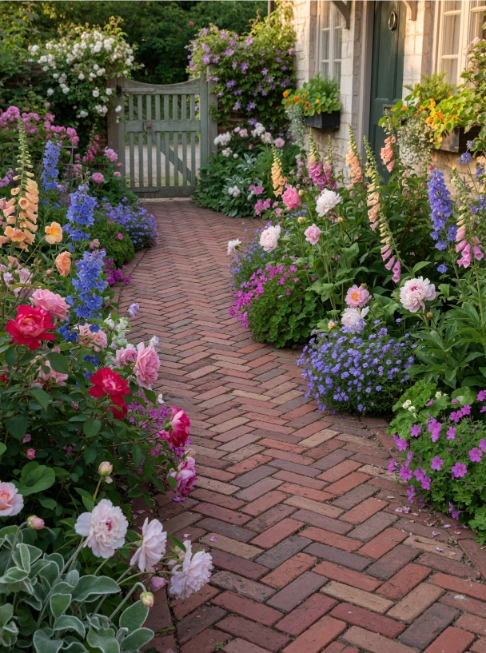
A sinuous reclaimed red brick path in a traditional herringbone pattern winding through a densely planted cottage garden is the most naturally beautiful and most characteristically English country house exterior approach treatment, combining the warm material beauty of aged handmade brick with the extraordinary sensory richness of a cottage garden planting of maximum floral abundance and deliberate, organized informality. Source genuinely reclaimed handmade bricks of the correct regional clay type and color — warm terracotta in the south and east, russet orange in the midlands, cooler grey-red in the north — choosing bricks with the slightly frog-marked surfaces, gentle color variation, and pleasingly imperfect shapes of genuine nineteenth century hand-pressed bricks rather than the uniform, machine-made regularity of modern equivalents. Lay the path in a traditional herringbone pattern using dry-jointed bricks on a sharp sand and hoggin bedding layer, omitting mortar from the joints to allow small self-seeding plants — thyme, mind-your-own-business, and lawn chamomile — to colonize the joints naturally over several seasons and soften the path’s geometric precision into the beautiful informality of a garden path that appears to have been there forever.
Plant the cottage garden borders flanking the path with the fullest, most generous, and most luxuriantly varied planting of traditional cottage garden perennials available — tall delphiniums and hollyhocks at the back, peonies, roses, and dahlias in the middle, hardy geraniums, catmint, and lady’s mantle at the front edge spilling generously over the brick path edge — choosing varieties in the characteristically English cottage garden palette of pink, blue, purple, white, and soft yellow that creates a color harmony of extraordinary natural beauty and deliberately uncontrived organic abundance. This reclaimed brick cottage garden path earns exceptional Pinterest engagement because it creates the approach sequence of maximum sensory richness and most complete English countryside beauty — a path through a garden in full summer bloom toward a country house front door that makes every arrival home feel like walking into the most beautiful painting of English domestic life ever made.
14. Lead Downpipes and Rainwater Heads
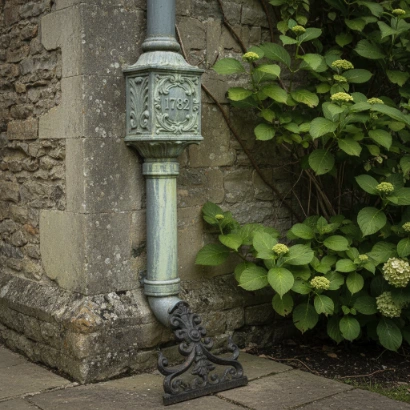
Original lead rainwater heads and downpipes are the most refined and most historically correct rainwater goods for the English country house exterior, representing a level of material quality, architectural craftsmanship, and decorative attention to the building’s functional external details that distinguishes the most carefully maintained and historically sensitive country house properties from those where modern plastic alternatives have been allowed to replace the original lead work with materials of dramatically inferior visual character and material permanence. The lead rainwater head — a three-dimensional hopper-shaped casting that collects water from the gutters and directs it into the downpipe — provides the most important opportunity for decorative expression in the exterior rainwater drainage system, with traditional examples bearing date cartouches recording the year of construction, heraldic shields, scrolled acanthus surrounds, and the initials of the original building owner in a formal architectural program of decorative ambition entirely appropriate to the seriousness and permanence of the lead material itself. Lead’s characteristic natural patination — developing over years from the bright silver of freshly cast and worked lead through warm grey to the distinctive soft blue-grey surface with its characteristic white carbonate bloom and occasional green verdigris streaking — creates a material surface of extraordinary beauty and environmental sensitivity that changes slowly and continuously with weathering.
Commission lead rainwater heads from specialist plumber-artists working in the traditional craft of lead casting and working, specifying a decorative program appropriate to the house’s architectural period and regional building tradition. Restore damaged or stolen lead rainwater goods using recycled or reclaimed lead of matching density and surface character rather than replacing them with modern aluminium or plastic alternatives that lack the material weight, surface warmth, and architectural character of genuine lead. This lead rainwater head exterior detail earns devoted Pinterest engagement because it represents the most refined and most architecturally sensitive level of attention to the English country house exterior — the care for the building’s every functional detail, however small or high, that distinguishes the genuinely loved and seriously maintained historic country house from one where the demands of authentic material quality have been sacrificed to the convenience and economy of modern substitute materials.
15. Yew Topiary Garden Architecture
Monumental clipped yew topiary defining the formal garden architecture of an English country house exterior is the most dramatically sculptural and most permanently impressive landscape feature available to any property with the space, vision, and patience to establish a topiary garden of genuine architectural ambition and extraordinary visual power. Taxus baccata — the native English yew — is the most architecturally perfect and most horticultural suitable topiary subject available in the English garden tradition, combining an extremely dense, fine-textured dark green foliage of remarkable clipping tolerance with a growth rate sufficiently vigorous to build significant topiary volume within a gardener’s lifetime while remaining slow enough to maintain a clipped form without requiring more than one or two annual clipping sessions to sustain the geometric precision and sculptural clarity of the finished shapes. Establish yew topiary in the forms most characteristic of the English formal garden tradition — tall obelisks and pyramids, rounded domes of varying diameters, flat-topped rectangular buttresses, elaborate peacock and chess piece figures, and the magnificent undulating hedges of great English gardens that create green architectural walls of extraordinary visual authority along principal garden axes.
Clip established yew topiary once annually in late August or early September when the current season’s growth has fully hardened, using long-handled shears or powered hedge trimmers for larger geometric forms and hand shears for detail work on figurative pieces and complex curved surfaces. Feed the topiary garden generously with a balanced fertilizer in spring to support the annual growth that provides new clipping material and gradually increases the topiary’s size and visual presence year upon year. This yew topiary garden exterior earns magnificent Pinterest engagement because it represents the most architecturally serious and most visually dramatic of all English country house garden design achievements — a landscape of living green architecture whose sculptural power, formal grandeur, and extraordinary permanence of effect make it the single most impressive and most unmistakably English exterior landscape feature that any country house garden can possess.
16. Stone Balustrade Terrace
A classical stone balustrade terrace connecting the English country house to its formal garden is the most architecturally grand and historically prestigious of all exterior landscape features, creating a raised outdoor room of extraordinary spatial quality and formal beauty that mediates between the house’s interior living spaces and the garden landscape below with a confident architectural transition of permanent stone construction and classical decorative ambition. Design the terrace balustrade using carved limestone or reconstituted stone balusters of correctly proportioned classical profile — typically a vase or column-and-bead form — with a substantial top coping rail and a continuous plinth base course that gives the entire balustrade composition its most architecturally resolved and materially complete appearance. The balustrade’s repeated rhythmic pattern of alternating solid balusters and open voids creates a screen of extraordinary visual complexity at the terrace edge, simultaneously defining the boundary between terrace and garden, framing views outward over the garden landscape, and providing a foreground of decorative stone geometry that enhances the overall exterior composition with a three-dimensional architectural richness of considerable formal beauty.
Position large stone or lead urns at regular intervals along the balustrade coping rail — at each corner and at the midpoint of each bay — planting them with generous seasonal displays of agapanthus and trailing ivy in summer, followed by cornus stems and evergreen ivy in winter, to introduce living color and plant material into the stone terrace composition throughout the year. Descend from the terrace to the garden below via wide stone steps of generous tread depth and low riser height that allow comfortable descent in formal dress and provide a transition of appropriate ceremonial quality between the terrace’s elevated formal register and the garden landscape below. This stone balustrade terrace earns exceptional Pinterest engagement because it represents the most grandly formal and most completely architecturally resolved of all English country house exterior landscape features — a terrace of permanent stone construction and classical decorative quality that places the house within its garden with the most self-assured, most historically authoritative, and most permanently beautiful architectural confidence imaginable.
17. Wildflower Meadow Approach
A wildflower meadow approach to the English country house is the most naturalistically beautiful, most ecologically rich, and most powerfully evocative exterior landscape treatment available to any rural property with sufficient ground to allow the management of a genuine species-rich meadow of traditional English grassland character. Establish the wildflower meadow on existing grass ground using the yellow rattle parasitic annual to weaken the vigorous grass species that suppress wildflower establishment, followed by plug-planting of locally appropriate native wildflower species — meadow cranesbill, ox-eye daisy, field scabious, knapweed, ragged robin, cowslip, and the annual species of cornflower, corn poppy, and corn marigold — in sufficient plant numbers and species diversity to create a sward of genuine botanical richness and seasonal color succession from early spring cowslips through the magnificent high summer ox-eye daisy and poppy peak to the late summer knapweed and field scabious that sustain the meadow’s color and ecological value into autumn. Mow the meadow once annually after mid-July when all the wildflower species have set seed, removing the cut material from the sward to reduce soil fertility and encourage the wildflower species over the vigorous grass competitors that prefer the richer sward conditions created by cut-and-leave management.
Cut a sinuous mown grass path through the meadow from the entrance gate to the house front door, using a domestic rotary mower set at its lowest blade height to create a clear contrast between the tall, flower-rich unmown meadow and the close-mown path surface that draws the eye and the visitor forward through the meadow toward the house beyond. This wildflower meadow approach earns devoted Pinterest engagement because it represents the most complete and most genuinely ecological expression of the English countryside in the country house exterior landscape — a meadow that is simultaneously the most beautiful, most biodiverse, most practically simple to maintain, and most powerfully romantic of all possible approaches to the English country house.
18. Lantern Porch Light with Aged Patina
A large wall-mounted lantern with a beautifully aged brass or verdigris bronze patina beside the English country house front door is the most atmospherically perfect and most welcoming exterior lighting feature available to the country house entrance, creating a focused source of warm amber light that illuminates the arrival experience with the particular golden glow of traditional lantern technology and makes every evening return to the house feel genuinely welcomed, sheltered, and beautifully lit in the most flattering and characteristically English exterior lighting manner. Choose a lantern of genuinely substantial size — the most common mistake in exterior lantern selection is choosing a fitting too small for the architectural scale of the house entrance it is intended to illuminate and ornament — specifying a hexagonal or square lantern body of a height proportional to the door height and the wall surface available, with a domed or pyramidal roof cap, clear or slightly amber-tinted glass panels, and a wall mounting bracket of sufficient decorative quality and material weight to complement the lantern body’s own decorative ambition. Specify the lantern in unlacquered brass, aged bronze, or cast iron that is allowed to develop its natural patination rather than being maintained in an artificially bright polished condition, as the progressive development of verdigris, tarnishing, and the green-brown surface complexity of genuinely weathered metal creates a material beauty and historical character of incomparably greater depth and warmth than any artificially preserved bright metalwork surface.
Fit the lantern with a warm-toned bulb of the lowest practical wattage in a candle or filament form that provides the most gentle, most flattering, and most atmospherically appropriate illumination quality at the front entrance — a warm amber point of light visible from a distance down the drive that draws the returning visitor toward the house with the most ancient and most powerful of all human lighting instincts, the attraction toward a warm visible light source in the gathering darkness of an English countryside evening. This aged lantern exterior lighting idea earns the most warmly felt and most universally resonant Pinterest engagement of any English country house exterior feature because the image of warm lantern light glowing beside a painted front door in the early evening darkness represents the most complete, most emotionally powerful, and most irreplaceably beautiful expression of the English country house exterior at its most welcoming, most sheltering, and most perfectly, timelessly, and unforgettably home.