17 Tuscan Inspired Italian Garden Ideas Full of Mediterranean Charm
1. Cypress Avenue Entrance Allée
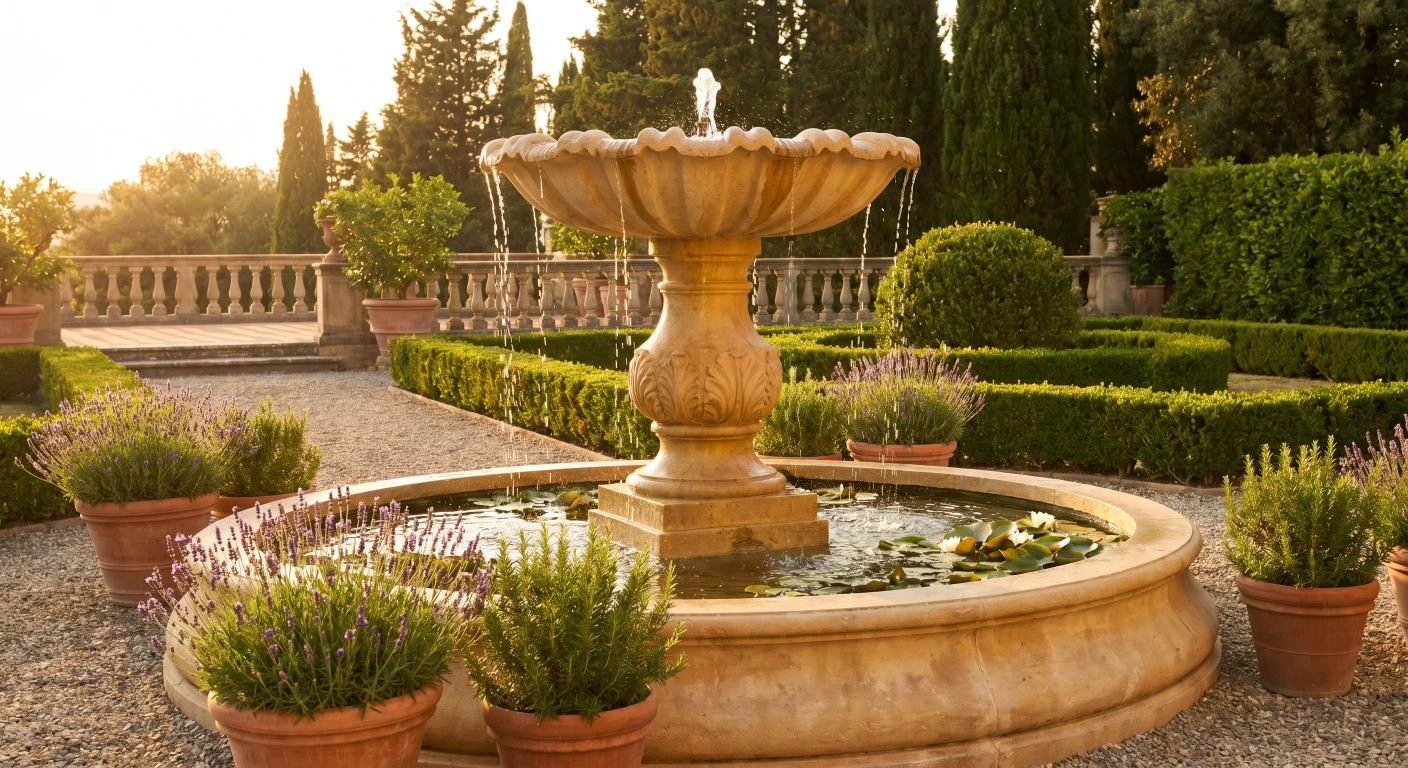
A formal cypress avenue allée — two perfectly aligned rows of tall, slender Italian cypress trees creating a dramatic green corridor that draws visitors toward the garden’s principal destination — is the single most powerfully evocative and immediately transporting Tuscan inspired Italian garden idea that recreates the specific, breathtaking visual experience of approaching a historic Florentine villa or Sienese estate along its ceremonial entrance drive, the columnar trees’ dark, architectural silhouettes creating a living architecture of extraordinary presence and formal beauty.
Plant Italian cypress — Cupressus sempervirens ‘Stricta’ or ‘Pyramidalis’ — at consistent spacing of eight to twelve feet between specimens for the most convincingly formal, architecturally resolved allée composition. Choose specimen trees of consistent height and form at planting — variations in size between adjacent trees will remain permanently visible and compositionally disruptive throughout the allée’s long life. Allow the trees to reach their full natural height of forty to sixty feet over the decades-long development of a mature allée — accepting that the most magnificent Italian garden cypress avenues are genuinely multigenerational investments in landscape beauty that reward long-term vision with incomparable results.
2. Stone Fountain with Tiered Basin
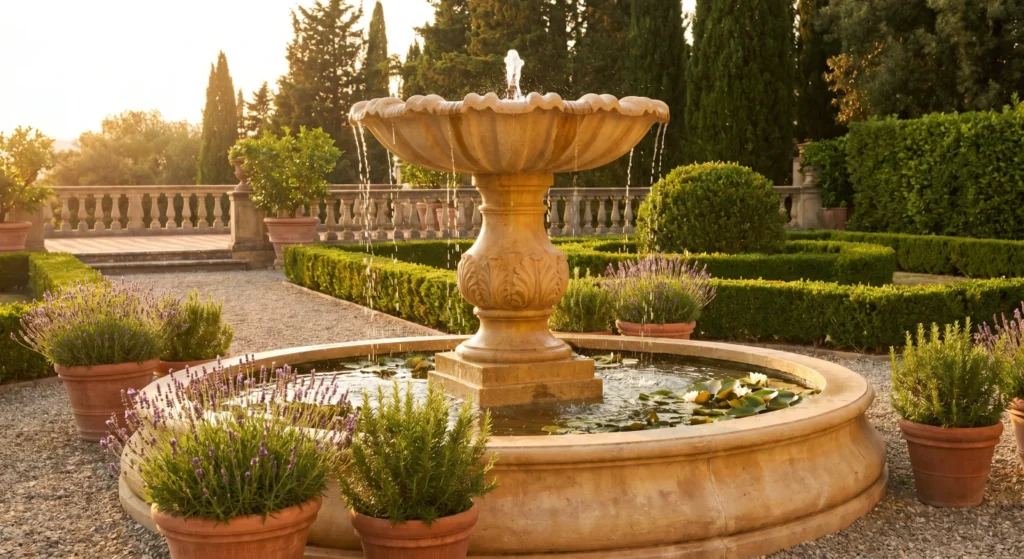
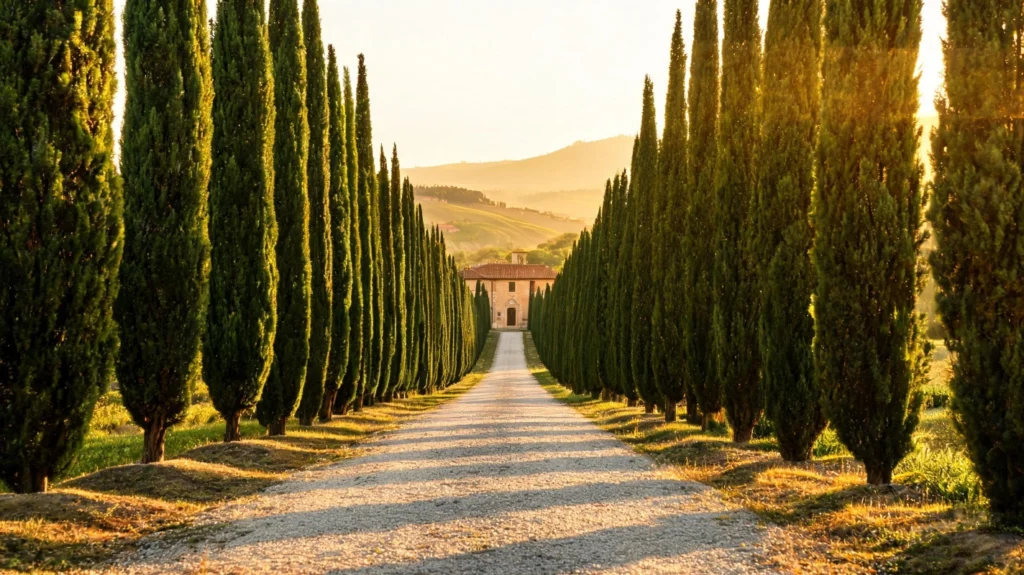
A hand-carved limestone or travertine tiered fountain at the garden’s ceremonial center is the most classically beautiful and genuinely Italian Tuscan garden idea for a water feature that draws directly from the extraordinary tradition of Renaissance and Baroque Italian garden fountain design — where water was considered the most precious, most visually spectacular, and most spiritually significant element in the garden, worthy of the most magnificent sculptural treatment and the most prominently honored position in the overall garden composition.
Source a genuine hand-carved stone fountain from Italian stone carvers in Pietrasanta, from quality American importers of Italian garden stonework, or from skilled local stone masons who work in authentic classical tradition. The tiered design — upper shell or mask-head basin delivering water to a larger lower receiving pool — is the most characteristically Italian fountain form, instantly evoking the classic garden aesthetic of Tuscany, Umbria, and Lazio. Position the fountain at the intersection of the garden’s primary and secondary axes for the most compositionally resolved, most formally correct Italian garden placement that gives the fountain its appropriate centrality and commanding presence.
3. Terracotta Lemon Tree Pots — Limonaia Style
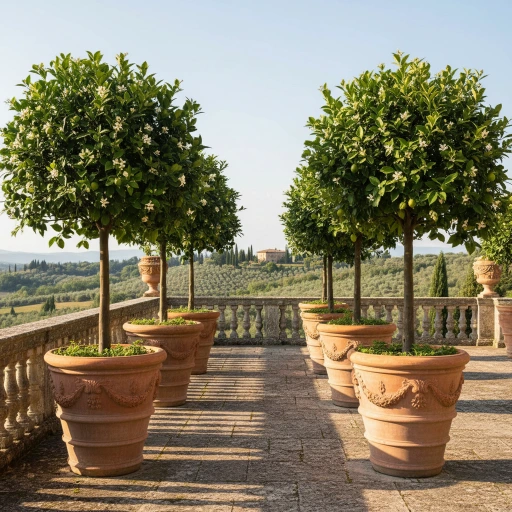
A collection of enormous traditional terracotta pots containing standard-trained lemon trees — their glossy deep green foliage, fragrant white blossoms, and ripening yellow fruit creating the most authentically Italian and sensory-rich garden moment imaginable — is the most classically Tuscan and genuinely Mediterranean Tuscan inspired Italian garden idea that directly references the ancient limonaia tradition of Italian Renaissance gardens where potted citrus trees were considered among the garden’s most prized and most carefully tended treasures.
Source traditional Italian terracotta pots from quality importers of Impruneta terracotta — the specific fire-resistant, frost-hardy terracotta produced in the Florentine hills of Impruneta that has been the most prized and most beautiful Italian garden pot material for centuries. Genuine Impruneta terracotta is heavier, more precisely formed, and significantly more durable than mass-produced alternatives, developing the most beautiful, most authentically aged patina with outdoor exposure over seasons of genuine garden use. Plant grafted lemon trees — Citrus limon ‘Eureka’ or ‘Meyer’ for regular fruiting — trained to a clean standard form with a clear stem of thirty-six inches and a rounded head of approximately equal width.
4. Wisteria-Draped Pergola
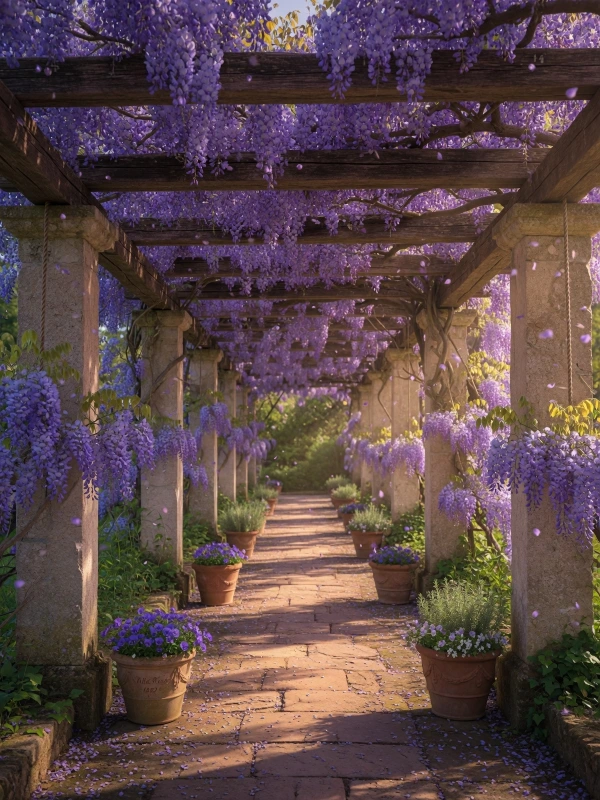
A wisteria-draped pergola with cascading purple-blue flower racemes hanging from every horizontal member in breathtaking abundance is the single most romantically magnificent and genuinely Italian Tuscan garden idea for an overhead structure that transforms the pergola from a functional shade element into a seasonal spectacle of such extraordinary beauty, fragrance, and visual drama that it becomes the garden’s single most photographed, most talked about, and most emotionally powerful feature during the brief, glorious weeks of peak bloom each spring.
Construct the pergola from substantial stone or rendered masonry pillars — at least twelve by twelve inches in section — supporting heavy oak or cedar primary beams of sufficient depth to carry the considerable mature weight of a fully established wisteria plant without bowing or sagging. Plant Wisteria sinensis ‘Prolific’ or Wisteria floribunda ‘Multijuga’ at each alternate pillar and train the main stems horizontally along every timber beam during the first three to five years of establishment — accepting that the most spectacularly blooming, most flower-laden wisteria pergolas require a minimum of ten years of establishment and skilled annual pruning before reaching their most gloriously abundant and breathtaking mature flowering performance.
5. Formal Herb Garden in Geometric Beds
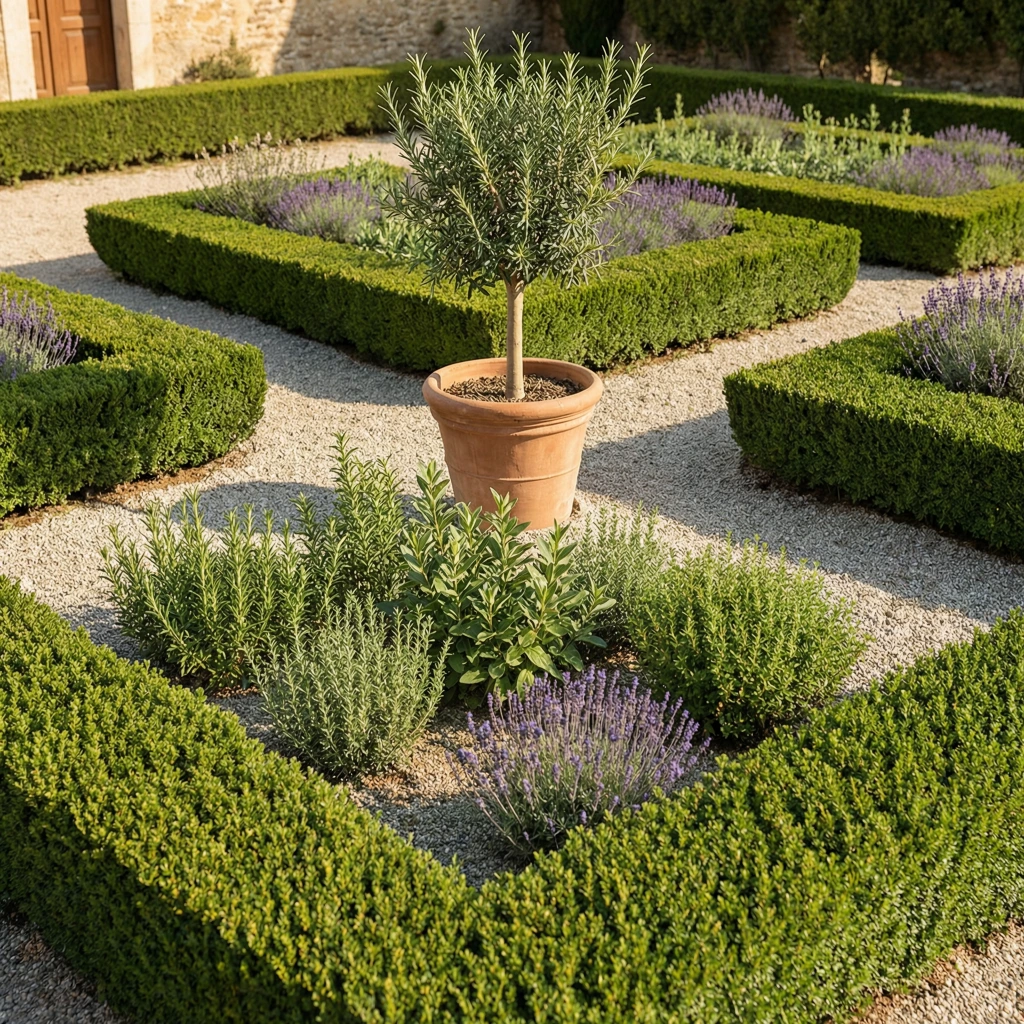
A formal herb garden laid out in geometric parterre beds defined by low clipped box hedges is the most practically beautiful and deeply Italian garden design idea that combines the Renaissance tradition of the giardino segreto — the formal enclosed garden — with the deeply embedded Italian cultural relationship between beautiful gardens and beautiful food, creating a growing space where the visual pleasure of perfectly maintained geometric form and the sensory richness of fragrant culinary herbs grown in their most idealized, most carefully tended formal presentation reinforce each other in the most completely satisfying garden aesthetic.
Design the herb parterre beds around a central axis leading to a focal point feature — a standard bay tree in a large terracotta pot, a small tiered fountain, or a carved stone armillary sphere — for the most formally resolved and compositionally complete Italian garden parterre arrangement. Plant each bed with a generous, full-coverage planting of a single herb species rather than mixing multiple species within the same bed — rosemary in one section, lavender in another, sage in a third, and low-growing thyme or marjoram as the ground-covering fill between — for the most graphically satisfying, most visually coherent formal garden pattern that reads clearly and beautifully from an elevated viewing position.
6. Rustic Stone Retaining Walls with Planted Crevices
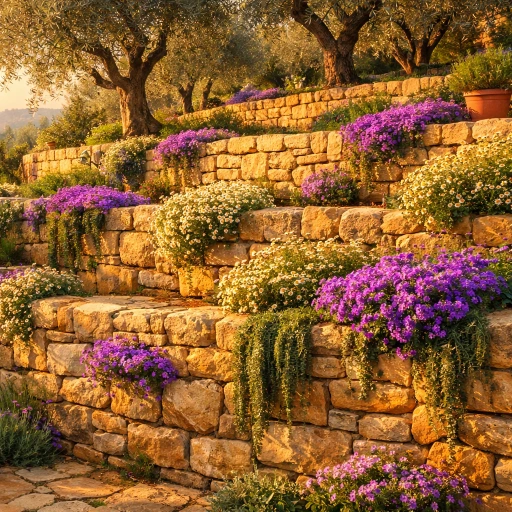
Rustic dry-stone retaining walls of warm honey-colored limestone creating planted terraces on a sloping garden is the most authentically Tuscan and most architecturally integrated Italian garden idea for sloped sites — the dry-stone walling tradition of the Tuscan, Umbrian, and Ligurian countryside having produced some of the most beautiful man-made landscape features in all of Italian agricultural and garden history through the skilled, labor-intensive process of fitting naturally quarried stone into stable, load-bearing walls without mortar.
Commission an experienced dry-stone waller who can create genuinely stable, aesthetically beautiful walls using locally sourced or regionally authentic stone — the most beautiful Tuscan-inspired walls use warm limestone or sandstone in varied block sizes with consistent horizontal coursing and a slight backward batter angle that provides structural stability while communicating the confident, time-tested quality of traditional Italian agricultural wall construction. Plant wall crevices during construction rather than after completion — inserting small plants of Erigeron karvinskianus, Aubrieta, trailing Rosmarinus, Erigeron, and small Dianthus into the gaps between stones as they are laid, ensuring the most naturalistic, most organically established crevice planting result.
7. Olive Grove with Gravel Underplanting
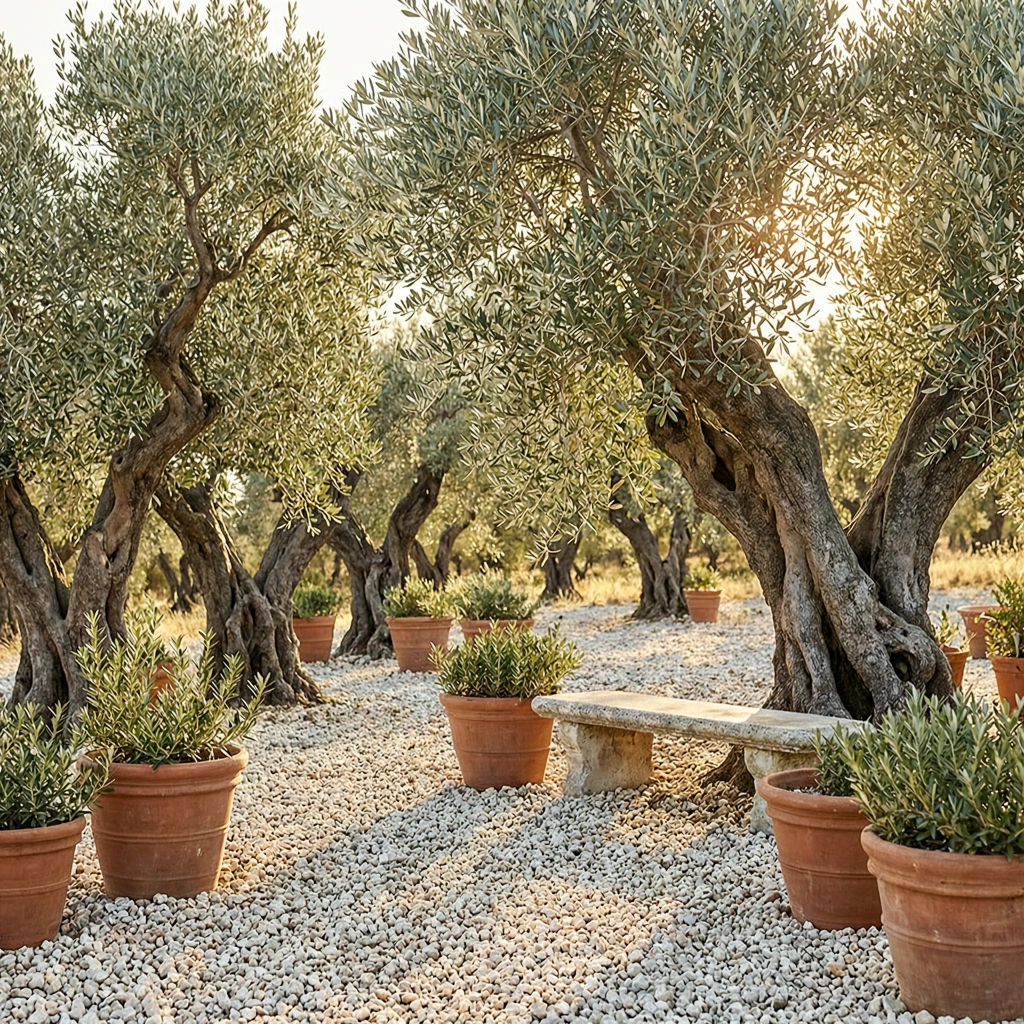
An informal olive grove with gnarled, silver-leaved trees planted in a naturalistic grouping over a clean pale gravel underplanting is the most atmospherically Tuscan and genuinely Mediterranean Italian garden idea that draws directly from the specific, incomparably beautiful visual character of the Tuscan agricultural landscape — where ancient, magnificently gnarled olive trees with their silvery, wind-trembling foliage are the single most characteristic and most beloved plant element of the entire Italian countryside aesthetic.
Source mature, characterful olive specimens — preferably five to fifteen year old trees with genuinely interesting, gnarled trunk character — from specialist Mediterranean tree nurseries rather than planting young whips that lack the immediate architectural presence and visual character that make established olive trees so magnificent as garden specimens. Olive trees are far more cold-hardy than commonly believed — Olea europaea tolerates temperatures to approximately 15°F when established in a well-drained site — making them viable garden plants in USDA zones 8 and above. Underplant with pale Cotswold gravel or crushed limestone for a clean, drought-tolerant, visually authentic Mediterranean underplanting that requires no irrigation once established.
8. Terracotta Pot Collection — Varied Heights and Ages
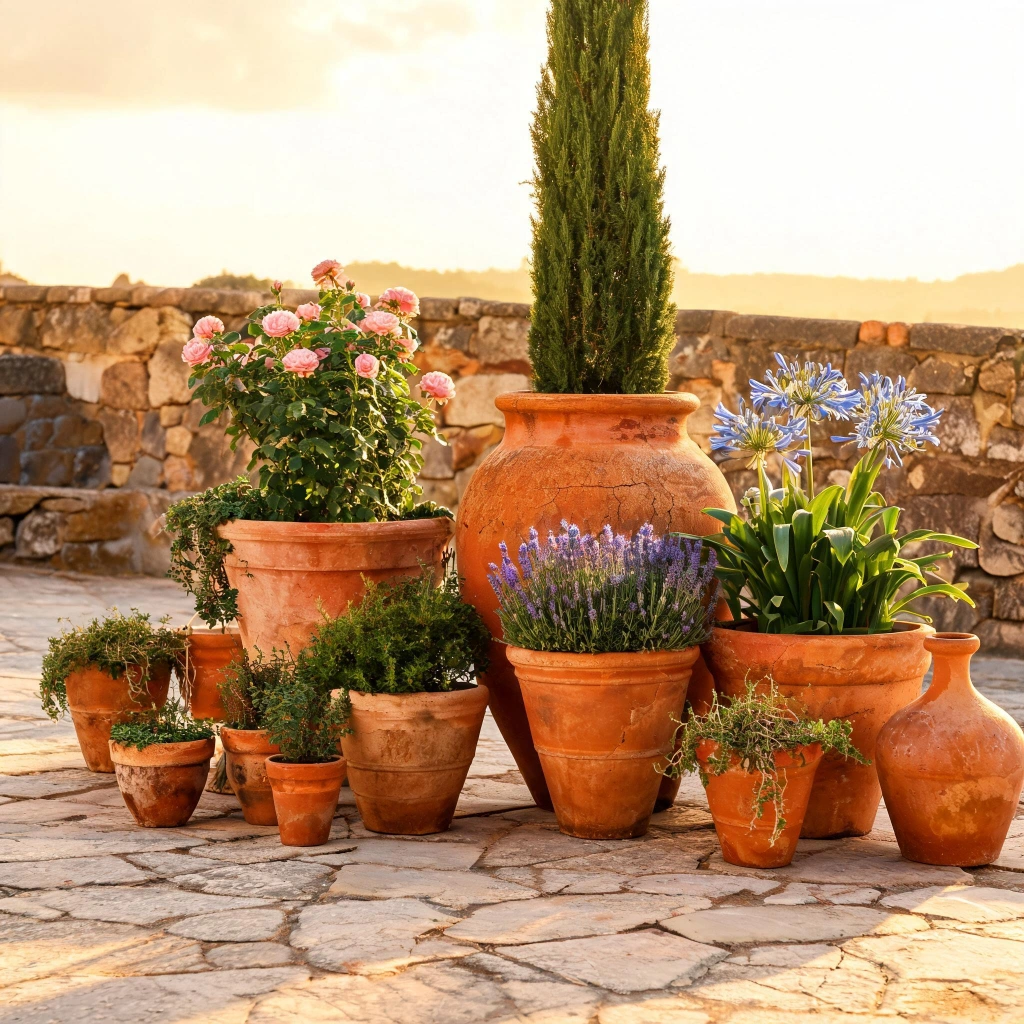
A curated collection of terracotta pots in dramatically varied sizes — from small six-inch accent pots to enormous twenty-four inch statement urns — arranged in a deliberately composed grouping on a stone terrace is the most authentically Italian and most instantly evocative Tuscan garden idea for container display that recreates the characteristic Italian terrazza aesthetic where terracotta pots of every size, age, and degree of beautiful weathered patina accumulate over generations of gardening into the most generous, most abundantly planted, and most photographically beautiful container garden arrangements.
The height variation principle is the most important organizational rule for a beautiful Italian terracotta pot grouping — arrange pots so that the tallest specimens occupy the back and center positions with progressively smaller pots stepping down toward the composition’s edges and front, creating a silhouette of constantly varying height that catches and holds the eye. Use genuine aged or artificially aged terracotta rather than new, uniform-colored pots — the natural variation in terracotta color, the mineral deposits, moss patches, and surface weathering of pots that have experienced multiple seasons of outdoor use producing the most authentically beautiful and most genuinely Italian container garden aesthetic achievable.
9. Lavender Parterre with Stone Path
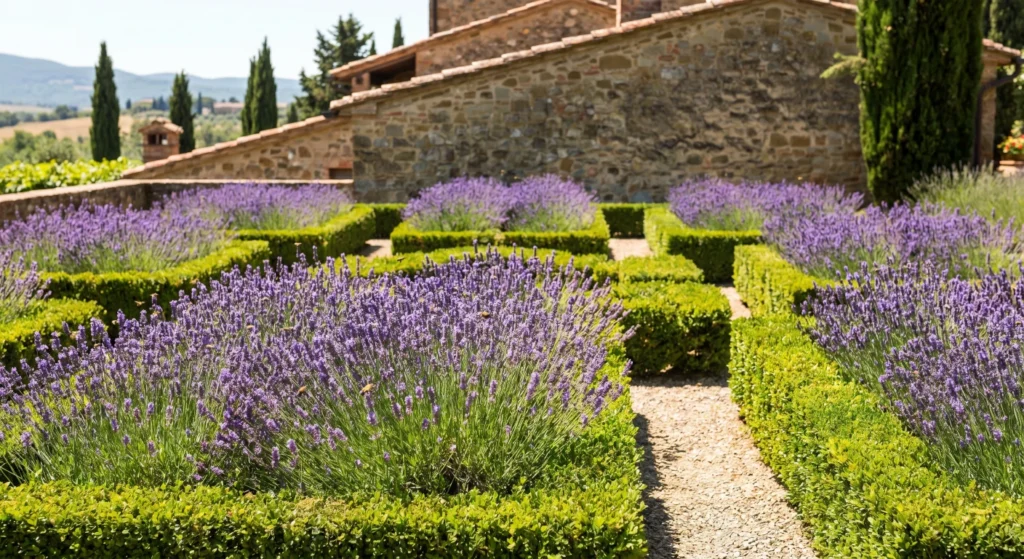
Formal lavender parterre beds laid out in geometric rows with stone paths between them is the most fragrantly beautiful and visually spectacular Tuscan inspired Italian garden idea for a flowering parterre — the lavender’s intense blue-purple bloom color, its intoxicating fragrance that fills the entire garden with the specific, deeply evocative scent of Provence and Tuscany combined, and the plants’ beautiful silvery-gray foliage creating a planting that is equally beautiful in bloom, in bud, and in its fragrant silver winter structure.
Plant lavender in the most generous, most uncompromising quantities possible — a lavender parterre that impresses with genuine visual scale requires minimum plantings of fifty to one hundred specimens per bed section to achieve the full, abundant floral display that makes lavender gardens so breathtakingly beautiful at peak bloom. Choose Lavandula angustifolia ‘Hidcote’ for the most intense, deepest purple flower color and most compact, hedgeable growth habit for formal bed edging — or Lavandula x intermedia ‘Grosso’ for the most intensely fragrant and most abundantly flowered variety that produces the most generous, most visually impressive bloom display of any commonly available lavender cultivar.
10. Espaliered Fruit Trees on Stone Walls
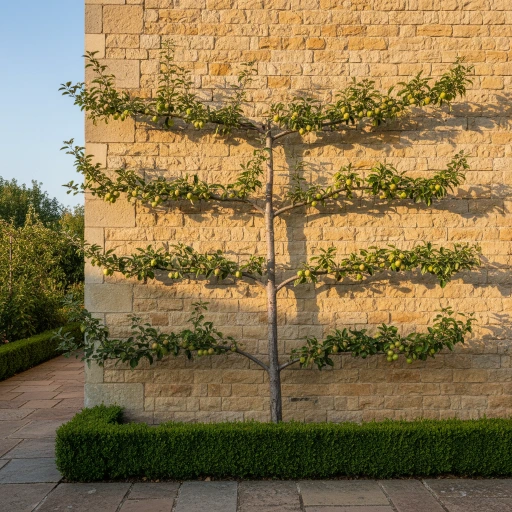
Espaliered fruit trees trained in formal horizontal tiers against warm stone walls are the most elegantly productive and genuinely Italian garden art form that combines the aesthetic tradition of formal garden plant training with the deeply embedded Italian cultural relationship between beautiful gardens and beautiful food — the espalier technique simultaneously maximizing fruit production, maximizing solar ripening against a heat-retaining wall, and creating a piece of living garden architecture of extraordinary formal beauty and disciplined horticultural skill.
Choose apple, pear, fig, or peach varieties for espalier training — all produce particularly beautiful formal trained forms against stone walls while yielding generous crops of high-quality fruit. Plant bare-root trees in winter and begin the training framework from the first growing season — establishing the lowest horizontal tier in the first year, the second tier in the second year, and continuing upward annually until the wall’s full height is covered with perfectly horizontal, evenly spaced fruiting tiers. Use stainless steel wire stretched horizontally between wall-mounted vine eyes at twelve-inch vertical intervals as the training support structure, tying new growth to the wire with soft horticultural twine throughout the growing season.
11. Roman-Style Loggia with Climbing Roses
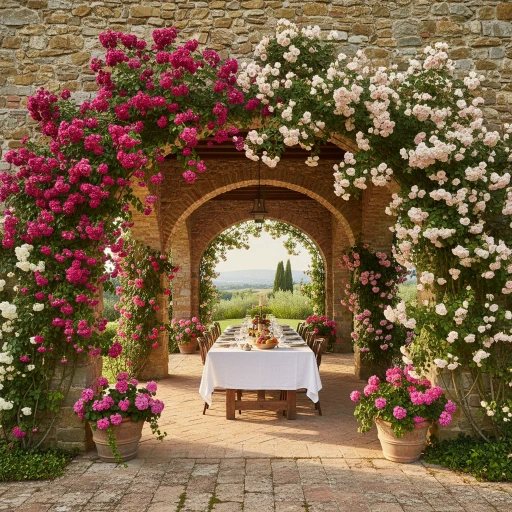
A stone loggia with rounded arches covered in cascading climbing roses is the most romantically beautiful and genuinely classical Tuscan inspired Italian garden idea for an outdoor covered living space that recreates the specific, incomparably beautiful combination of stone architecture, abundant climbing roses, and dappled shade that characterizes the most photographed and most aspirationally desired outdoor living spaces of historic Italian villas, converted Tuscan farmhouses, and the most beautiful privately owned gardens of the Italian countryside.
Plant vigorous, disease-resistant climbing roses at each loggia pillar base — choosing varieties renowned for their exceptional floral abundance, their strong fragrance, and their ability to cover large structural surfaces within five to seven years of establishment. Rosa ‘New Dawn’ provides the most vigorous, most generously flowering pearl-pink climbing rose for covering large structures; Rosa ‘Climbing Iceberg’ delivers the most prolific, most cleanly white floral display; and Rosa ‘Generous Gardener’ from David Austin offers the most intensely myrrh-fragrant and most beautifully formed soft pink climbing rose for the most romantic, most authentically English-Italian garden aesthetic possible.
12. Grape Vine Covered Pergola — Outdoor Dining Room
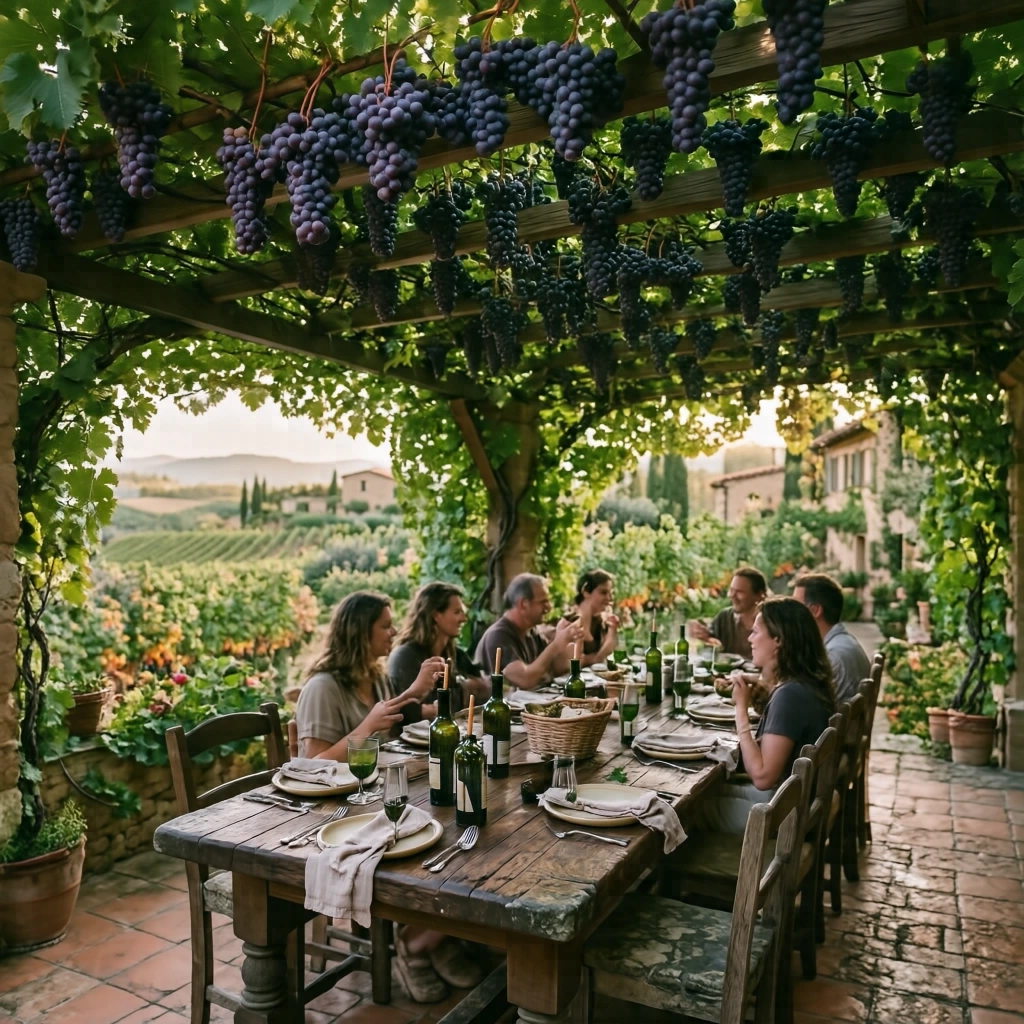
A grape vine covered pergola with ripening fruit clusters hanging through the overhead canopy, shading a long rustic table set for an abundant Italian outdoor meal, is the most authentically Italian and most genuinely sensory-rich Tuscan garden idea for an outdoor dining structure that directly references the most beloved visual and cultural symbol of the Italian garden lifestyle — the shared meal beneath the vine, the fruit within reach overhead, the dappled light filtering through large grape leaves, and the promise of wine from the garden’s own harvest.
Plant productive table or wine grape varieties at every other pergola upright — choosing vigorous, disease-resistant varieties appropriate for your climate zone and desired fruit use. Vitis vinifera ‘Muscat of Alexandria’ for sweet table grapes, ‘Sangiovese’ for authentic Tuscan wine production, or ‘Concord’ for the most reliable, most disease-resistant performance in continental American climates — all develop the most spectacular, most canopy-filling vine coverage within five to seven years of establishment when trained consistently along the pergola’s overhead beam structure. Train two or three permanent main trunks up each upright and along every horizontal beam for maximum canopy coverage and fruit production.
13. Sunflower and Poppy Wildflower Meadow
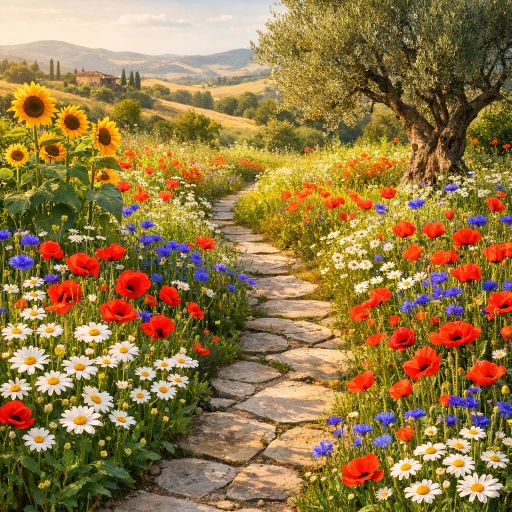
A wildflower meadow planted with sunflowers, field poppies, cornflowers, and wild daisies is the most joyfully beautiful and genuinely Tuscan inspired Italian garden idea for an informal flowering area that captures the specific, breathtaking visual experience of the Italian countryside in summer — when the roadsides, field margins, and uncultivated land between vineyards and olive groves explode with the most abundant, most chromatic, and most spontaneously beautiful wildflower display in all of European agricultural landscape, a visual feast that has inspired painters, poets, and garden designers for centuries of Italian cultural history.
Prepare the meadow area by stripping existing vegetation, scarifying the soil surface to improve seed-to-soil contact, and sowing a seed mixture of Italian and Mediterranean wildflowers in autumn or early spring — including Helianthus annuus, Papaver rhoeas, Centaurea cyanus, Leucanthemum vulgare, and Agrostemma githago for an authentic Tuscan wildflower palette of warm golds, vivid scarlets, deep blues, and clean whites. Allow the meadow to self-seed naturally after the first season’s flowering — the self-seeding of annual and biennial species creates the most convincingly naturalistic, most organically beautiful meadow aesthetic that improves in floral abundance and botanical diversity with each successive growing season.
14. Box-Edged Parterre with Central Ornament
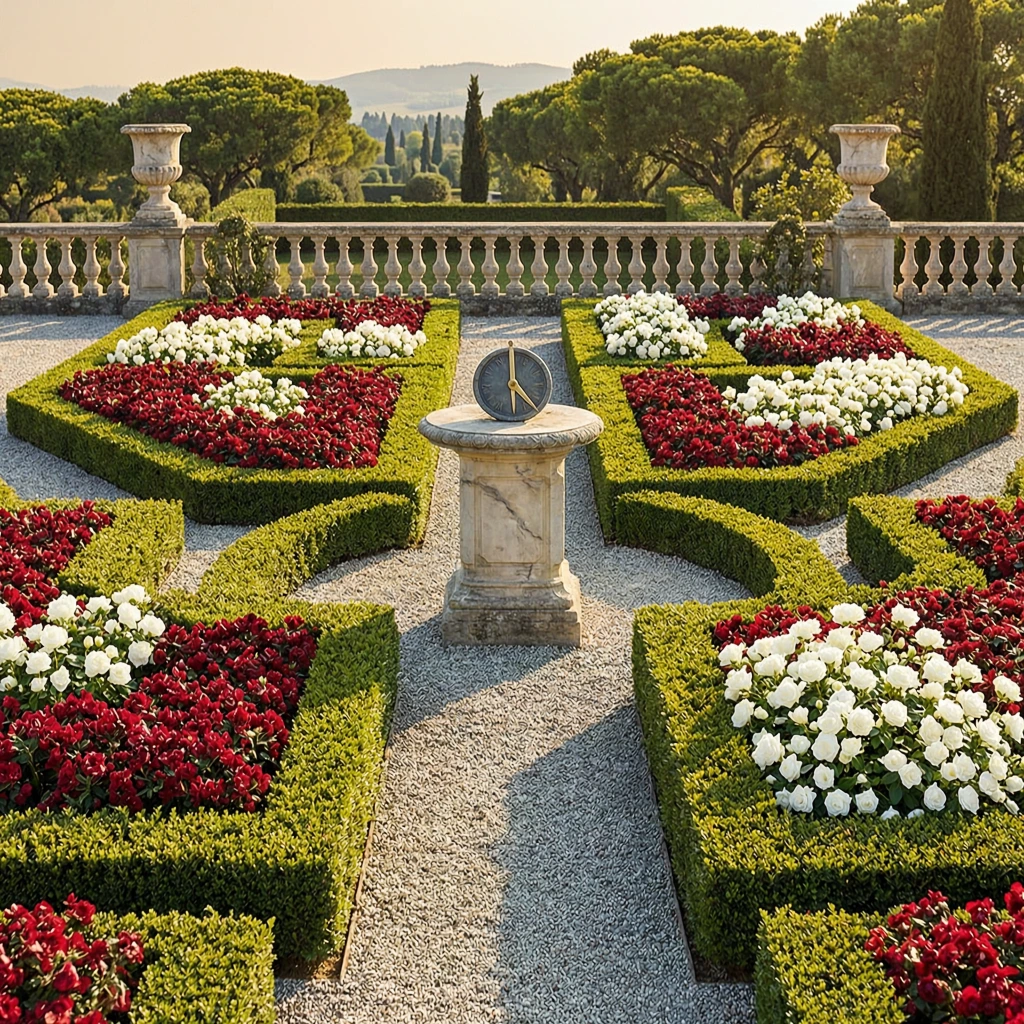
A formally designed box-edged parterre with precisely clipped Buxus sempervirens hedges defining elegant geometric bed shapes and a carved stone ornament at the compositional center is the most classically Italian and genuinely Renaissance-inspired Tuscan garden idea for a formal garden area that draws directly from the extraordinary tradition of Italian Renaissance garden design — where the parterre, with its precisely defined geometric beds, was considered the most intellectually sophisticated and most visually beautiful expression of the human capacity to impose rational order and mathematical beauty onto the living natural world.
Design the parterre with beds defined by low box hedges at a consistent height of six to twelve inches — the hedge height being sufficient to visually define the bed boundaries clearly at all viewing distances while remaining low enough to allow the bed planting to be the composition’s primary visual element rather than the hedge structure itself. Plant the bed interiors with seasonal flowering subjects chosen for their bold color impact — deep red Salvia, cobalt blue Agapanthus, or pure white Nicotiana in summer; red and cream tulips in spring — always using a single species per bed section for the most graphically powerful and most formally resolved color display.
15. Terracotta Tile Outdoor Living Area
A terracotta tile outdoor living area with classic reddish-orange handmade terracotta floor tiles creating a warm, authentically Italian outdoor room is the most materially genuine and sensory-rich Tuscan inspired Italian garden idea for a paved terrace or outdoor dining space that uses the most ancient, most geologically authentic, and most visually warm paving material available — the fired clay terracotta tile that has paved Italian farmhouses, villas, and garden terraces for two thousand years of continuous use, each tile carrying the warmth and authenticity of the clay-rich Italian earth from which it was formed.
Source handmade or traditionally produced terracotta tiles from Italian manufacturers like Cotto d’Este, Cotto Senese, or quality American importers of Italian terracotta for the most authentically beautiful and most genuinely warm result. Specify irregular handmade tiles rather than machine-pressed uniform alternatives — the slight variations in size, thickness, and surface texture of handmade tiles creating the most beautiful, most characterful terracotta floor surface. Seal with a penetrating sealer that protects against moisture and staining while preserving the clay’s characteristic warm, matte surface quality rather than applying a surface sealer that creates an artificial plastic-looking sheen incompatible with the material’s authentic aesthetic character.
16. Rosemary and Sage Aromatic Border
A generous aromatic border planted with sweeping masses of rosemary, sage, lavender, catmint, and thyme creating a fragrant, silver-blue planting palette along a stone path is the most sensorially rich and genuinely Italian garden idea for a planting border that celebrates the specific aromatic plant traditions of the Mediterranean kitchen and the Italian garden simultaneously — the same herbs that flavor Italian cooking grown in their most garden-worthy, most abundantly beautiful masses alongside stone paths where every brushing contact releases their extraordinary fragrance into the warm garden air.
Plant aromatic herbs in the most generous, most abundant quantities possible — an aromatic border that genuinely impresses with fragrance requires massed plantings of five to twenty specimens of each species to create sufficient aromatic oil concentration for immediate, powerful scent release with every walk along the adjacent path. Position the border to receive maximum direct southern or western sun exposure — aromatic Mediterranean herbs require at least six hours of direct daily sunlight to produce their highest essential oil concentrations and their most intensely fragrant foliage. Clip rosemary and sage lightly after flowering to maintain compact, bushy habits and encourage the production of the most fragrant new growth throughout the garden season.
17. Moon Gate or Arched Entrance to Garden Rooms
A stone arched gateway or moon gate connecting two distinct garden rooms — one arch-framed glimpse of a fountain, a cypress avenue, or a lavender parterre creating a moment of genuine architectural drama and horticultural narrative — is the most compositionally sophisticated and genuinely theatrical Tuscan inspired Italian garden idea for spatial organization that treats the transition between different garden areas not as an incidental, undesigned passage but as a deliberate, beautifully framed architectural moment worthy of the most careful, most historically informed design consideration and the most skillful stone masonry execution.
Construct the arched gateway from locally quarried or regionally authentic stone — warm limestone, travertine, or sandstone — using proper arch construction techniques with a correctly proportioned keystone and appropriate haunch angles for structural stability and visual elegance. The arch opening should be generous — at least four feet wide and seven feet tall — to provide comfortable passage while maintaining the visual proportion that makes a stone arch appear most architecturally beautiful and most formally resolved. Plant climbing roses, jasmine, and honeysuckle at the arch’s base pillars, training them over the stonework over years of patient, attentive tying and pruning that gradually creates the most romantically beautiful, most fragrant, most garden-poetry-worthy flowering arch imaginable.