🌹 17 English Country Entrance Ideas Full of Charm
1. Climbing Rose Arched Entrance Gate
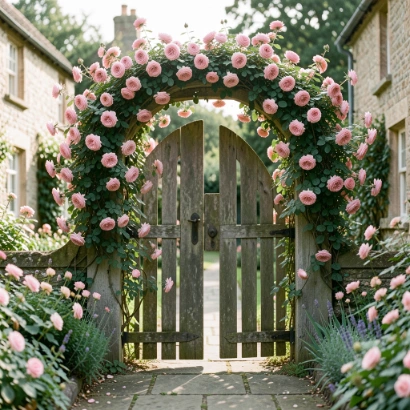
A wooden arched entrance gate smothered in climbing roses is the most romantically powerful and quintessentially English country entrance statement imaginable — a living threshold that changes with breathtaking beauty through every season, from the tight red buds of late spring through the extraordinary abundance of full June bloom to the decorative rosehip display of autumn and the elegant bare framework of thorned winter stems. This single planting decision transforms the act of entering a property into a genuinely moving sensory experience of fragrance, colour, and natural magnificence.
Choose heritage climbing rose varieties for the most authentic English country character and the most intoxicating fragrance — Rosa ‘Generous Gardener’, ‘Constance Spry’, ‘Cecile Brunner’, or the vigorous and wonderfully perfumed ‘Rambling Rector’ for larger structures. Train the climbing stems horizontally along the arch framework during early establishment years to encourage the maximum number of flowering laterals and the densest, most spectacular bloom display. Underplant the arch base with lavender, catmint, and hardy geraniums in complementary soft pink and purple tones for a layered cottage planting at the entrance threshold that extends the sensory beauty of the rose arch experience from ankle height to overhead canopy.
2. Flagstone Path with Lavender Borders
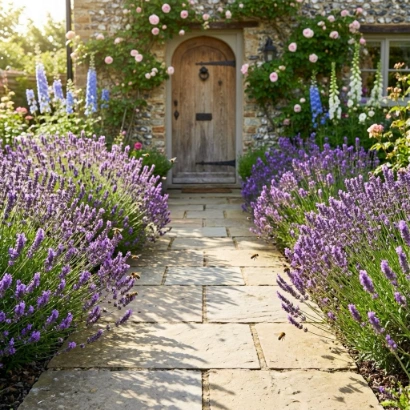
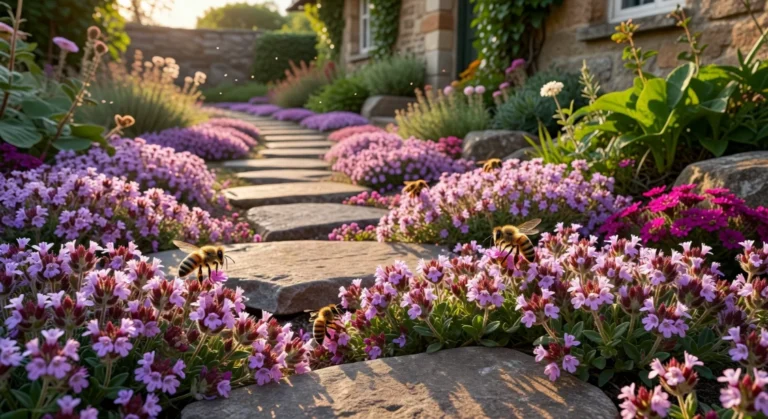
A wide flagstone path bordered on both sides by generous lavender plantings creates an entrance approach of such complete, multi-sensory English country beauty that the experience of walking its length — the warm stone underfoot, the buzzing of bees in the lavender, the wave of fragrance released by brushing past the purple flower spikes — becomes one of the most genuinely pleasurable daily rituals of country home life. The pairing of warm honey limestone flags and silver-green lavender is one of the most harmonious and enduringly beloved combinations in the entire English garden tradition.
Choose natural limestone, York stone, or reclaimed sandstone flags in large irregular formats, laid with natural lime mortar joints wide enough to allow creeping thyme, mind-your-own-business, and self-seeded alchemilla to colonise them over time for an authentically settled, aged appearance. Plant lavender generously in bold drifts on both sides of the path — ‘Hidcote’ for deep purple compactness, ‘Munstead’ for prolific early flowering, or ‘Grosso’ for the most intensely fragrant variety — allowing the bushes to billow softly over the path edges with the beautiful informality that characterises the best English cottage garden planting traditions.
3. Wisteria-Draped Stone Porch Entrance
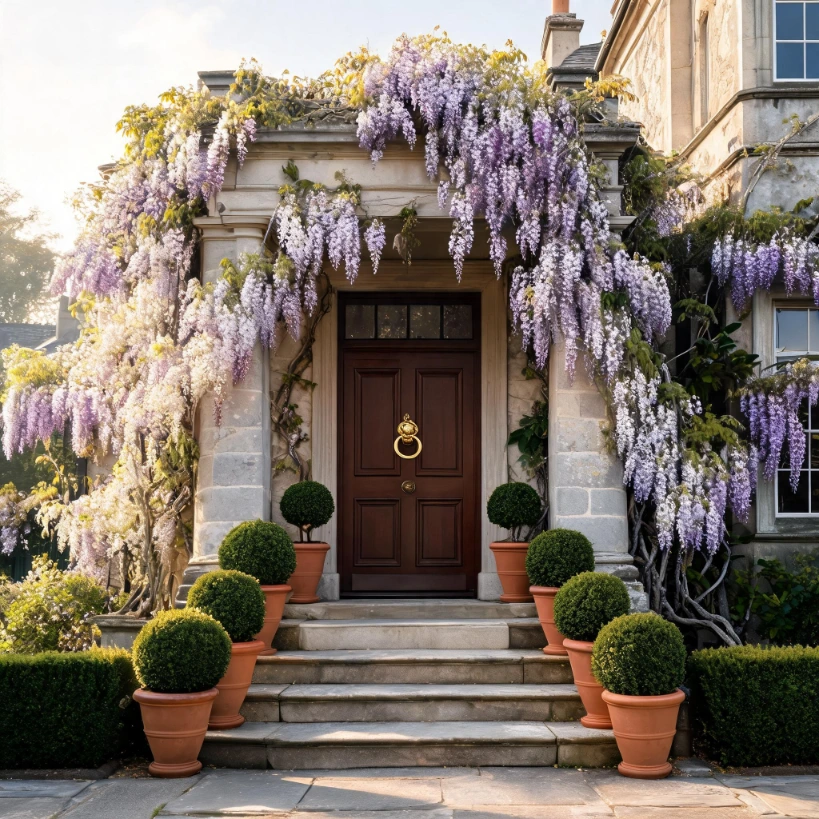
Wisteria draped over a stone porch entrance represents the pinnacle of the English country house arrival experience — those extraordinary cascading racemes of purple, lilac, or white flowers hanging in fragrant curtains above the front door creating a theatrical entrance threshold that stops every visitor in their tracks with its breathtaking, intoxicating beauty. The combination of ancient-looking wisteria stems — which develop impressive, gnarled, vine-like trunks over decades of growth — and traditional stone architecture creates a facade of romantic, painterly magnificence that appears to belong simultaneously to the building and to the wild natural world.
Wisteria sinensis and Wisteria floribunda are the two primary species for English country entrances, with floribunda varieties producing the longest, most dramatically pendant flower racemes of up to sixty centimetres in the finest named varieties. Prune twice annually — once in late summer to reduce whippy growth to five leaves, and once in late winter to cut the same shoots back to two or three buds — to build the compact, heavily budded framework that produces the most spectacular floral display. Pair stone steps leading to the porch with symmetrically placed terracotta pots of clipped bay or box topiary for an entrance composition of classical English formality beautifully softened by the exuberant natural abundance of the flowering wisteria above.
4. Dry Stone Wall with Cottage Garden Planting
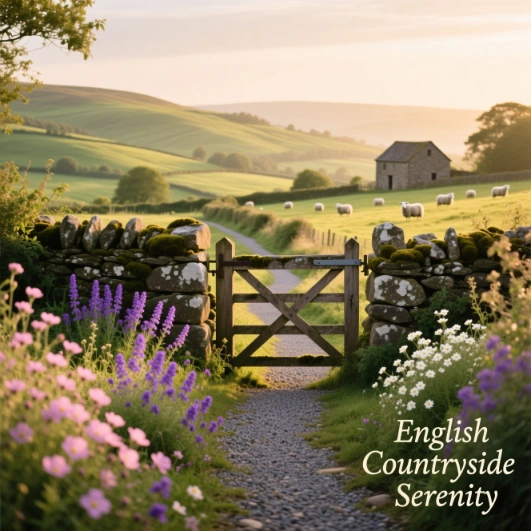
A traditional dry stone wall lining the entrance approach — built without mortar, using only the skilled placement of local fieldstone in a construction technique refined over centuries across the English countryside — creates an entrance boundary of such authentic, deep-rooted beauty and material honesty that it appears to have grown from the landscape as naturally as the hedgerows and hillsides surrounding it. The irregular surface of a well-built dry stone wall, with its varied stone faces, crevice planting niches, and slow accumulation of moss, lichen, and fern, creates a living boundary of extraordinary ecological and visual richness.
Encourage self-seeded cottage garden plants to establish themselves in the wall’s crevices and along its base — red and yellow wallflowers, purple aubretia, pink and white valerian, and hart’s tongue ferns colonising the stone faces with romantic, informal beauty that the wall’s original builders would have celebrated rather than removed. The top course of the wall can be planted with sedums, houseleeks, and creeping thyme for additional crevice planting interest and the subtle fragrance released when the thyme is brushed by a passing hand. This ancient, nature-integrated entrance boundary is one of the most pinned and most genuinely admired elements of the English country property aesthetic across all garden and architecture platforms.
5. Black Painted Ironwork Gate & Railings
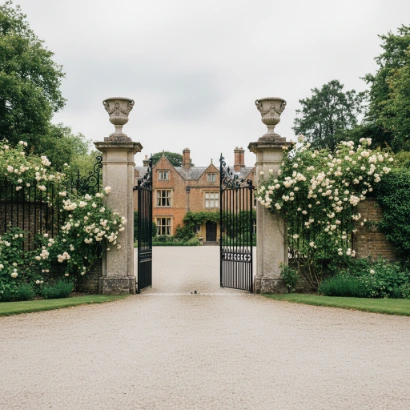
Tall black painted wrought iron railings and a decorative ironwork entrance gate with traditional finial and scroll details provide the most elegant and architecturally distinguished English country entrance boundary treatment — one that references the great ironwork traditions of Georgian and Victorian estate design while remaining entirely appropriate for properties of every scale, from the grandest manor house to the modest period cottage. The deep matte black of properly maintained painted ironwork provides a graphic, defined boundary line that simultaneously encloses and frames the entrance with confident formal beauty.
The decorative vocabulary of quality wrought or cast iron gate design — spear-headed finials, twisted bar sections, scrolled bracing panels, and cast fleur-de-lis or acorn details — creates an entrance gate with sufficient visual complexity and craft quality to merit close examination and genuine admiration. Stone or brick gateposts crowned with carved urn, ball, or pineapple finials frame the gate opening with classical symmetry and appropriate material weight. Underplanting the railings on the interior boundary with climbing roses, honeysuckle, and clematis that thread their stems through the ironwork as they grow creates a seasonal softening of the formal gate structure with the most romantically beautiful results imaginable.
6. Thatched Gate Lodge Entrance
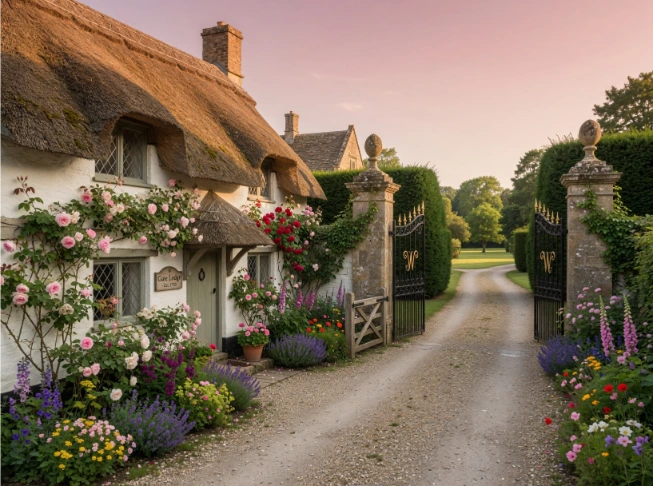
A thatched gate lodge positioned beside the entrance gates to an English country property represents the most complete and historically evocative entrance composition in the entire canon of rural British architecture — a miniature domestic building whose sole purpose is to mark the threshold between the public road and the private parkland beyond with a gesture of such architectural charm and romantic beauty that every passing car slows instinctively for a second, longer look. The golden thatch roof, whitewashed walls, and cottage garden planting of the traditional gate lodge create an entrance experience of storybook perfection.
Even without an original gate lodge, the decorative principles it embodies — the marking of an entrance with significant vertical architectural elements, the softening of formal gateposts with exuberant cottage garden planting, the welcoming warmth of a habitable building at the threshold — can be applied at any scale to create an English country entrance of great charm and character. A pair of substantial stone or brick gateposts flanking the driveway entrance, planted with climbing roses and underplanted with a generous cottage garden border of hollyhocks, foxgloves, and geraniums, creates the essential entrance experience of the great thatched gate lodge tradition in a form achievable by any country property owner with a love of the English garden.
7. Pleached Lime Tree Entrance Avenue
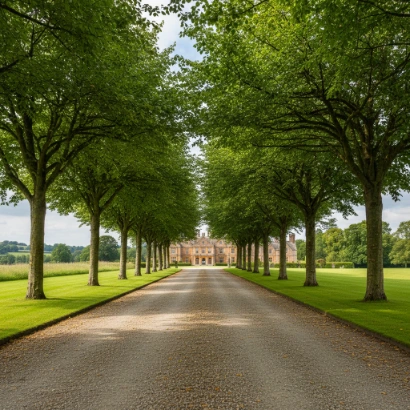
A formal avenue of pleached lime trees flanking the driveway approach to an English country property creates one of the most architecturally dramatic and historically prestigious entrance experiences in the entire landscape design tradition — a living green tunnel of interlocked overhead branches that transforms the approach drive into a theatrical procession, building anticipation with every metre travelled beneath the dappled canopy toward the house revealed at the avenue’s end. This avenue tradition has been a feature of English country house design since the seventeenth century and shows no signs of diminishing in its aspirational appeal.
Pleaching — the practice of training young trees onto a framework of canes and wires to develop flat, horizontal planes of growth that eventually graft together into a continuous interlocked canopy — requires patience and consistent annual training over five to ten years to achieve its full architectural effect. Tilia cordata, the small-leaved lime, is the preferred species for pleached avenues, combining vigorous growth and excellent response to training with a beautiful heart-shaped leaf, fragrant midsummer flowers beloved by bees, and a clean, pale bark on the clear stems below the pleached canopy. The formal symmetry of a mature pleached lime avenue creates an entrance composition of extraordinary, processional grandeur that makes arriving at any English country property feel genuinely ceremonial.
8. Topiary Box Balls Flanking Front Door
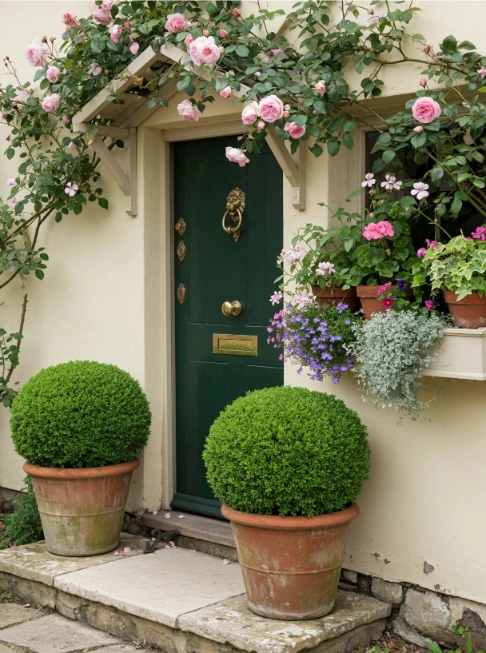
A symmetrically placed pair of clipped box ball topiary in aged terracotta or lead-effect pots flanking the front door is one of the most classically beautiful and immediately charming English country entrance gestures available — combining the precision of the topiarist’s art with the warm informality of cottage garden planting tradition to create a front door composition of perfect, accessible elegance. The dense, deep green spheres of well-maintained Buxus sempervirens provide a permanent structural anchor to the entrance planting that retains its form and evergreen colour through every season of the year.
The most characterful topiary specimens are those that have been maintained for many years, developing the slight imperfections, moss patches, and irregular surface textures that accumulate on truly aged box balls into a patina of horticultural history no newly clipped specimen can possess. As an alternative to box following the spread of box blight across British gardens, consider Ilex crenata, Euonymus japonicus, or Pittosporum tobira ‘Nanum’ as blight-resistant alternatives that clip to similarly satisfying dense spherical forms. Age new terracotta pots rapidly by painting with natural yoghurt to encourage moss and lichen growth — the resulting green-patinated terracotta pairing with clipped topiary to create a front door entrance of instantly convincing established English country character.
9. Honeysuckle & Clematis Covered Porch
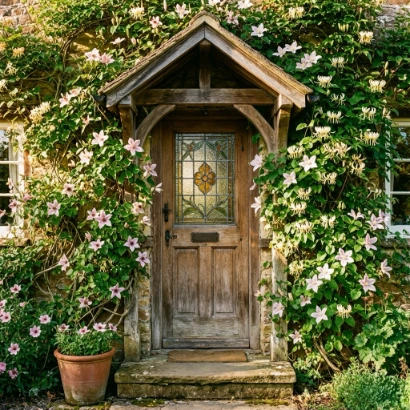
A simple wooden porch canopy above the front door completely covered in twining honeysuckle and clematis creates an entrance of such fragrant, flowering abundance and romantic, tumbling beauty that it represents perhaps the most beloved and universally aspired-to image of the English country cottage entrance in the entire cultural imagination. The combination of the honeysuckle’s extraordinary evening fragrance — released most powerfully in warm summer dusks to attract pollinating moths — and the clematis’s magnificent flowers in cream, pink, purple, or deep red creates a sensory entrance experience of genuinely extraordinary richness.
Plant Lonicera periclymenum ‘Serotina’ or ‘Graham Thomas’ for the finest honeysuckle fragrance and the most extended late-season flowering, pairing with a large-flowered clematis such as ‘Nelly Moser’, ‘The President’, or the sweetly fragrant Clematis montana for a climbing plant combination that covers the porch structure with colour and scent from May through September. Train both climbers carefully onto the porch framework from the outset, ensuring the honeysuckle’s twining stems have adequate support wires to grip while directing the clematis through the honeysuckle’s framework to create an intimately intertwined floral composition. The meeting of these two beloved English garden climbers on a cottage porch entrance creates a threshold experience of such beauty that returning home each evening becomes one of the day’s most anticipated and genuinely pleasurable moments.
10. Gravel Driveway with Wildflower Verges
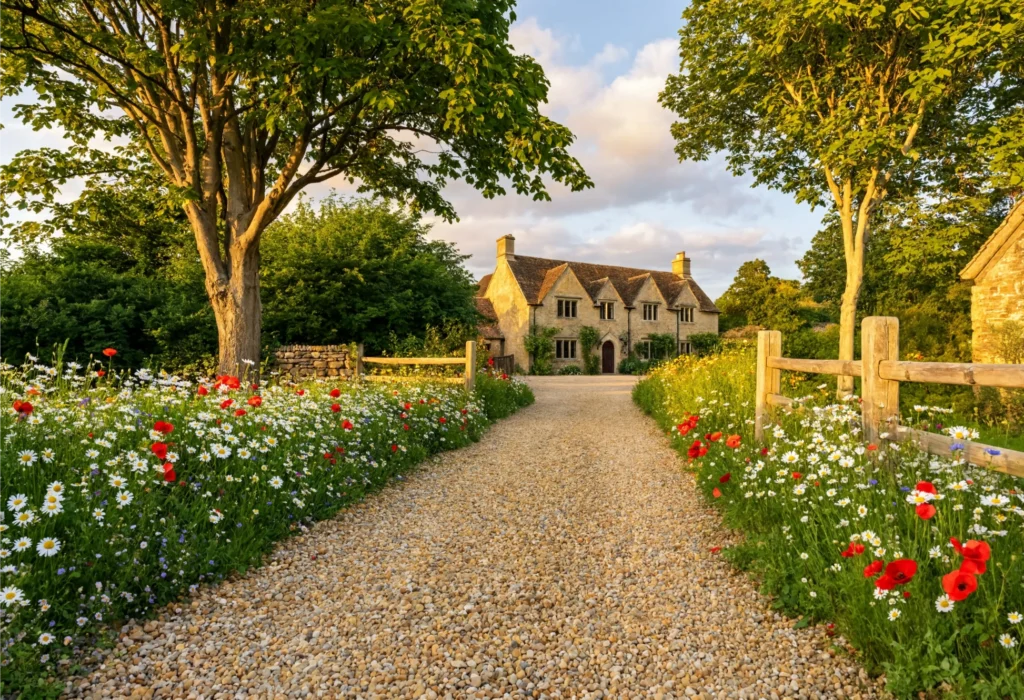
A fine golden gravel driveway bordered by naturalistic wildflower verges — where the maintained gravel surface gives way at each edge to a deliberately unmown meadow strip of seasonal wildflower abundance — creates an English country entrance that is simultaneously orderly and wild, formal and natural, managed and ecologically generous in a combination that perfectly captures the best of the English landscape design tradition. The seasonal wildflower display of the verges changes the character of the entrance approach dramatically week by week from the first ox-eye daisies of late May through the poppy and cornflower abundance of June and July.
Establish wildflower verges by stripping the existing turf, scarifying the soil to reduce fertility, and sowing with a native wildflower and grasses seed mix formulated for the specific soil type and light conditions of the driveway setting. Include yellow rattle — the partial parasite of grasses — in the seed mix to naturally reduce grass vigour and allow the wildflowers to establish and proliferate with less competition over the first three to five years. The low maintenance requirements of established wildflower verges, mown only once in late autumn after seeds have dropped, make them both ecologically responsible and practically straightforward — a genuine win for the English country entrance that satisfies the gardener, the naturalist, and the landscape photographer equally.
11. Stone Gateposts with Carved Finials
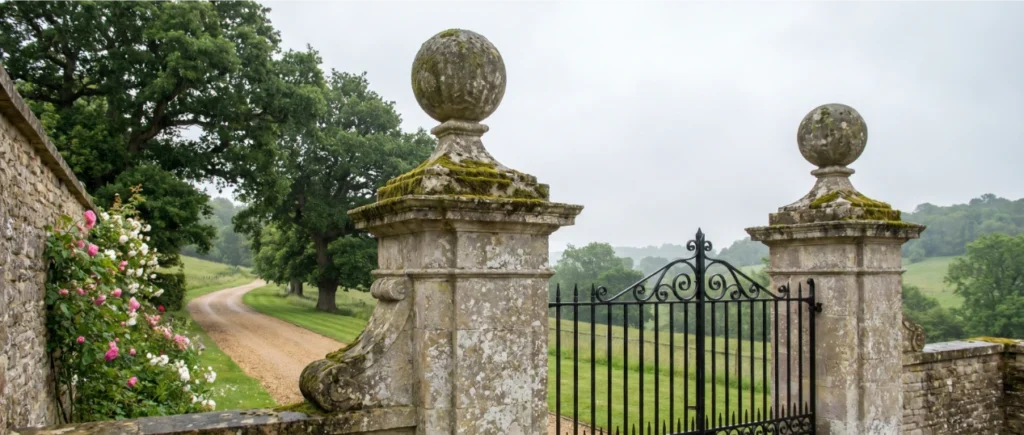
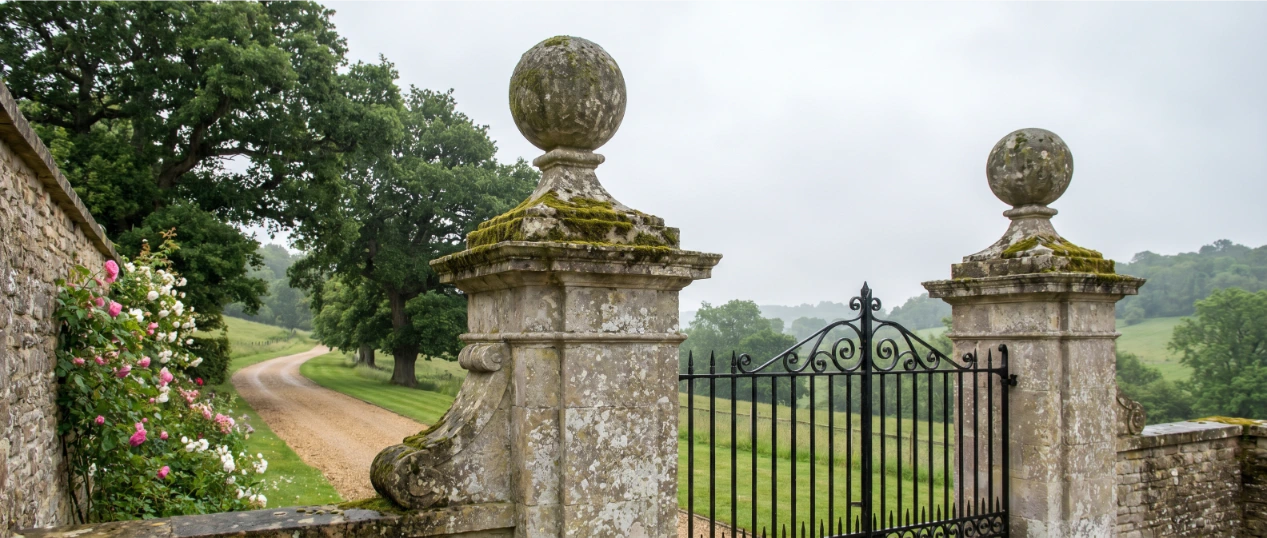
Substantial stone gateposts with hand-carved finials — ball, urn, pineapple, acorn, or heraldic beast — create the most architecturally distinguished and permanently impressive English country entrance markers available, their mass, craftsmanship, and material quality communicating the character of the property beyond with eloquent authority before a single step has been taken through the gate. Limestone, Bath stone, or locally quarried sandstone gateposts develop a beautiful surface patina of lichen, moss, and weathering over decades that no new stone can begin to replicate, acquiring the appearance of belonging absolutely to their landscape setting.
Commission stone gateposts from a specialist architectural stonecutter for bespoke finial carving — choosing a design with personal or heraldic significance to the property for a truly unique entrance marker of genuine craft and permanent stone quality. Alternatively, source original period gateposts from architectural salvage specialists, who frequently offer complete matched pairs salvaged from demolished period properties at prices that represent extraordinary value given the irreplaceable quality of genuinely old carved stonework. The slow accumulation of lichen on the stone surface — gold, grey, and orange crustose lichens creating a natural abstract pattern across the carved surfaces — takes years to develop but creates a visual richness and settled antiquity that is the most honest and beautiful form of weathered stone decoration imaginable.
12. Traditional Five-Bar Gate & Hedgerow
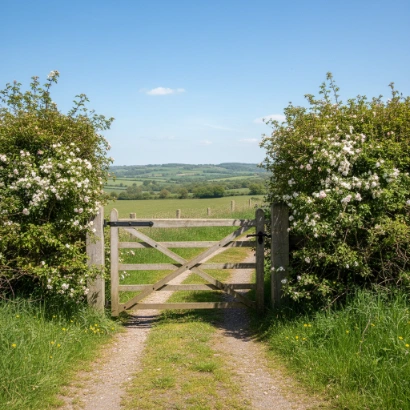
A traditional oak five-bar field gate flanked by a dense, well-managed mixed native hedgerow is one of the most authentically English country entrance treatments possible — drawing directly from the agricultural landscape vernacular that has defined the rural scenery of England for centuries and placing the domestic entrance in honest, beautiful continuity with the working countryside surrounding it. The silver-grey weathered oak of an aged five-bar gate, its mortice-and-tenon joinery and traditional proportions unchanged from the gates in a Constable landscape painting, creates an entrance of enduring, understated rural character.
A mixed native hedgerow of hawthorn, blackthorn, dog rose, field maple, spindle, and crab apple provides a dense, impenetrable, and ecologically magnificent boundary planting that changes with extraordinary seasonal beauty — white hawthorn blossom in May, dog rose flowers in June, red rosehips and blackberries in autumn, and the structural sculptural quality of bare thorned stems through winter. A traditionally laid hedgerow — its stems partially cut and laid at an angle to produce an impenetrable, self-renewing stock-proof barrier — represents one of the great craft traditions of the English countryside, and maintaining or creating a laid hedge at the entrance to a country property connects the domestic landscape directly to this ancient rural management tradition.
13. Cottage Garden Border Entrance Path
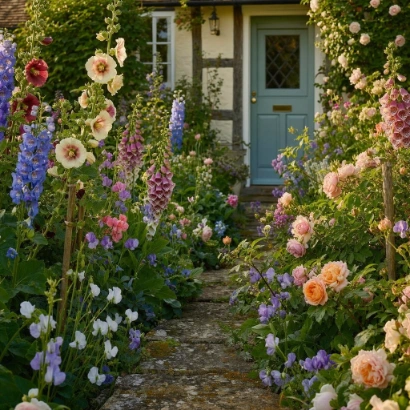
A cottage garden entrance border overflowing with the exuberant, self-seeding abundance of traditional English cottage garden plants — hollyhocks reaching above head height, delphiniums in towering blue spires, foxgloves leaning into the path, sweet peas threading upward on rustic hazel poles, and roses scrambling through everything — creates an entrance approach of such generous, unrestrained floral magnificence that the narrow path through its centre becomes a celebrated journey through a living garden rather than a simple route to a front door. This is English country planting at its most joyfully extravagant and most deeply beloved.
The secret of the authentic English cottage garden entrance border lies in its apparent informality concealing considerable horticultural knowledge and deliberate compositional skill — the seemingly artless mingling of tall, medium, and low plants in a rich colour tapestry requires an understanding of each plant’s habit, vigour, and seasonal contribution to maintain its beautiful balance year after year. Encourage self-seeding by allowing foxgloves, aquilegia, alchemilla, nigella, and Welsh poppies to distribute themselves freely through the border, creating the naturalistic spontaneity that distinguishes a genuinely lived-in English cottage garden from a designed planting scheme of however great technical accomplishment.
14. Brick Pathway with Herringbone Pattern
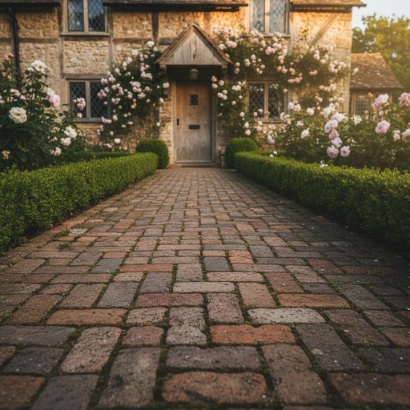
A reclaimed handmade brick pathway laid in a traditional herringbone pattern creates one of the most textually rich and warm-toned entrance surfaces available to the English country home — the irregular shapes, varied kiln-fired colours, and slightly uneven surfaces of genuinely old bricks combining in the woven diagonal geometry of the herringbone bond to create a pathway of extraordinary visual complexity and period authenticity. The warm tones of aged handmade bricks — ranging from pale cream-buff through warm terracotta and soft red to deep plum-purple — shift and glow in changing light with a richness that modern machine-made bricks entirely lack.
Source reclaimed handmade bricks from specialist salvage merchants who sort and grade them by type, age, and colour to ensure consistent supply of matched material throughout the pathway project — old London stock bricks, Staffordshire blues, and traditional red wire-cut bricks all offering subtly different colour palettes to complement different property styles and colour schemes. Allow moss, lichen, and creeping thyme to colonise the sand and lime mortar joints between the bricks over time, the gradual greening and softening of the joints with living organisms giving the pathway an increasingly settled, organic, and beautifully aged appearance that improves with every passing season of light, rain, and gentle foot traffic.
15. Vintage Lantern Post Entrance Lighting
A traditional cast iron lantern post positioned at the entrance to an English country property — its warm amber light glowing against the blue hour twilight sky and illuminating the stone pathway below with a soft, romantic pool of incandescent warmth — creates one of the most evocative and emotionally resonant entrance lighting effects imaginable, combining the heritage aesthetic of the Victorian gas lamp tradition with a warmth and intimacy no modern LED fitting on a contemporary post can approach in terms of atmosphere and period-appropriate character.
Choose a genuine cast iron lantern post from a specialist heritage lighting manufacturer or architectural salvage dealer rather than an aluminium reproduction — the weight, surface detail, and paint depth of true cast iron creating a physical presence and material quality that immediately communicates authentic craftsmanship rather than decorative imitation. Use warm white or amber LED bulbs within the traditional lantern housing to combine period-appropriate light colour and quality with modern energy efficiency and lamp longevity. Position the lantern post at the entrance gate or at a turn in the driveway where its light is most needed and most dramatically framed by surrounding planting — the effect of a traditional lantern glowing warmly amid climbing roses or a dense dark yew hedge on a winter evening is one of the most powerfully beautiful entrance lighting experiences available.
16. Espaliered Fruit Tree on Entrance Wall
A beautifully trained espalier fruit tree — an apple, pear, or quince whose branches have been carefully pruned and trained over many years into perfectly horizontal parallel tiers against a warm brick or stone wall — creates one of the most refined and intellectually sophisticated English country entrance garden features available, combining the ornamental precision of formal topiary with the practical abundance of the productive kitchen garden in a single spectacular wall-trained specimen of remarkable visual elegance and horticultural achievement.
The training of an espalier begins with a young maiden whip tree planted close to a wall fitted with horizontal training wires at forty-five centimetre intervals, with each tier of horizontal branches developed over successive years by carefully angled tying and selective pruning that redirects the tree’s energy from upward growth into the production of short fruiting spurs along the horizontal branches. A mature espalier apple or pear covering the full width and height of an entrance garden wall is the work of fifteen to twenty years and represents one of the most beautiful long-term investments in English country garden character and productive horticultural heritage that any patient gardener can undertake, rewarding every year of careful training with increasingly magnificent seasonal spectacle.
17. Hand-Painted House Name Sign on Stone
A hand-painted or hand-carved stone house name sign — bearing the cottage’s traditional English name in beautifully formed lettering surrounded by carved botanical motifs — is the most personal and enduringly charming final detail of the English country entrance, placing the home’s individual identity at the threshold with a gesture of quiet confidence and artisanal pride that welcomes visitors by name from the very first moment of arrival. The finest examples are carved directly into a piece of local stone — a section of the same limestone or sandstone used in the property’s construction — creating a material continuity between sign and building of complete, satisfying integrity.
Commission a hand-carved stone sign from an independent letter-cutter or stonemason — one of the ancient craft traditions surviving strongly in Britain — specifying a traditional serif letter style such as Roman capitals or Caslon for the most classically beautiful and period-appropriate result. Alternatively, a skilled sign painter working in oil paint on a piece of reclaimed timber or slate can produce a hand-lettered house name sign of tremendous charm using a deep background colour — racing green, navy, or deep burgundy — with cream or gold letters for a composition of refined, heritage-inspired elegance. Mount the finished sign on the entrance gate post, wall, or beside the front door where it can be seen clearly from the approach path, perhaps flanked by a cast iron coach light and framed with climbing rose or honeysuckle stems for a completely beautiful and deeply, authentically English country entrance detail of the finest and most welcoming kind.