15 Minimalist Exterior Design Ideas for Modern Homes
1. Monochromatic White Render Facade with Black Steel Window Frames
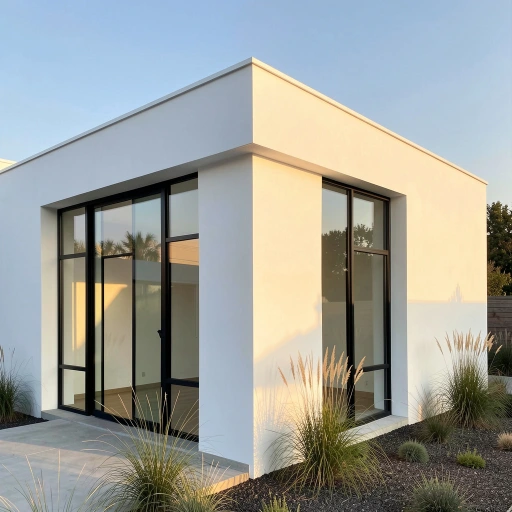
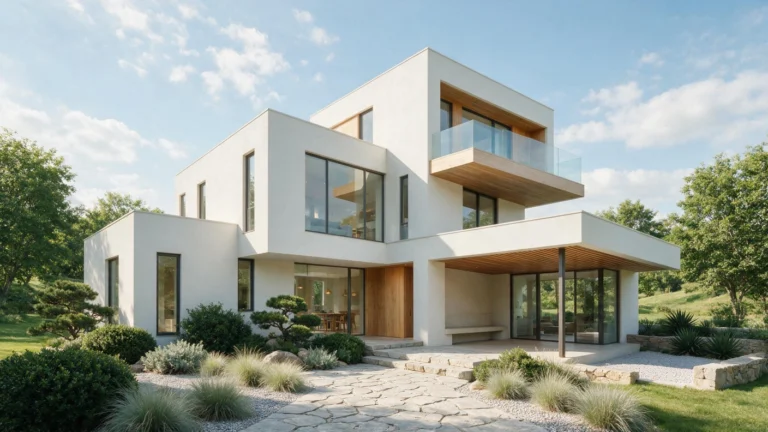
A seamless white smooth render facade paired with large black powder-coated steel window frames is the most fundamentally pure and most universally recognized expression of minimalist residential exterior design — a combination whose formal logic is so complete, so internally consistent, and so visually resolved that it has established itself as the defining aesthetic signature of contemporary minimalist architecture across every continent and every climate zone where the modern house tradition has taken meaningful root. The white render surface achieves its extraordinary visual power through the complete elimination of surface incident — no brick joints, no timber texture, no stone coursing, no applied ornament of any kind — reducing the entire building envelope to a single, continuous, light-reflecting plane whose only visual complexity comes from the shadows cast by the building’s massing, the window reveals, and the quality of the light falling across it at different times of day.
Apply the render using a through-colored acrylic or silicone polymer system with a fine aggregate finish — two to three millimeters of texture that catches raking light beautifully while remaining visually smooth at normal viewing distances — specified in a pure white tone without the blue or grey undertones that can make white render appear cold and clinical in northern light conditions. Detail all window reveals at a minimum depth of one hundred and fifty millimeters to create the deep shadow lines that give the facade its visual definition and prevent the window openings from reading as flat, punched apertures in an otherwise featureless surface. Specify the black steel window frames in a genuine powder-coated structural steel rather than aluminum with applied film — the slight variation in thickness and the visible corner welds of a fabricated steel frame communicate a quality and material honesty that aluminum systems cannot replicate. Maintain the roofline as an absolutely flat parapet with a precisely detailed coping that terminates the white render plane cleanly against the sky without the visual complexity of a pitched roof silhouette.
2. Vertical Timber Cladding with a Deep Canopy Entrance
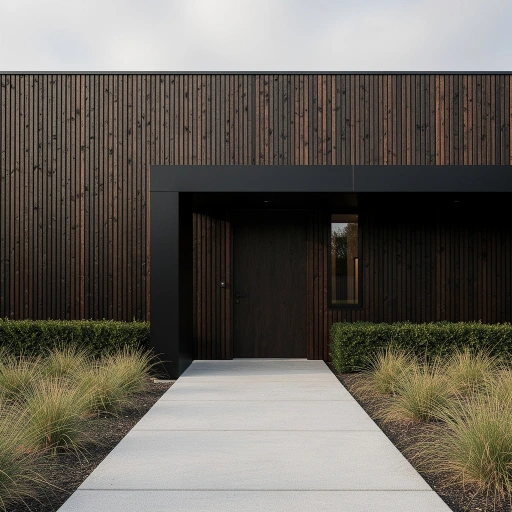
Vertical dark-stained timber cladding in a narrow board-and-gap profile — its regular rhythm of thin vertical boards separated by consistent shadow-gap joints creating a surface of controlled, directional texture that emphasizes the building’s height while maintaining the visual simplicity of a consistent, repeated element — paired with a deep canopy entrance in blackened steel projecting boldly from the facade plane, is the minimalist exterior design approach that most warmly, most naturally, and most materially richly combines the human scale and organic warmth of natural timber with the formal precision and crisp geometry of minimalist architectural composition. The vertical board orientation is the critical decision that distinguishes this cladding approach from the more casual, horizontally oriented weather-board tradition — its strong vertical linearity connects the ground to the roofline in a series of continuous, uninterrupted lines that give the facade a quality of visual discipline and architectural intentionality that horizontal boarding cannot achieve with the same formal authority.
Specify a hardwood or modified softwood cladding board with genuine dimensional stability for exterior exposure — Accoya modified pine, Siberian larch, or Western red cedar all offer excellent long-term performance in exterior cladding applications with appropriate surface treatment. Apply a deep, penetrating oil stain in a dark charcoal or near-black tone that allows the wood grain to remain partially visible beneath the dark surface color — the visibility of grain beneath the dark stain creates a surface depth and material warmth that solid paint conceals, maintaining the cladding’s identity as a natural material with organic character rather than reducing it to a painted surface whose timber substrate is entirely invisible. Detail the board and gap joint at a minimum shadow gap of ten millimeters — deep enough for the shadow to read clearly from typical viewing distances as a genuine dark line rather than a superficial texture mark — and maintain absolute consistency of board width, gap width, and board face profile across the entire facade for the disciplined uniformity that minimalist design demands of its repeated elements.
3. Concrete and Glass Composition with Horizontal Proportions
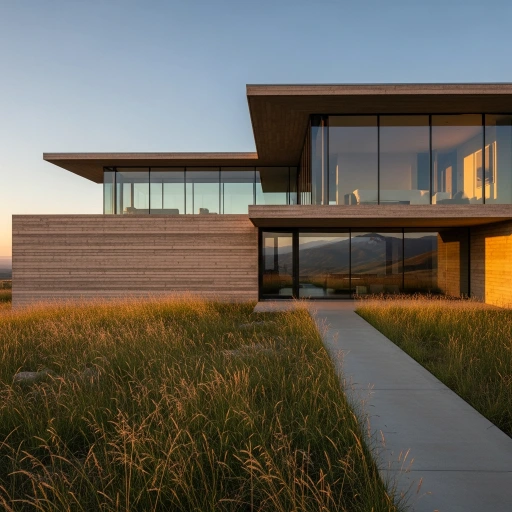
A board-formed concrete lower story combined with full-height glazing in the upper story — the entire composition organized around the strong horizontal emphasis of a projecting flat concrete roof slab and continuous ribbon windows that stretch uninterrupted across the full facade width — is the minimalist exterior design approach that most directly and most honestly expresses the material and formal values of the Miesian tradition of modernist architecture while achieving a spatial and visual generosity that makes the house feel genuinely grand despite the restraint and austerity of its formal means. Board-formed concrete — cast against rough timber boards whose grain is impressed into the concrete surface during the casting process — creates a wall surface of extraordinary material richness within the severely limited palette of minimalist design, the timber grain pattern providing a fine, linear texture that catches raking light beautifully and creates visual depth without introducing the color complexity or ornamental character that minimalism’s formal discipline excludes.
Form the concrete using rough-sawn pine boards installed in a consistent horizontal orientation at a consistent board width of approximately one hundred and fifty millimeters — the impressed grain pattern and the fine shadow line of each board joint creating a regular, horizontal texture that reinforces the building’s compositional emphasis on the horizontal and that will become more beautiful over time as the concrete’s surface tone darkens and stabilizes through weathering to its characteristic mature grey. Seal the finished board-formed concrete with a penetrating silane-siloxane water repellent that prevents moisture-driven deterioration without altering the surface color or introducing a sheen that would change the material’s characteristic matte quality. Specify the full-height glazing as a structural glass curtain wall system with minimal sight lines — the thinnest available structural profile in the chosen glazing system — to maintain the visual transparency and the quality of almost-frameless glass that allows the interior to read from outside as a single, continuous, illuminated volume rather than a compartmented sequence of individual window openings.
4. Black Zinc or Weathering Steel Cladding
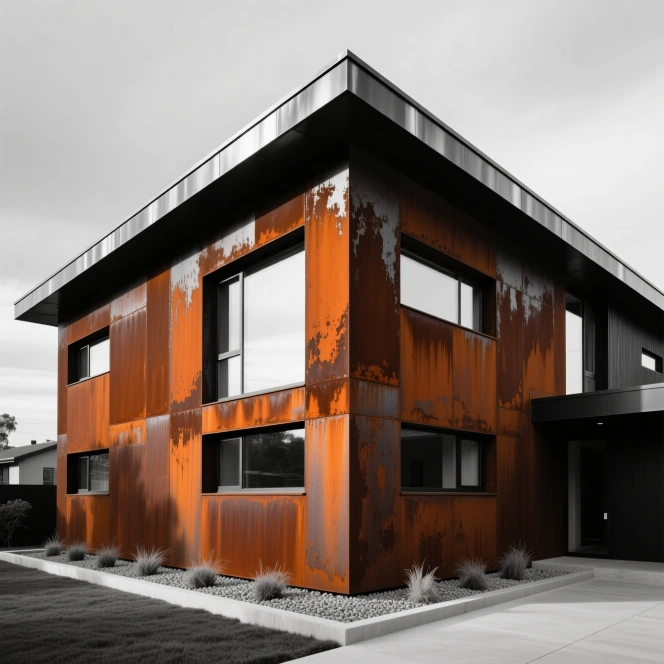
Weathering steel — the proprietary Corten steel alloy that develops a stable, tightly adhering rust patina on its surface when exposed to the cycle of wetting and drying in normal atmospheric conditions — used as the primary exterior cladding material creates a minimalist house facade of extraordinary material depth, color richness, and temporal beauty whose appearance changes over the first three to five years of exposure as the patina matures from an initial bright orange to the deep, complex brown-orange of fully stabilized weathering steel. This material’s remarkable quality as an architectural cladding is its combination of apparent contradictions — it is simultaneously a raw, industrial material and a refined architectural surface, apparently rusting and actively self-protecting, initially alarming in its color change and ultimately creating one of the most beautiful natural surface finishes available in the entire vocabulary of contemporary architecture.
Install the weathering steel panels as a rainscreen cladding system over a ventilated cavity — allowing air circulation behind the panels that promotes the wetting and drying cycle that develops the stable patina most effectively and most uniformly across the entire facade surface. Detail the panel joints as open, recessed channels rather than sealed joints — allowing the drainage of water from the panel faces without damming while creating the regular grid of shadow lines that gives the cladding its compositional structure and its visual articulation at the facade scale. Specify panels with a minimum thickness of three millimeters for sufficient rigidity and material presence — thinner panels flex in wind and fail to communicate the material weight and structural permanence that weathering steel’s visual character requires to be read as genuinely architectural rather than decoratively applied. Pair with minimal, precisely positioned window openings in a flat black powder-coated steel frame that disappears almost entirely into the dark tonal background of the mature patina, maintaining the facade’s visual unity and material dominance with complete compositional discipline.
5. Flat Roof with Green Sedum Planting and Clerestory Windows
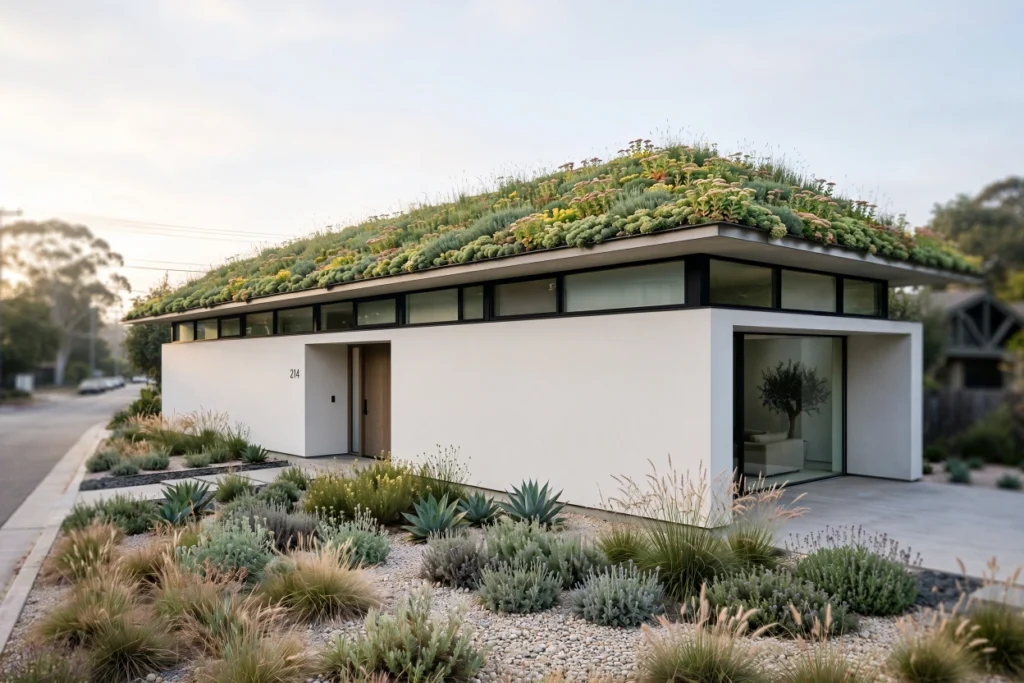
A flat roof planted with an extensive sedum and wildflower green roof system — visible from the street level as a continuous horizontal plane of low, dense botanical growth that softens the building’s upper profile against the sky — combined with a continuous band of clerestory windows running just below the roof level across the full facade width, is the minimalist exterior design approach that most successfully integrates environmental performance, architectural composition, and landscape sensitivity into a single formal gesture that achieves simultaneously the building’s most efficient drainage management, its most effective roof insulation layer, its most visually powerful connection between the building and the natural landscape, and its most architecturally sophisticated roofline profile. The green roof changes the house’s relationship with its site and its seasonal context in a way that no other roofing material can approach — in spring it blooms with wildflower color, in summer it presents a dense mat of succulent foliage, in autumn it develops warm russet and amber tones, and in winter the sedums’ frost-hardy rosettes maintain a spare, architectural ground plane above the roofline.
Specify an extensive green roof system with a growing medium depth of one hundred to one hundred and fifty millimeters — sufficient for the low-maintenance sedum, stonecrop, and shallow-rooting wildflower species appropriate for extensive green roof application while remaining within the structural load capacity of most flat roof constructions without additional reinforcement. Select a plant palette that prioritizes species with strong seasonal interest alongside the drought tolerance and minimal maintenance requirements that make extensive green roofs genuinely practical: Sedum album, Sedum acre, and Sedum spurium for year-round cover and summer flower, Thymus serpyllum for spring bloom and aromatic fragrance, and selected native wildflowers including field scabious, wild thyme, and bird’s-foot trefoil for biodiversity value and additional seasonal color. Detail the clerestory glazing below the green roof edge as a continuous horizontal slot of fixed glazing — no opening lights that would introduce vertical elements disrupting the band’s horizontal continuity — specified in minimal-profile structural glazing to maintain the slot’s visual thinness and its reading as a precise horizontal incision in the wall plane rather than a conventional window assembly.
6. Recessed Entrance Portal with Integrated Lighting
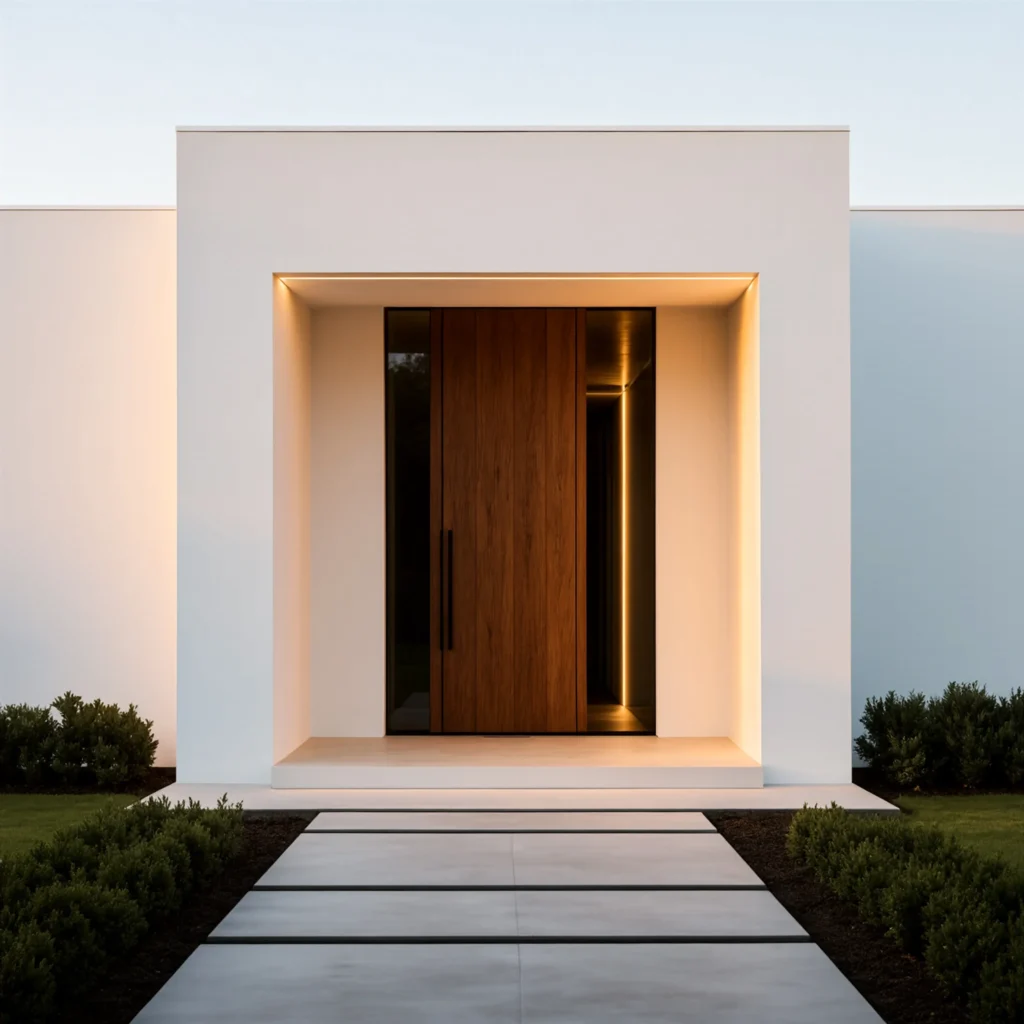
A deeply recessed entrance portal — a rectangular void cut into the building’s primary facade mass to a depth of at least one meter, creating a strong zone of shadow that frames the front door and marks the threshold between public and private space with unmistakable architectural clarity — with thin LED strip lighting integrated invisibly into the portal reveal edges is the minimalist exterior design element that most powerfully and most architecturally resolves the challenge of making the house entrance simultaneously legible, welcoming, and formally consistent with the minimalist design philosophy’s rejection of applied decorative elements in favor of spatial and compositional means. The recessed portal achieves everything that a conventional portico, canopy, or decorative door surround achieves through applied ornament — weather protection, entrance emphasis, threshold marking, human scale and welcome — through purely spatial and architectural means that require no ornament whatsoever, deriving their entire expressive power from the contrast between the shadow zone of the recessed void and the illuminated surface of the surrounding facade.
Size the portal to create the most architecturally powerful proportional relationship with the facade as a whole — a width of one-and-a-half to two meters and a height of two-and-a-half to three meters creates a portal with sufficient monumental presence to read as the building’s primary compositional element at the facade scale while maintaining the intimate, human-scale enclosure of the threshold zone within the portal’s shadow. Line the portal reveal surfaces — the ceiling, side walls, and floor — in a material that contrasts with the primary facade cladding to enhance the portal’s spatial depth: polished black granite or honed dark limestone for a facade of white render, raw concrete for a facade of timber cladding, or the same render carried continuously into the portal with the material continuity that emphasizes the portal as a carved void rather than an added element. Integrate the LED lighting as a single, continuous strip recessed into the junction between the portal ceiling and each side wall — a position that creates a wash of warm light down the portal side walls at dusk, marking the entrance with warm illumination visible from the street without introducing any visible light fixture that would interrupt the portal’s pure geometric surfaces.
7. Single-Material Facade in Large-Format Porcelain Panels
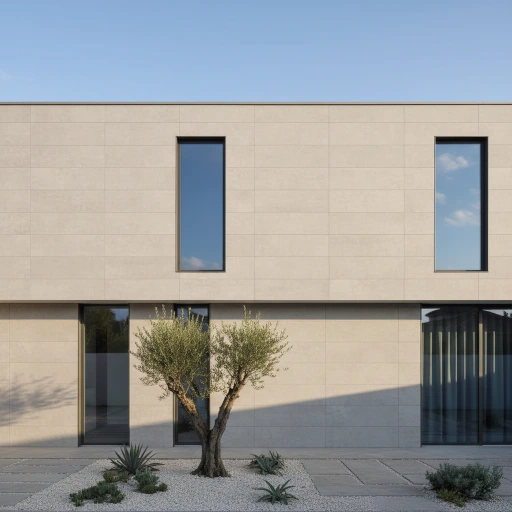
A single-material facade clad entirely in large-format porcelain panels — their surfaces finished in a subtle concrete, stone, or through-body colour that achieves an appearance of natural material with the manufacturing consistency, weather resistance, and surface perfection of engineered ceramic — installed with minimal grout lines in a running bond or stacked joint pattern that maintains the facade’s reading as a unified, continuous surface rather than a pattern of discrete tiles, is the minimalist exterior design approach that most precisely and most completely eliminates surface visual complexity while delivering a material quality and surface refinement significantly beyond what render, paint, or conventional ceramic cladding systems can achieve in terms of consistency, longevity, and the specific quality of precise, engineered perfection that distinguishes the best contemporary minimalist architecture from its more casual approximations. Large-format porcelain panels — available in sizes up to one-and-a-half by three meters from specialist manufacturers including Neolith, Dekton, and Lapitec — create a facade surface with the absolute minimum number of joints, achieving the closest possible approximation of a single, continuous material plane across the entire building envelope.
Specify panels in the maximum available size for the facade application — larger panels mean fewer joints, a more unified surface reading, and the stronger impression of a single material plane that the minimalist design intention requires. Choose a surface finish in the matte or lightly textured range rather than polished or high-gloss — the matte surface is more forgiving of the inevitable water marks, dust deposits, and minor surface contamination of normal weathering exposure, and more appropriate for the restrained, non-reflective character appropriate for minimalist exterior facades. Detail all joints at a maximum width of two millimeters using a through-colored grout or joint compound matched precisely to the panel face color — the minimum practically achievable joint width that disappears at normal viewing distances and prevents the grout line from becoming a visible compositional element competing with the panel surface for the eye’s attention. Specify flush-mounted glazing with the window frame face positioned in the same plane as the panel face — eliminating the shadow of a projecting frame that would interrupt the facade’s continuous surface reading and maintaining the minimalist design’s commitment to a single, undifferentiated building envelope plane.
8. Landscaped Concrete Pathway and Gravel Garden
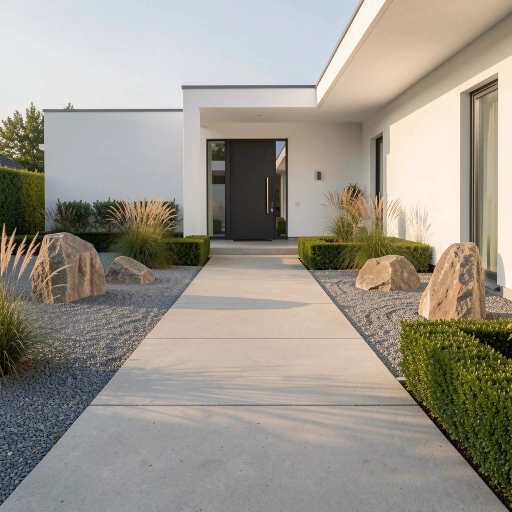
A wide concrete pathway of precise geometric proportions — its surface in a brushed or exposed aggregate finish that provides necessary anti-slip texture without introducing visual complexity, its edges detailed with a clean, sharp arris against the adjacent planting or gravel — leading directly and undeflected toward the entrance portal, flanked by a Japanese-influenced dry garden of raked gravel, carefully placed architectural boulders, and clipped geometric hedges, is the minimalist exterior design landscape approach that most completely extends the house’s formal discipline and material palette into the approach garden, creating a unified composition where architecture and landscape share a single design language rather than occupying separate aesthetic territories with a conventional grass lawn as the neutral territory between them. The landscape design of a minimalist house is as architecturally important as any facade material choice — a meticulously detailed building envelope can be entirely undermined by a surrounding landscape of conventional, historically arbitrary planting conventions that the minimalist design’s formal logic neither anticipates nor accommodates.
Specify the concrete pathway in a consistent width of at least 1,200 millimeters — sufficient to walk comfortably two abreast and to communicate the pathway’s status as a primary architectural element of the approach composition rather than a utility path scaled only to the minimum requirements of foot traffic. Use a broom-finished or lightly exposed aggregate concrete in a colour matched to the building’s render or cladding — maintaining the limited material palette of the minimalist composition into the landscape elements rather than introducing additional materials that would expand the design’s chromatic and textural range beyond the disciplined constraint that minimalist aesthetics requires. Design the gravel garden panels flanking the pathway using a single gravel species in a consistent size — ten to twenty millimeter pea gravel in a warm grey or natural stone color — raked to a consistent surface level and maintained with the same precision of line and surface that the architecture brings to its material surfaces. Place three to five architectural boulders in each gravel panel — each boulder chosen for its specific individual character and placed with the deliberate, irreversible commitment of a considered compositional decision rather than the casual randomness of conventional rock garden planting practice.
9. Floor-to-Ceiling Glass Corner with Steel Column
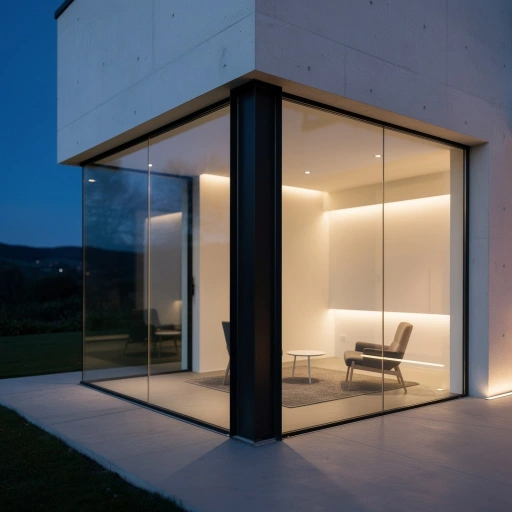
A floor-to-ceiling glass corner — where two planes of structural glazing meet at the building’s corner angle with no conventional corner post or frame between them, the glass panels held instead by a single slim exposed steel column set slightly back from the corner and visible as a precise structural element rather than concealed within the corner construction — is the minimalist exterior design detail that most dramatically and most architecturally demonstrates the technical possibilities of contemporary structural engineering in the service of a design philosophy that demands the absolute maximum transparency and the absolute minimum material impediment between interior and exterior. The glass corner is the quintessential minimalist architectural gesture — the complete dissolution of the building’s most structurally demanding point into a plane of transparent glass that makes the interior and exterior spaces appear to flow continuously past the corner without interruption or barrier.
Achieve the structural glass corner using a purpose-engineered system of structural glass fins, point-fixed spider fittings, or a minimal structural steel frame designed specifically to minimize the visual obstruction at the corner while carrying the actual structural loads through clearly expressed, honestly detailed elements rather than concealed behind drywall or cladding. The exposed steel column set back from the corner — its precise circular or cruciform profile providing the eye with a clear reading of the structure’s support logic — is the detail that makes this glass corner most architecturally honest and most satisfying as a design element rather than simply most transparent: the column’s visibility acknowledges the genuine structural challenge that the glass corner poses and resolves it with an elegant, minimal element rather than concealing the solution within the wall construction. Specify low-iron float glass for the corner glazing — its reduced green cast makes the glass appear genuinely colorless rather than the conventional slight green of standard float glass, maximizing the sense of the glass plane as pure transparency rather than as a material surface with its own inherent color. Detail the glass-to-floor junction with a minimal threshold of polished concrete or stone continuous with the exterior paving, eliminating the visual interruption of a conventional door threshold and maintaining the floor plane’s visual continuity from outside to inside.
10. Integrated Garage Door in Matching Facade Material
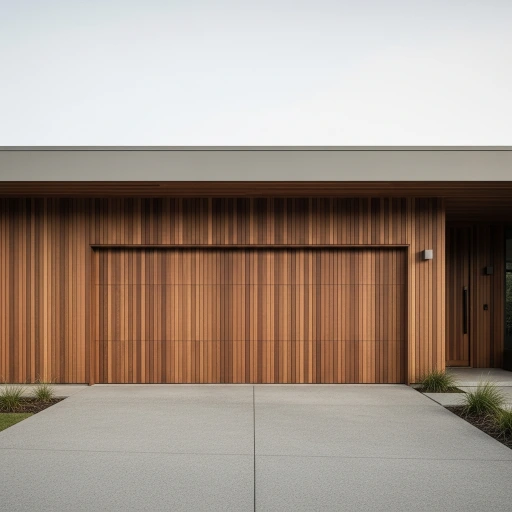
A garage door finished in the same material and with the same surface pattern as the surrounding facade — the vertical boarding, horizontal panel joints, or rendered surface of the primary wall cladding carried continuously across the garage door panel in perfect alignment with the surrounding surface pattern — creating an almost invisible garage door that maintains the facade’s reading as a single, unified surface rather than a collection of functional components differentiated by material and finish, is the minimalist exterior design detail that most clearly demonstrates the philosophy of the whole through a single, precisely executed decision about one relatively minor functional element. The conventional garage door — distinguished from the surrounding facade by its different material, its visible panel joints misaligned with the facade’s surface pattern, its different surface color, or simply its status as an obviously different product category introduced into the facade composition — represents exactly the kind of visual disruption that minimalist design identifies as the primary enemy of architectural coherence and material unity.
Achieve the matching garage door finish by fabricating the door panel as a site-specific commission from the same material as the facade cladding — for a timber-clad facade, this means constructing the garage door as a framed panel clad in the same species, same profile, and same finish of timber cladding board with joints precisely aligned to the surrounding wall grid. Specify an industrial sectional door mechanism operating entirely within the garage volume — with no visible track, no visible spring mechanism, and no visible operating hardware on the exterior face — for a door that, when closed, reads as a section of continuous facade surface. The only visible element distinguishing the garage door from the surrounding facade when closed should be the hair-line gap of the door’s perimeter seal — a gap of no more than five millimeters on all four sides that creates the minimum perceptible outline necessary for the door’s practical function without drawing visual attention to its presence as a separate facade element. Detail the driveway surface as a continuation of the approach pathway material — brushed concrete or resin-bound gravel running continuously from street to garage without the visual interruption of a material change that would draw attention to the garage door’s location within the facade.
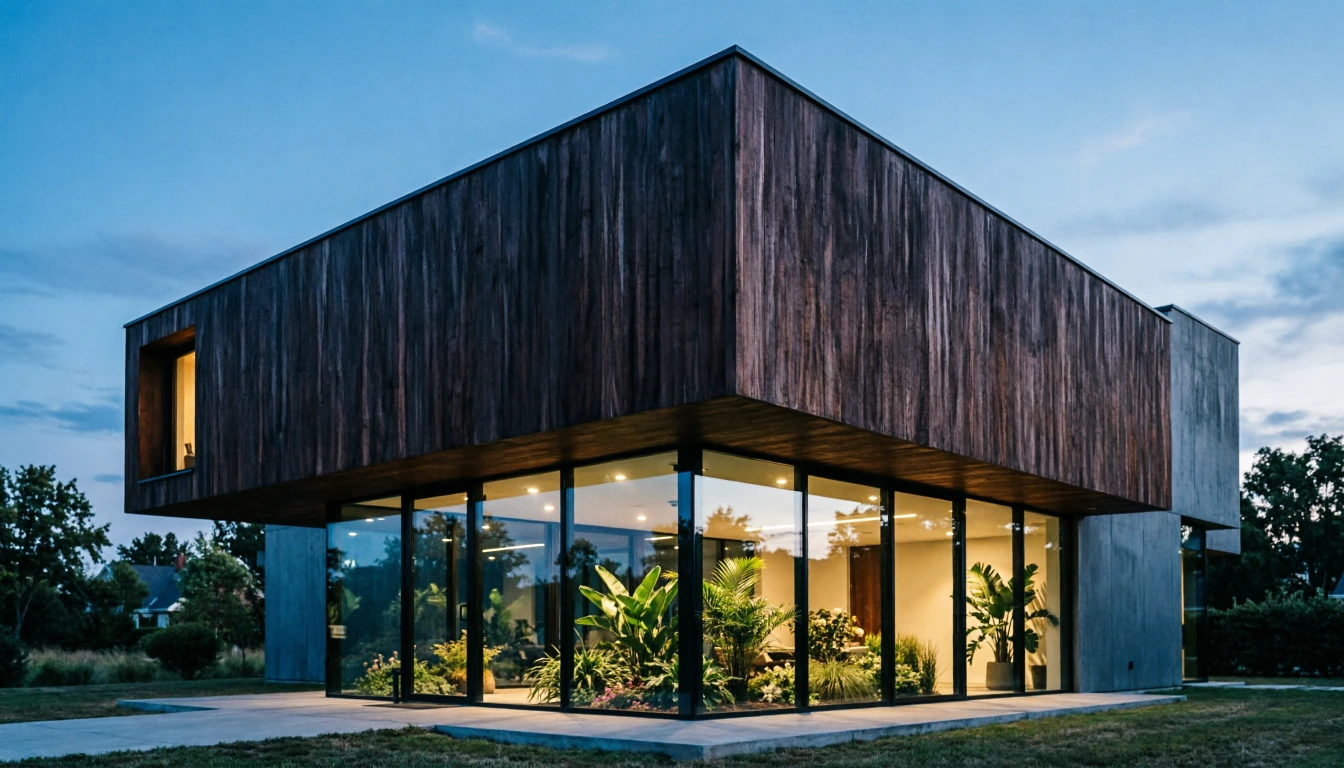
11. Cantilevered Upper Story Over Recessed Ground Floor
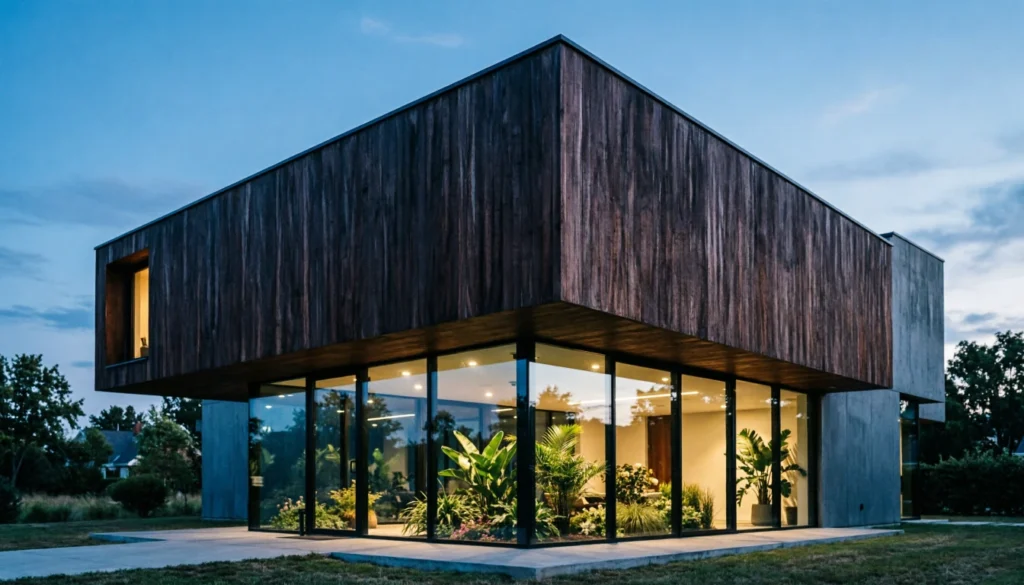
A cantilevered upper story — projecting forward from the building’s primary facade plane to create a strong horizontal shadow line between the levels and the specific visual drama of a substantial mass apparently floating above a recessed, transparent ground floor — is the minimalist exterior design approach that most powerfully uses architectural massing and the deliberate manipulation of structural logic to create visual interest, compositional dynamism, and spatial complexity without introducing any decorative element, applied ornament, or material variety beyond the minimum required by the design’s honest structural expression. The cantilever is one of modernist architecture’s most characteristic and most expressive structural gestures — its defiance of gravitational expectation, its deliberate imbalance of visual mass, and its requirement for genuine structural engineering solution create a facade composition whose interest is fundamentally architectural rather than decoratively applied.
Design the cantilever at a projection of at least one and a half to two meters beyond the ground floor facade plane — a dimension sufficient to create a genuinely covered external ground floor zone of practical use as covered outdoor space or protected parking while generating the strong, visually dominant horizontal shadow line that makes the cantilever readable as a bold compositional element at the scale of the street rather than a minor overhang detail. Clad the underside of the cantilevered upper floor slab in a material that creates a visual continuity between the upper story’s exterior cladding and its projecting soffit — for a dark timber upper story, use the same dark-stained timber on the cantilevered soffit, creating a continuous dark surface that wraps around the projecting mass and maximizes the contrast between the dark upper volume and the transparent, recessed ground floor. Specify the ground floor as a structural glass facade with minimal steel frame — its transparency allowing the planting and interior beyond to read through the ground floor zone, reinforcing the reading of the upper story as a floating, lifted volume hovering above a visual void rather than resting on a solid base.
12. Natural Stone Base with Render Upper Story
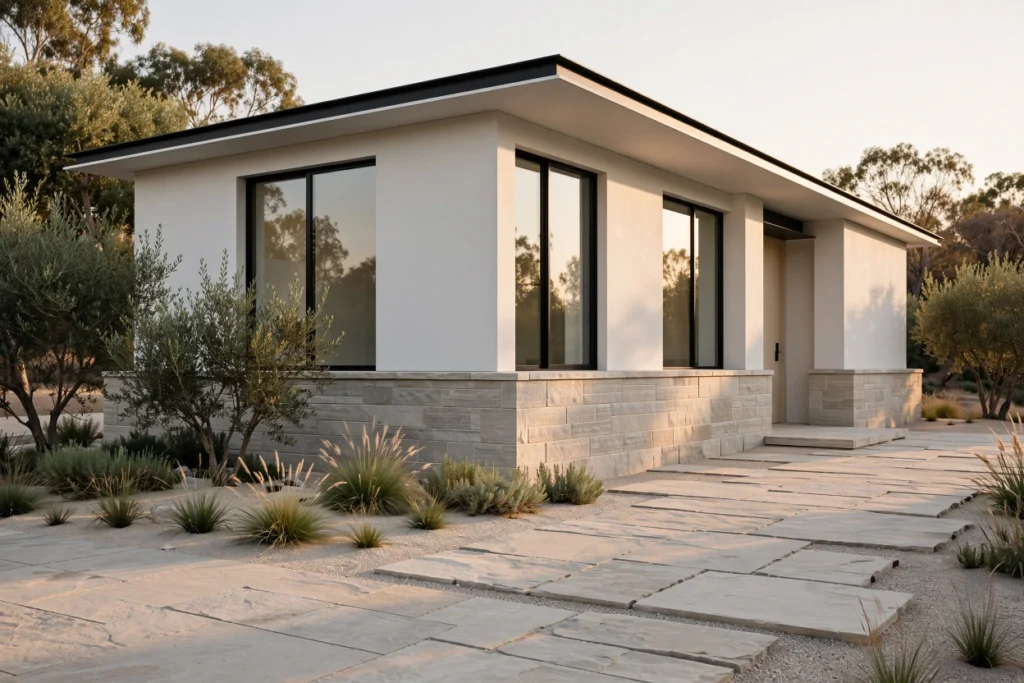
A natural stone base course — a continuous band of coursed natural stone approximately one meter high running the full perimeter of the house at ground level — transitioning to a smooth white render above at a precisely detailed horizontal joint is the minimalist exterior design approach that most successfully grounds the house in its landscape and geological context while maintaining the visual clarity and formal discipline of the minimalist design vocabulary through the deliberate limitation of the material palette to only two materials with a single, clean transition between them. The stone base performs multiple simultaneous design functions — it provides genuine weather protection to the most exposed, splash-zone section of the building envelope, it visually anchors the house to the ground with the geological permanence of natural stone, it connects the building materially to the landscape in which it stands, and it creates the most honest possible acknowledgment of the building’s relationship with the earth by using the material of the earth itself at the point of the building’s most direct physical contact with the ground.
Specify the stone in a species and coursing that is specific to the building’s regional landscape context — limestone in a countryside setting, granite in a coastal or highland location, sandstone in a red-earth rural landscape — choosing a coursing pattern of consistent height ranges laid in a natural, irregular bed rather than the mechanical precision of cut-stone ashlar that would impose an artificial regularity on a material whose beauty is inseparable from its natural variation. Detail the joint between stone and render as a precise, clean horizontal line rather than allowing the transition to be gradual or organic — the crisp boundary between the two materials creates a compositional clarity that honors the distinct identity and different formal character of each material while establishing a clear organizational logic for the facade. Extend the same stone material horizontally out from the building base to form the pathway and terrace paving — creating the material continuity between building and landscape that makes the house appear to grow from its site rather than to be placed upon it as a self-contained object indifferent to the geological and material character of its specific location.
13. Minimalist Timber Pergola as Outdoor Room Extension
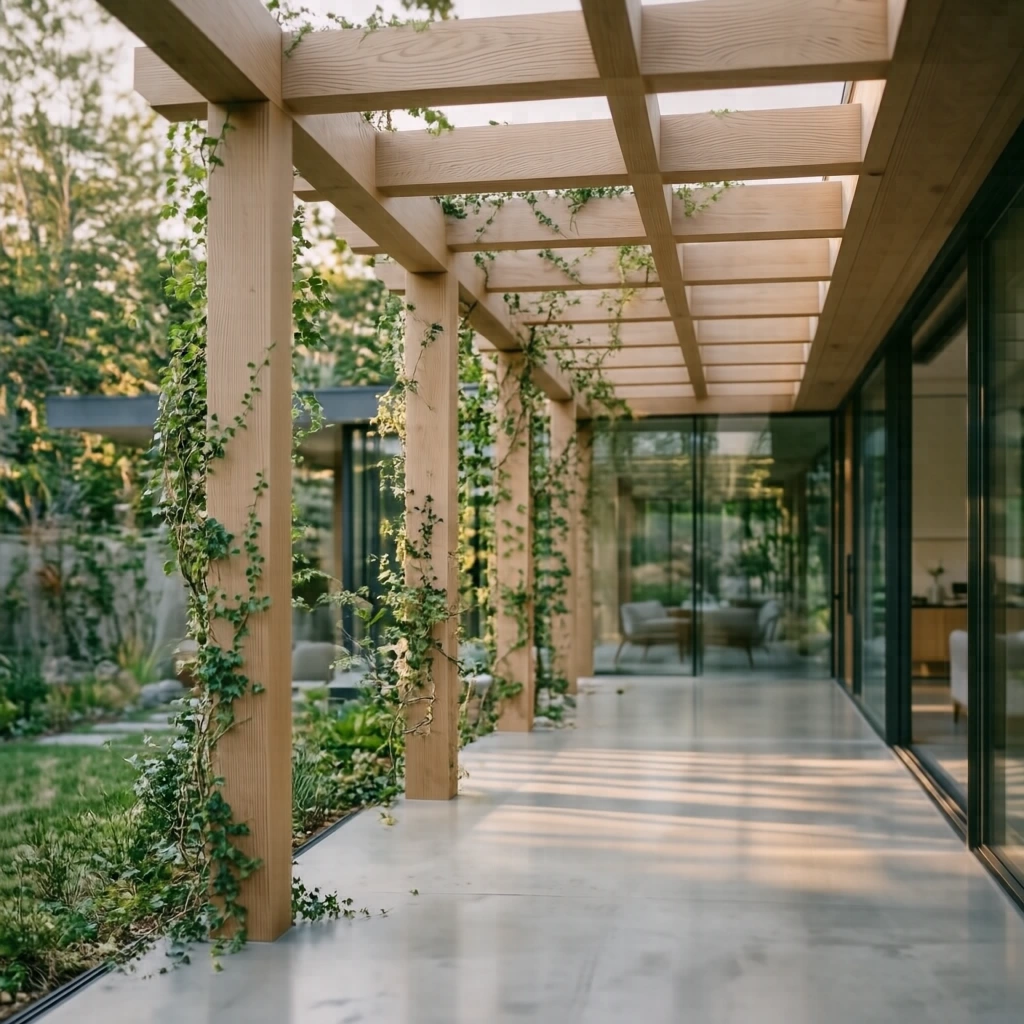
A minimalist timber pergola constructed from square-section posts and beams without any decorative detail, router profile, or applied ornament — its structural members sized and proportioned for genuine structural logic rather than visual lightness — extending from the primary facade as a covered outdoor room that continues the interior floor plane into the exterior landscape, is the minimalist exterior design element that most gracefully and most architecturally resolves the separation between the house’s interior living space and its surrounding garden by creating a transitional zone of covered outdoor space that is neither fully inside nor fully outside but participates in the qualities of both. The minimalist pergola achieves this mediation through the same design logic that the house applies to its facade — the rejection of all applied ornament in favor of the inherent visual interest of structural expression, material quality, and precise proportional relationships between the construction’s elements.
Specify the pergola posts and beams in a hardwood species with genuine natural durability for exterior exposure without applied preservative treatment — oak, Douglas fir, or Iroko all provide sufficient natural durability for open pergola construction in most climatic conditions while developing a beautiful natural silvering patina over the first two to three years of exterior weathering that progressively harmonizes the pergola’s color with the surrounding landscape. Size the structural members at the upper range of what structural requirements demand rather than the minimum — a one-hundred-and-twenty-millimeter square post and a one-hundred-and-fifty-millimeter deep beam communicate structural presence, material generosity, and the visual weight appropriate for a structure of genuine architectural scale rather than the lightweight, almost decorative character of under-dimensioned pergola construction. Detail all joinery connections as simple, expressed structural connections — a half-lap joint where beams cross, a direct bearing connection where beam meets post — without the decorative metal brackets, curved joist hangers, or applied post caps that would introduce ornamental elements into a structure whose design logic excludes them absolutely and without compromise.
14. Monolithic Concrete Gate and Boundary Wall
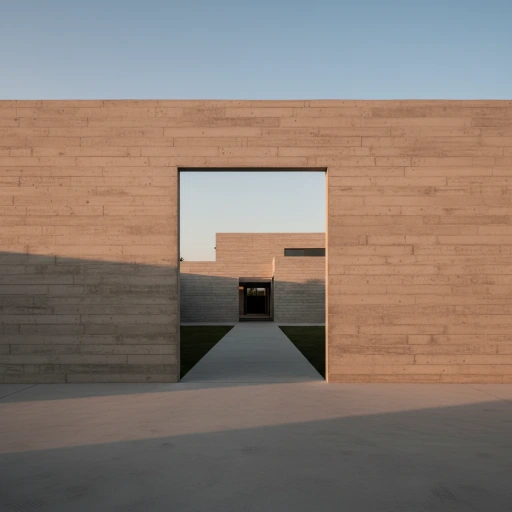
A monolithic concrete boundary wall — board-formed to create the same linear horizontal grain texture as the house facade, designed as a single, continuous element of consistent height and material without decorative features, coping details of exaggerated profile, or any other applied element that would interrupt its reading as a pure, solid geometric form — with a precisely proportioned rectangular gateway opening cut cleanly through its mass, is the minimalist exterior design approach that most powerfully extends the house’s architectural language and formal discipline into the property boundary, creating a complete architectural ensemble in which the house and its surrounding walls participate in a single, unified design rather than existing as separately designed elements in an accidental spatial relationship. The boundary wall in minimalist residential design is not a fence upgraded with architectural ambition but a genuine piece of architecture — an element with the same formal rigour, material integrity, and design attention as any element of the house itself.
Design the boundary wall at a height of between 1,800 and 2,200 millimeters — tall enough to provide genuine privacy within the property without the additional height that would create an oppressive or institutional quality inconsistent with the domestic context. Cast the wall in a continuous pour wherever possible — eliminating construction joints that would interrupt the wall’s reading as a single monolithic element — using the same board-form technique and timber board dimension as the house facade to maintain material and textural continuity across the entire composition. Detail the gateway opening as a pure rectangular void cut through the wall mass without any frame, gate, lintel feature, or threshold detail beyond the clean concrete arris of the cut edge — the absence of a gate expresses the most confident, most architecturally resolved interpretation of the minimalist gateway while remaining practically appropriate for the majority of residential applications. Position a single, recessed LED uplighter in the concrete wall immediately below the gateway opening — illuminating the gateway’s concrete reveal from below at dusk with a warm wash of light that marks the threshold with architectural presence without introducing any visible fixture, box, or hardware onto the wall face that the clean concrete surface and the minimalist design philosophy together absolutely refuse to accommodate.
15. Seamless Indoor-Outdoor Floor Plane in Large-Format Stone
A seamless indoor-outdoor floor plane — large-format natural stone or through-body porcelain tiles installed at an identical level on both the interior living floor and the exterior terrace, with a flush-threshold sliding or lift-and-slide glazing system that creates zero visual or physical interruption at the transition between inside and outside — is the minimalist exterior design idea that most fundamentally challenges and most successfully dissolves the conventional architectural distinction between interior and exterior space, creating a living environment where the boundary between the sheltered interior and the open exterior is defined exclusively by the transparent glazing plane rather than by any change in floor level, floor material, or spatial character that would reinforce the distinction the minimalist design is philosophically committed to eliminating. This single design decision — the continuous floor plane across the glazing threshold — transforms the entire experience of the house by making the exterior terrace a genuine extension of the interior living space rather than a separate outdoor area reached by stepping down or across a material transition.